Poland · Europe
Moving to Wroclaw
Wroclaw quick facts
Poland at a glance
Europe & Central Asia
Economy
World Bank · 2025Religion
% of populationCIA World Factbook / national censuses
Cost of living in Wroclaw
Can you move to Poland?
Pick your passport to see whether you can enter Poland — and what it takes to stay.
Entry rules come from github.com/imorte/passport-index-data, updated 17 February 2026. They change without notice — confirm with the official immigration service before booking.
Getting set up in Poland
Temporary residence, and the Dolnośląskie appointment wave
One combined permit covers residence and work for a named employer. Since 27 April 2026 the MOS portal is the only accepted channel, so a login.gov.pl trusted profile is now a prerequisite. Dolnośląskie processes faster than Małopolskie or Mazowieckie, but it manages demand by releasing appointment slots in announced waves rather than keeping a rolling calendar — which changes the tactics completely.
Read the full step-by-step guideExchanging a licence in a city with no emission zone
EU and EEA licences remain valid indefinitely. A non-EU licence expires for Polish purposes six months after you establish residence and must be exchanged, with a sworn translation and — for countries outside the Vienna and Geneva road traffic conventions — a Polish theory exam. Unlike Kraków, Wrocław has no clean transport zone, so an older vehicle is still usable; the constraint here is paid parking and a tram network that is usually quicker.
Read the full step-by-step guideBanking, BLIK, and getting paid in euros
Opening an account is straightforward and Polish retail banking is genuinely excellent. Do two things deliberately: issue your profil zaufany through the bank app, because it now gates the MOS residence filing, and — if you will be paid in a foreign currency — open a currency sub-account and understand that Polish tax accounting converts your invoices at the National Bank's published rate, not at the rate you actually received.
Read the full step-by-step guideNFZ cover, the family form nobody files, and private packages
An employment contract enrols you in NFZ automatically through employer ZUS contributions. A B2B contract does not: you pay the health contribution yourself, at a rate that depends on which tax regime you elected. Public primary and emergency care works; the specialist queue is the weak point, which is why an employer private package is close to a default benefit in Wrocław's banking and R&D sector.
Read the full step-by-step guideMobile, fibre, and the tenement problem in Nadodrze
Four networks and a healthy reseller market at some of the lowest prices in the EU. Every SIM, prepaid included, must be registered against an identity document. Home fibre is widely available in the postwar blocks and the new developments, but the surviving nineteenth-century tenements in Nadodrze, Ołbin and parts of Śródmieście are a lottery — check the building rather than the postcode.
Read the full step-by-step guidePIT, ryczałt, and the 5% IP Box most engineers never claim
Employment income is taxed at 12% and 32%, with a PLN 30,000 tax-free allowance and a near-total exemption for workers under 26. Most of Wrocław's R&D and games sector instead invoices through a sole trader registration on the ryczałt lump-sum regime at 12% of revenue. Sitting underneath that is IP Box — a 5% rate on income from qualified intellectual property, including bespoke software — which requires records kept from day one and which a great many eligible engineers never claim.
Read the full step-by-step guideEach guide has verified costs, timelines, required documents, and the non-obvious gotchas — sourced from official government pages. Last verified August 2026.
Essential Polish phrases
Reading a list isn’t learning it. Globe Quest turns these into a trainer — hear each phrase spoken, drill them with spaced repetition, and get scored as you say them out loud.
What to know before you go
Dolnośląskie releases appointments in waves — watch the queue page, not the calendar
CriticalWrocław's voivodeship office is genuinely faster than Kraków's or Warsaw's, but it rations differently. Biometrics and submission slots are released in batches announced by the office rather than sitting permanently open, and the current wait for a personal appointment runs two to three months. The queue status page at rezerwacje.duw.pl is the thing to check daily. Missing a wave costs you a month; nothing about your file changes that.
Get the trusted profile before you need it for anything else
CriticalSince 27 April 2026 residence applications may only be filed through the MOS portal, authenticated via login.gov.pl. That makes a profil zaufany a prerequisite for the immigration application itself, not a convenience for later. The quickest route is inside a Polish bank's app, which reorders the first month: account first, digital identity second, residence filing third.
The advertised rent is not the rent
CriticalPolish listings quote the base rent only. On top sits the czynsz administracyjny — the building's monthly charge to its cooperative or owners' community — commonly PLN 550–950 in Wrocław, plus metered electricity and gas. Budget 20–30% above the headline figure, and ask what the czynsz includes, because in a district-heated building it covers heating and hot water and swings hard in January.
Ask which districts flooded in 1997
ImportantJuly 1997 put a third of the city under water. Wrocław has since been re-engineered — the Racibórz Dolny dry polder upstream and the modernised Wrocław water node together held the far larger 2024 flood off the city entirely, which is why Wrocław made the news for not flooding. But the map still matters: Kozanów in particular is cheap for a reason people who were here in 1997 understand and newcomers do not. Ask, and check the flood risk before signing a long lease or buying.
This is a German city with a Lwów memory and neither is decoration
Good to knowWrocław was Breslau until 1945 and its population was almost wholly exchanged: Germans expelled west, Poles arriving from Lwów and the eastern territories, many of them expelled in turn. That is why the architecture is Prussian, the Ossolineum library and the Racławice Panorama came from Lwów, and why the city talks about itself as a place of arrivals. It is also why almost nobody's grandparents are from here, which makes it unusually easy to be new.
There is no low-emission zone here, and none before 2028 at the earliest
Good to knowKraków's clean transport zone came into force in January 2026 and covers most of that city. Wrocław prepared one for four years and then shelved it, citing annual nitrogen dioxide levels below the 40 µg/m³ limit; the city has said it will not introduce a zone before 2028, and would only be obliged to if the measurements breach the limit. So an older car remains usable for now — though the city has been steadily expanding paid parking across the centre and the tram network reaches most places faster than driving does. Wrocław's own anti-smog resolution has phased coal out of city heating, which is what actually improved the winter air.
Top industries & employers
Telecoms & network R&D
Nokia, Ericsson, Sygnity, Capgemini Engineering
Nokia's Wrocław technology centre employs around five thousand people and is the largest ICT research institution in Poland, running the company's main Central European hub for 5G radio access development.
Banking & financial operations
UBS, Santander, Credit Agricole, BNY, Nordea
UBS runs one of its largest global operations centres here. The sector recruits in English at scale and is the most common entry point into Wrocław for people without Polish.
Games
Techland, Ten Square Games, QLOC, Fool's Theory
Techland, the studio behind Dying Light, is headquartered on the edge of the city and is the reason Wrocław has a genuine games labour market rather than a couple of studios.
Automotive & industrial
Volvo, Toyota, Bosch, Whirlpool, ABB, LG Energy Solution
The Lower Silesian industrial belt around Wrocław includes Toyota's engine and R&D operations and, at Biskupice Podgórne, one of Europe's largest electric vehicle battery plants.
Shared services & consulting
Google, Atos, EY GDS, Infosys, Luxoft
The office belt along Legnicka and around Business Garden hosts a deep shared-services layer — reliably English-speaking, and the sector that most readily hires newcomers.
Higher education & research
Wrocław University of Science and Technology, University of Wrocław, Wrocław Medical University
Over a hundred thousand students in a city of 674,000. Wrocław Tech in particular supplies the engineering pipeline that brought Nokia, Volvo and Bosch here in the first place.
Where to go in Wroclaw
Rynek & the Old Town
Landmark · Stare Miasto
One of Europe's largest medieval market squares, rebuilt after 1945 around a Gothic town hall that survived.
Local tip: The Piwnica Świdnicka beneath the town hall is one of the oldest restaurants in Europe, operating since the thirteenth century. Look for the dwarfs — there are several hundred bronze ones across the city and the hunt is a genuine local pastime rather than a tourist gimmick.
Ostrów Tumski
Culture · Cathedral Island
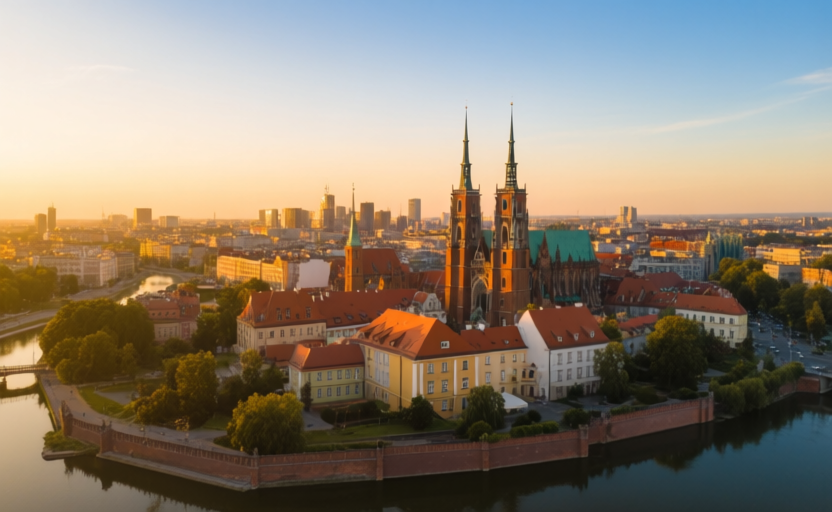
The oldest part of Wrocław, a cluster of Gothic churches on what was once a river island, still gas-lit.
Local tip: Come at dusk. A lamplighter in period dress lights the gas lamps by hand every evening, all year, and it is one of the last places in Europe where that is a job rather than a re-enactment.
Hala Stulecia
Landmark · Szczytnicki Park, east
Max Berg's 1913 Centennial Hall, a reinforced concrete dome that was the largest in the world when built and is now a UNESCO site.
Local tip: The Japanese Garden and the enormous Szczytnicki Park sit immediately behind it, and the multimedia fountain out front runs free shows on summer evenings. Almost every visitor sees the hall and almost none walks the park.
Nadodrze
Neighborhood · North of the river
A dense grid of nineteenth-century tenements that escaped both the 1945 siege and the postwar demolitions, now the city's craft and gallery district.
Local tip: Walk the courtyards off Łokietka and Roosevelta. The district was derelict twenty years ago and is now where the studios, workshops and better small bars are — the version of Wrocław that has not been renovated into blandness.
Racławice Panorama
Culture · East of the old town
A 114-metre painted cyclorama of the 1794 battle, brought from Lwów in 1946 and kept rolled up in storage for forty years because the subject embarrassed the authorities.
Local tip: It is displayed in a purpose-built rotunda and takes about half an hour. The story of how it got here — and why it could not be shown until 1985 — is the actual reason to go and tells you more about this city than the painting does.
Wyspa Opatowicka & the Odra islands
Hidden gemNature · South-east, on the river
A wooded island in the Odra reachable by footbridge, part of a chain of twelve river islands that give Wrocław more bridges than any Polish city.
Local tip: Rent a bike and follow the river east from the centre — the path runs through Opatowicka and out past the weirs of the flood-control system, which is worth seeing precisely because it is what kept the city dry in 2024. Almost no visitors get past Hala Stulecia.
Emergency numbers in Wroclaw
Compare Wroclaw with…
Side-by-side cost of living, language, climate and careers — to help you choose.