Bulgaria · Europe
Moving to Sofia
Sofia quick facts
Bulgaria at a glance
Europe & Central Asia
Economy
World BankReligion
% of populationBulgaria Census 2021 (the religion question was optional)
Cost of living in Sofia
Can you move to Bulgaria?
Pick your passport to see whether you can enter Bulgaria — and what it takes to stay.
Entry rules come from github.com/imorte/passport-index-data, updated 17 February 2026. They change without notice — confirm with the official immigration service before booking.
Getting set up in Bulgaria
The single permit, the Migration Directorate, and Bulgaria's post-Schengen position
Bulgaria's mainstream route is the single residence and work permit: one application producing one document that authorises both. The Employment Agency decides the labour element — including a labour market test unless an exemption applies — and the Migration Directorate issues the card. A type D long-stay visa is obtained at a Bulgarian mission before travelling. Long-term residence follows after five years of continuous lawful residence. Bulgaria has been a full Schengen member since 1 January 2025, so the resulting card carries ordinary Schengen movement.
Read the full step-by-step guideExchanging a licence, the vignette, and a city where the metro beats the car
EU and EEA licences are valid and exchangeable without a test. Licences from countries party to the relevant road traffic conventions can generally be exchanged after a theory examination; others require the full Bulgarian test. Motorway and main-road use requires an electronic vignette bought against the plate. Sofia has a metro that reaches the airport and most of the residential districts, which makes car ownership optional in a way it is not in Belgrade or Zagreb.
Read the full step-by-step guideOpening a Bulgarian account in the first year of the euro
Bulgarian retail banking is modern, and the euro changeover on 1 January 2026 removed the currency question entirely — accounts, salaries and rents are all in euro now, and Bulgaria is inside the single euro payments area for transfers. Most banks want the residence card and LNCh before opening a full resident account, though some will open a limited account on a passport. The one live oddity is that legacy documentation, old contracts and older systems still show lev figures.
Read the full step-by-step guideHealth insurance, the personal doctor, and the mountain rescue that is not covered
Employment in Bulgaria brings compulsory health insurance contributions and entitlement to the state system through a chosen personal doctor (lichen lekar). Emergency care is provided regardless of status. The public system is inexpensive and adequate; private clinics in Sofia are numerous, quick and cheap by Western European standards, and are what most professionals use for routine care. Two Sofia-specific points: the winter air quality genuinely matters, and mountain rescue on Vitosha is not covered by health insurance.
Read the full step-by-step guideSIM cards, fibre, and the euro-priced tariffs
Bulgaria has three mobile operators — A1, Yettel and Vivacom — and prices are low by European standards. Prepaid SIMs are registered against identity documents and available immediately; postpaid wants the residence card and usually a Bulgarian bank account. Fixed broadband in Sofia is fast and cheap, with fibre widespread in the residential districts. All tariffs have been restated in euro since the January 2026 changeover.
Read the full step-by-step guideTen per cent, flat, on everything — and what it does not cover
Bulgaria levies a flat 10% personal income tax with no bands, no surcharges and no meaningful personal allowance — the joint-lowest headline rate in the EU and the simplest system in the region. Corporate tax is also 10%. Employee social contributions are modest by regional standards, so Bulgarian gross-to-net arithmetic is unusually favourable. Employees rarely file. The complications are for the self-employed, where social contributions on a declared insurable income are the real number, and for anyone with foreign income.
Read the full step-by-step guideEach guide has verified costs, timelines, required documents, and the non-obvious gotchas — sourced from official government pages. Last verified August 2026.
Essential Bulgarian phrases
Reading a list isn’t learning it. Globe Quest turns these into a trainer — hear each phrase spoken, drill them with spaced repetition, and get scored as you say them out loud.
What to know before you go
Bulgaria adopted the euro on 1 January 2026 — every lev figure you read is historic
CriticalBulgaria became the twenty-first euro area member on 1 January 2026 at the fixed rate of 1.95583 lev to the euro. Lev and euro cash circulated together for January and the euro has been the sole legal tender since 1 February 2026. Dual price display began on 8 August 2025 and ran for a year, so shop labels through most of 2026 showed both. The practical consequence for a newcomer: salary figures, rent quotes, thresholds and fees found in leva anywhere online are converted historic numbers, and anyone quoting you a lev salary in 2026 is working from an old spreadsheet.
The 10% flat tax is genuinely 10%, and the contributions underneath it are genuinely light
CriticalBulgaria's personal income tax is a flat 10% with no progressive bands and no meaningful allowance — the joint-lowest headline rate in the EU. What makes it more than a headline is that employee social contributions here are modest by regional standards, around a seventh of gross, against roughly a third in Romania. So the gap between Bulgarian gross and Bulgarian net is the narrowest in this part of Europe, and a Sofia salary converts to take-home more efficiently than a nominally higher one in Bucharest, Zagreb or Ljubljana. This is the single strongest financial argument for the city.
Winter air in the Sofia valley is a real health consideration
CriticalSofia sits in a basin ringed by Vitosha, Lyulin and the Balkan range. In cold, still weather a temperature inversion caps the valley and traps emissions from solid-fuel household heating in the surrounding settlements, older vehicles and construction dust. On the worst December and January days Sofia has registered among the highest particulate readings of any European capital. It is episodic rather than constant and the higher southern suburbs toward Vitosha are noticeably better than the low centre. Track the readings, put an air purifier in the flat budget, and treat the municipality's reduced-fare pollution ticket as a signal that a bad day is under way.
Vitosha is not a day trip — it is a city bus ride
ImportantCherni Vrah, at 2,290 metres, is inside the Sofia municipality and reachable by ordinary public transport from the city centre in under an hour. There is skiing in winter, marked hiking in summer and a chairlift at Aleko. Almost no European capital has anything comparable this close. Two practical notes: mountain rescue in Bulgaria is run by the Red Cross and is not covered by statutory health insurance, so separate mountain insurance is worth having; and the mountain weather changes far faster than the city's.
Sofia is the cheapest capital in the European Union, and the gap is widest on services
ImportantRent, restaurants, transport, gyms, childcare and household services are all markedly below the EU average, and the monthly public transport card at EUR 25.50 is a fraction of what any Western European city charges. Where Bulgaria is not cheap is imported goods, cars and electronics, which are priced at or above EU levels because they are imported. The combination — very cheap services, EU-priced goods — means the cost advantage is largest for someone who lives here rather than someone who buys things here.
Bulgaria joined Schengen fully in January 2025, and it changed weekend travel
ImportantAir and sea borders opened in March 2024 and land borders on 1 January 2025 following the Council decision of December 2024. A Bulgarian residence card now carries ordinary Schengen movement and the land crossings to Greece and Romania have no passport check. Guidance written before 2025 describes Bulgaria as EU but not Schengen, which is now simply wrong. Thessaloniki is a comfortable drive and Bucharest a short one.
Top industries & employers
Software & IT services
Chaos, Progress Software, SAP Labs Bulgaria, VMware/Broadcom, Telerik, Docler, Bianor
Chaos, which makes the V-Ray renderer used across the global film and architecture industries, was founded in Sofia and is the country's best-known product company.
Business process & shared services
DXC, IBM, TELUS International, Sutherland, Concentrix, HPE, Coca-Cola HBC
Sofia is one of Europe's largest outsourcing destinations per head, hiring in German, French, Dutch, Nordic and Greek alongside English — language pay premiums here are substantial.
Fintech & payments
Paysafe, Payhawk, Nexo, Paysera, eMerchantPay
Payhawk became Bulgaria's first technology unicorn in 2022, and Sofia has an unusually dense payments and fintech cluster for a city its size.
Engineering & industrial
Festo, Sensata, Melexis, Visteon, Liebherr, ABB
Bulgaria's electronics and precision engineering base sits partly in Sofia and partly in the Plovdiv corridor, with substantial R&D headcount in the capital.
Energy & utilities
Bulgargaz, Kozloduy NPP, Energo-Pro, EVN, ContourGlobal
Bulgaria is a net electricity exporter in the region and the Kozloduy nuclear plant is central to that; the sector's head offices and regulators are in Sofia.
Higher education & research
Sofia University, Technical University of Sofia, Bulgarian Academy of Sciences, Sofia Tech Park
The Technical University supplies much of the engineering workforce, and Sofia Tech Park was the country's first attempt at a state-backed research and startup campus.
Where to go in Sofia
Vitosha & Cherni Vrah
Nature · Southern edge of the municipality
A 2,290-metre mountain inside the city boundary, with skiing, marked trails, a chairlift and a summit an hour from the centre.
Local tip: The stone rivers (kamenni reki) on the northern slopes are the geological oddity nobody mentions — vast fields of boulders left by periglacial weathering, and quite unlike anything else in the Balkans. The Zlatnite Mostove trailhead is where to start.
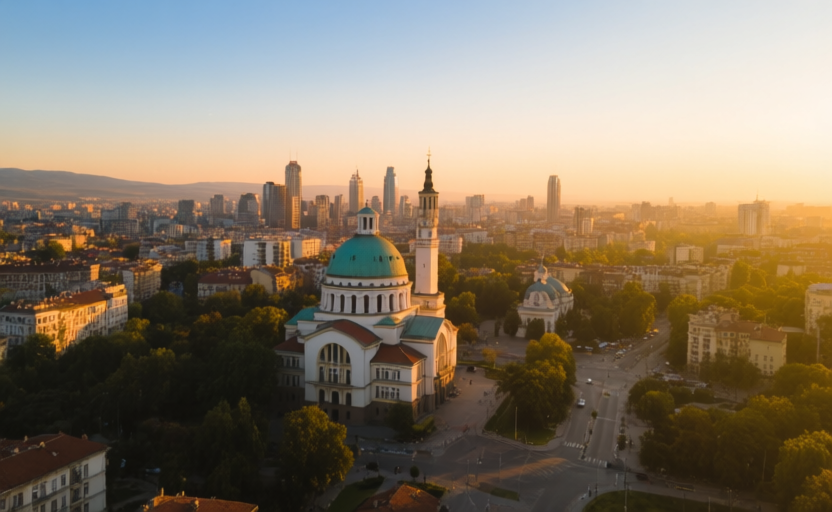
Alexander Nevsky Cathedral & the yellow bricks
Landmark · Central Sofia
The gold-domed Orthodox cathedral, and the distinctive yellow paved boulevards radiating from it.
Local tip: The yellow paving bricks were a wedding gift from Austria-Hungary in 1907 and are still being restored piece by piece. They are also lethal in the rain — locals know to walk on the edges.
The Central Mineral Baths & Sofia's springs
Culture · Central, next to the Banya Bashi mosque
Sofia sits on mineral springs; the former public bathhouse is now the city museum, with public taps outside where people still fill bottles.
Local tip: The queue at the outdoor taps is the most Sofia thing in Sofia — people arrive with crates of empty bottles for water that comes out of the ground at 46°C. It is free and it has been drunk here since the Romans called the city Serdica.
Zhenski Pazar
Food · Central, near Serdika
The largest open-air market in the city — produce, cheese, spices and the best prices in central Sofia.
Local tip: Go in the morning for produce and late afternoon for the discounted end of the day. The surrounding streets have the city's best cheap eating, and it is the one place in central Sofia where almost no English is spoken.
Boyana Church & the Vitosha foothills
Culture · Boyana, southern suburbs
A small mediaeval church with 1259 frescoes that are a UNESCO World Heritage site, at the foot of the mountain.
Local tip: Entry is timed and limited to a few minutes to protect the paintings, which is exactly why it is worth planning around rather than dropping into. Combine it with the National History Museum next door and the walk up into the Vitosha foothills behind.
The Sofia Synagogue and the Square of Tolerance
Hidden gemLandmark · Central, near Zhenski Pazar
The largest Sephardic synagogue in south-eastern Europe, standing within a few hundred metres of a mosque, an Orthodox cathedral and a Catholic church.
Local tip: The four buildings sit close enough to be seen from a single point that Sofia calls the Square of Tolerance. The synagogue itself is quiet, rarely visited and has a small museum on the wartime rescue of Bulgaria's Jewish population — one of the more remarkable and least known stories of the period.
Emergency numbers in Sofia
Compare Sofia with…
Side-by-side cost of living, language, climate and careers — to help you choose.