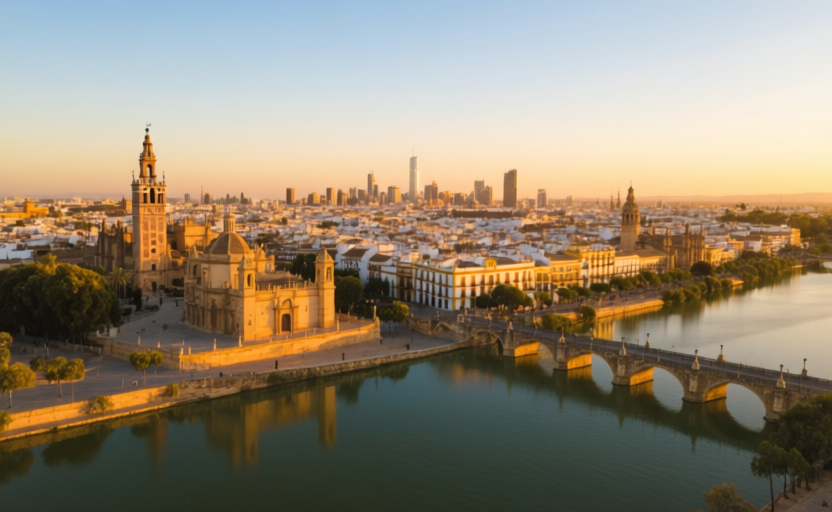
Spain · Europe
Moving to Seville
Seville quick facts
Spain at a glance
Europe & Central Asia
Economy
World Bank · 2025Religion
% of populationCIA World Factbook / national censuses
Cost of living in Seville
Can you move to Spain?
Pick your passport to see whether you can enter Spain — and what it takes to stay.
Entry rules come from github.com/imorte/passport-index-data, updated 17 February 2026. They change without notice — confirm with the official immigration service before booking.
Getting set up in Spain
NIE, TIE and the empadronamiento that unlocks everything
Spanish residency is a sequence and the order matters: a NIE number, then municipal registration on the padrón, then a TIE card, then social security, then a health card. Each step is a prerequisite for the next and each needs a cita previa that is genuinely hard to get. Seville's Oficina de Extranjería is smaller than Madrid's and appointment pressure is a running local complaint.
Read the full step-by-step guideExchanging a licence, and Europe's flattest cycling city
EU and EEA licences are exchangeable straightforwardly. For everyone else it depends on whether Spain has a bilateral agreement with the issuing country — if it does you exchange without a test, if not you take the full Spanish exams in Spanish. The six-month clock starts when you become resident. Seville is flat, compact and built one of Europe's most successful segregated cycle networks almost overnight, so many residents genuinely do not need a car.
Read the full step-by-step guideOpening a Spanish account, and the resident-versus-non-resident distinction
Spanish banks distinguish sharply between resident and non-resident accounts, and the non-resident version carries higher fees and a certificate that must be periodically renewed. With a NIE and a padrón certificate you qualify for a resident account. Spanish banks charge maintenance fees far more readily than UK or US ones, so the waiver conditions are worth real money.
Read the full step-by-step guidePublic healthcare, the Andalusian card, and surviving the heat
Spanish public healthcare is good and free at the point of use once you are in it — but entry runs through social security rather than residency alone. The sequence is padrón, then social security registration, then the Andalusian health card. The distinctively Sevillian health issue is heat: this is the hottest major city in Europe and heat illness here is a real clinical risk rather than a discomfort.
Read the full step-by-step guideGetting a Spanish SIM, and why the NIE gates the good tariffs
Spain requires every SIM to be registered against an identity document, so there is no anonymous pay-as-you-go. A prepaid SIM can be activated on a passport, which is what to do on arrival. Contract tariffs — better value and usually bundled with fibre — need a NIE and a Spanish bank account, so the sequence is prepaid first, contract once the paperwork lands.
Read the full step-by-step guideIRPF, the Andalusian scale, and the wealth tax this region rebates
You become a Spanish tax resident by spending more than 183 days in the country in a calendar year, or by having your main economic interests here — and Spanish tax residency is worldwide. Income tax is half national and half regional, and Andalusia has cut its regional scale in recent years. Andalusia also rebates wealth tax entirely, where Valencia and Catalonia charge it — though a separate state-level solidarity levy was introduced specifically to reach very large fortunes that regional rebates release.
Read the full step-by-step guideEach guide has verified costs, timelines, required documents, and the non-obvious gotchas — sourced from official government pages. Last verified August 2026.
Essential Spanish phrases
Reading a list isn’t learning it. Globe Quest turns these into a trainer — hear each phrase spoken, drill them with spaced repetition, and get scored as you say them out loud.
What to know before you go
Andalusia rebates wealth tax entirely — Valencia and Catalonia do not
CriticalSpain's wealth tax is designed nationally but the autonomous communities can rebate it, and Andalusia rebates it in full. Half of income tax is also regionally set, and Andalusia has cut its scale in recent years. For someone with significant assets, living in Seville rather than Valencia or Barcelona is a materially different tax position on identical Spanish residency. Note that a separate state-level solidarity levy on very large fortunes was introduced specifically to capture what regional rebates release, so this is not a complete exemption at the very top — take advice rather than assuming.
The heat is a scheduling constraint, not a weather complaint
CriticalSeville is the hottest major city in Europe, routinely above 40 °C for weeks, and in 2022 it became the first city in the world to name and categorise heatwaves the way tropical storms are named. The city adapts rather than suffers: work and social life shift to early morning and late evening, streets are shaded with awnings, and July and August empty out. Plan your housing around air conditioning and orientation, and do not schedule anything outdoors between two and six in the afternoon in summer.
Empadronamiento first — almost nothing else works without it
CriticalThe padrón is the municipal register of residents and its certificate unlocks the public health system, school places, your TIE appointment and residency renewals. Register at the ayuntamiento with your passport and a rental contract or proof of address in your first fortnight. People treat it as low-priority administration and then find three separate processes stalled behind it.
Seville is the cheapest major Spanish city, and that is the main reason to be here
ImportantRents run well below Madrid, Barcelona and Valencia for comparable property, and everyday costs follow. What you trade is a much thinner professional job market — the local economy is aerospace, public administration, tourism and agriculture rather than a broad corporate base. It works best for remote workers, for the aerospace and defence cluster, and for anyone whose income is not set by the Sevillian labour market.
Semana Santa and the Feria are two consecutive weeks when the city stops
ImportantHoly Week processions occupy the streets day and night and make large parts of the centre genuinely impassable, and the April Feria follows shortly after. Between them they take up much of the spring. Nothing administrative happens, moving house is impossible, and accommodation prices multiply. Either engage with both fully — they are extraordinary — or plan to be elsewhere, but do not plan to work normally through them.
Spain requires identity registration for a SIM, and a NIE for the good tariffs
Good to knowEvery Spanish SIM is registered against an identity document. A prepaid SIM can be activated on a passport, which is what to do on arrival. Contract tariffs — much better value and usually bundled with fibre — need a NIE and a Spanish bank account, so the sequence is prepaid first, contract later.
Top industries & employers
Aerospace & defence
Airbus Defence and Space, Aernnova, Alestis, Aciturri
Seville assembles the A400M military transport, and the surrounding aerospace supply chain is one of the largest industrial clusters in southern Spain.
Public administration
Junta de Andalucía, Parlamento de Andalucía, Ayuntamiento de Sevilla
Seville is the capital of Andalusia, Spain's most populous autonomous community, which makes regional government one of the largest single employers in the city.
Tourism & hospitality
Hotel groups, Real Alcázar, Catedral de Sevilla, tour operators
The Alcázar and the cathedral draw very large visitor numbers year-round, and hospitality is the most visible part of the city economy — with the seasonality and wage levels that implies.
Agriculture & agri-food
Migasa, Acesur, Grupo Ybarra, Persán
Andalusia produces a large share of the world's olive oil, and the processing, bottling and export businesses around Seville are substantial industrial employers.
Technology & shared services
NTT Data, Accenture, Indra, Everis, Cognizant
A growing base of technology delivery and shared service centres attracted by low costs and the universities' engineering output, though generally at lower salaries than Madrid.
Higher education & research
Universidad de Sevilla, Universidad Pablo de Olavide, CSIC centres
The University of Seville is one of Spain's largest, and the Isla de la Cartuja technology park hosts research institutes alongside the aerospace and energy companies.
Where to go in Seville
The Real Alcázar
Landmark · Old city
A royal palace begun under Muslim rule and rebuilt over centuries, with Mudéjar courtyards, tiled halls and gardens that still function as a working royal residence.
Local tip: Book online well ahead and go at opening or in the last hour — the middle of the day is both crowded and unbearably hot. The Baños de Doña María de Padilla, the vaulted rainwater tank beneath the gardens, is the single best room and many visitors miss it entirely.
The Cathedral & La Giralda
Landmark · Old city
The largest Gothic cathedral in the world, built on the site of the great mosque, with the minaret retained as its bell tower.
Local tip: The Giralda has ramps rather than stairs — built so a rider could ascend on horseback — which makes the climb far easier than it looks. Go up at the end of the day for the light across the rooftops.
Barrio de Santa Cruz & the old Jewish quarter
Neighborhood · Old city, east of the cathedral
A maze of whitewashed lanes, patios and small squares that was the medieval Jewish quarter, now the most photographed part of the city.
Local tip: The lanes are crowded by day and lovely at ten at night when the tour groups have gone. Look for the open patios in the early evening — Sevillian houses are built around them and residents leave the gates ajar in summer.
Parque de María Luisa & Plaza de España
Nature · South of the centre
A large shaded park of ponds, tiled benches and orange trees, with the vast semicircular Plaza de España built for the 1929 exposition at its edge.
Local tip: The park is where the city goes to survive August — the tree cover drops the temperature noticeably. The tiled alcoves around the Plaza de España represent every Spanish province, and finding the one for a place you know is the local way to spend twenty minutes there.
Triana
Neighborhood · West bank of the Guadalquivir
The old ceramics and flamenco quarter across the river, with a covered market built over the ruins of a castle and a fiercely separate identity.
Local tip: Cross the Isabel II bridge at sunset for the view back at the city, then eat in the Mercado de Triana rather than on Calle Betis, where the riverside terraces charge for the view. Triana considers itself distinct from Seville and it is worth taking that seriously.
Las Setas & the Antiquarium
Hidden gemCulture · La Encarnación
An enormous timber lattice structure over the old market square, with Roman remains excavated and displayed in the basement beneath it.
Local tip: Everyone photographs the structure and few go down to the Antiquarium, where a Roman house with intact mosaics sits under the square. The rooftop walkway at sunset costs little and is the best elevated view of the old city.
Emergency numbers in Seville
Compare Seville with…
Side-by-side cost of living, language, climate and careers — to help you choose.