United Kingdom · Europe
Moving to Oxford
Oxford quick facts
United Kingdom at a glance
Europe & Central Asia

Economy
World Bank · 2025Religion
% of populationCIA World Factbook / national censuses
Cost of living in Oxford
Can you move to United Kingdom?
Pick your passport to see whether you can enter United Kingdom — and what it takes to stay.
Entry rules come from github.com/imorte/passport-index-data, updated 17 February 2026. They change without notice — confirm with the official immigration service before booking.
Getting set up in United Kingdom
eVisas, share codes, and the routes a college or hospital will sponsor
UK immigration status is entirely digital: no biometric residence permit card, and no visa vignette sticker for new applicants. Your permission lives in a UKVI account as an eVisa and you prove it with a share code. The Oxford-specific question is which route your sponsor is using, because the university, the NHS and a spinout company will each reach for a different one and the downstream rules on switching, dependants and settlement are not the same.
Read the full step-by-step guideExchanging a licence, the Zero Emission Zone, and the bus gates
Licence exchange depends on where your licence was issued: EU and EEA licences can be used and exchanged without a test, a defined list of designated countries can exchange without testing within five years of residency, and everyone else takes the UK theory and practical tests. Oxford's own complication is not the exchange but the driving — a Zero Emission Zone pilot charges non-zero-emission vehicles on a named set of central streets, and bus gates make a great deal of the city undrivable regardless of what your vehicle emits.
Read the full step-by-step guideOpening a UK account, and the two councils that will bill you
UK banks require proof of identity and proof of address, which creates the familiar loop: no address, no account; no account, no address. Digital banks break it by opening on a passport and a video selfie. In Oxford there is an easier second route most people miss — the university, the colleges, the hospitals trust and the science-park employers all issue employment and address letters for international staff as a matter of routine, and high-street banks accept them.
Read the full step-by-step guideNHS England, the Headington hospitals, and the prescription charge
You paid the Immigration Health Surcharge with your visa, which entitles you to NHS care on the same basis as a resident, but nothing starts until you register with a GP. England charges a flat fee per prescription item that the rest of the UK abolished; a prepayment certificate caps it. Oxford's hospital provision is concentrated in Headington — the John Radcliffe, the Churchill and the Nuffield Orthopaedic within a mile of each other — which is excellent clinically and a genuine transport problem practically.
Read the full step-by-step guideGetting a UK SIM, and broadband in a city of listed buildings
The UK requires no identity check to buy or activate a pay-as-you-go SIM. The friction is contracts, which run a credit check you will fail with no UK credit file — so start pay-as-you-go or on a rolling one-month plan. For broadband, Oxford splits between newer suburbs built or upgraded with full fibre and a historic core where conservation-area rules and listed-building consent slow or limit what an operator may install.
Read the full step-by-step guideEnglish income tax, PAYE, and the college and spinout complications
England has three income tax bands above the personal allowance, with the Higher rate at £50,270 and the Additional rate at £125,140. Most employees never file a return because PAYE handles everything. Oxford complicates that more often than most cities: academics frequently hold a college appointment alongside a university one, so two payrolls apply tax codes to the same person, and the spinout economy pays partly in equity.
Read the full step-by-step guideEach guide has verified costs, timelines, required documents, and the non-obvious gotchas — sourced from official government pages. Last verified August 2026.
Essential English phrases
Reading a list isn’t learning it. Globe Quest turns these into a trainer — hear each phrase spoken, drill them with spaced repetition, and get scored as you say them out loud.
What to know before you go
The whole city is designated for additional HMO licensing, and that is unusual
CriticalOxford City Council has designated its entire area under section 56(1)(a) of the Housing Act 2004 for Additional HMO Licensing, which pulls three- and four-person shares into the licensing regime alongside the nationally mandatory five-plus. The 2021 designation ran to 9 June 2026 and a fresh five-year designation came into force on 25 June 2026. This works strongly in a tenant's favour: a licensed HMO has council-enforced standards on room sizes, amenity provision, fire safety and management, and the council can inspect. Operating an unlicensed HMO exposes the landlord to a civil penalty and to a rent repayment order covering up to twelve months' rent paid back to the tenant. Before you sign for any shared house here, ask for the licence number and check it. Cambridge, the obvious comparator city, has no such scheme at all.
Oxford has two councils, and knowing which one to call saves weeks
CriticalUnlike Birmingham or Manchester, Oxford is not a unitary authority. Oxford City Council handles housing, HMO licensing, Council Tax billing, bins and planning. Oxfordshire County Council handles transport, roads, parking enforcement policy, schools and social care. So a broken street light, a residents' parking scheme and the Zero Emission Zone are county matters, while your tenancy, your HMO licence and your Council Tax bill are city matters. Newcomers routinely spend a fortnight talking to the wrong one. If it is inside your home, it is the city; if it is on the road outside, it is the county.
The Zero Emission Zone is far smaller than its name suggests — for now
ImportantThe ZEZ has operated since February 2022 as a pilot across a small named set of city-centre streets — New Road, Queen Street, Cornmarket Street, New Inn Hall Street, Market Street, Ship Street, St Michael's Street, Shoe Lane and Bonn Square — not the whole centre. Non-zero-emission vehicles entering those streets pay a daily charge. A much wider zone covering most of the city centre has been proposed and was expected to go to the county council's cabinet during 2026, but had not been settled at the time of writing. So the current cost is small and the future one is not decided. Check Oxfordshire County Council's own pages before assuming either way, and do not confuse the ZEZ with the separate network of bus gates, which restrict access rather than charge for it.
The rental year runs on the academic calendar and clears before term
ImportantMichaelmas begins in early October, and the private market moves through the summer accordingly — stock appears from May, peaks in June and July, and is thin by mid-September. Miss the window and you are choosing from what nobody wanted until the January lull. If your start date is flexible, arriving in May or June puts you ahead of the student intake rather than inside it. If it is not, budget for temporary accommodation instead of assuming you will find something in your first fortnight.
The map lies: Oxford is threaded with bus gates and closed streets
ImportantA route that looks like a straight line through the city is frequently not drivable, because it passes a camera-enforced bus gate that only buses, taxis and bicycles may cross. This is a deliberate long-standing policy, not a temporary works arrangement, and satnavs handle it inconsistently. The practical effect is that crossing the city by car often means going out to the ring road and back in, while the same journey by bike takes a quarter of the time. Look at the actual restrictions before you decide a neighbourhood is convenient for your commute.
Oxford is not just the university — Cowley builds cars and Headington runs hospitals
Good to knowRoughly half the city's economy has nothing to do with colleges. BMW's Mini plant at Cowley is one of the largest manufacturing employers in the south of England; Headington holds the John Radcliffe, the Churchill and the Nuffield Orthopaedic, which together make Oxford University Hospitals a very large employer; and the Harwell and Culham campuses south of the city host national science facilities. This matters when you are choosing where to live, because the commutes to Cowley, Headington and the Harwell corridor point in three different directions from the centre.
Top industries & employers
Higher education & research
University of Oxford, Oxford Brookes University, 39 colleges, the Bodleian Libraries
The university is also one of the region's largest employers and landowners, and its colleges own a substantial share of the city and the surrounding science parks.
Healthcare & clinical research
Oxford University Hospitals (John Radcliffe, Churchill, Nuffield Orthopaedic, Horton), the Big Data Institute
Headington is effectively a hospital district. Oxford's clinical trials infrastructure is world-class and was the visible route by which the city's vaccine research reached the public.
Life sciences & biotech
Oxford Nanopore, Immunocore, Barinthus Biotherapeutics, Exscientia alumni, the Oxford Science Park
One of the densest university-spinout ecosystems in Europe, with Magdalen College owning a majority stake in the Oxford Science Park where much of it sits.
Automotive manufacturing
BMW Group Plant Oxford (Mini) at Cowley, the local supply chain
Cars have been built at Cowley since 1913, and the plant remains one of the largest manufacturing employers in southern England — a side of Oxford's economy that visitors never see.
Scientific instruments & deep tech
Oxford Instruments, Diamond Light Source and the Harwell campus, UKAEA at Culham
The corridor south of the city holds national-scale research facilities — a synchrotron, fusion research, space and satellite applications — that draw a specialist workforce well beyond the university.
Publishing & professional services
Oxford University Press, Elsevier operations, Blackwell's, a large legal and consulting sector
OUP is the largest university press in the world and has been a significant Oxford employer for centuries; the wider publishing and editorial economy around it is substantial.
Where to go in Oxford
Port Meadow
Nature · North-west, along the Thames
Ancient common land that has never been ploughed, grazed by horses and cattle, flooding in winter and running down to the Thames and two riverside pubs.
Local tip: Walk out from Walton Well Road to the Perch at Binsey or on to the Trout at Wolvercote. In a hard winter the meadow floods and then freezes, and the whole city comes out to skate on it — an event nobody schedules and everybody hears about within an hour.
The Covered Market
Food · Between High Street and Market Street
A permanent indoor market trading since the eighteenth century — butchers, a pie shop, a cobbler, cafés and the famous cake maker, in a warren of narrow aisles.
Local tip: It is genuinely a working market rather than a food hall, and the butchers and greengrocers are cheaper than the supermarkets. Go on a weekday morning; on a Saturday it is impassable.
Cowley Road
Neighborhood · East Oxford, over Magdalen Bridge
A mile of independent restaurants, music venues, pound shops and grocers from every continent — the part of Oxford that is a city rather than a university.
Local tip: The best value eating in Oxford is on this road and nowhere near it. Start at the Plain end and work east; the further from Magdalen Bridge you get, the cheaper and better it becomes.
The Bodleian and the Radcliffe Camera
Landmark · City centre
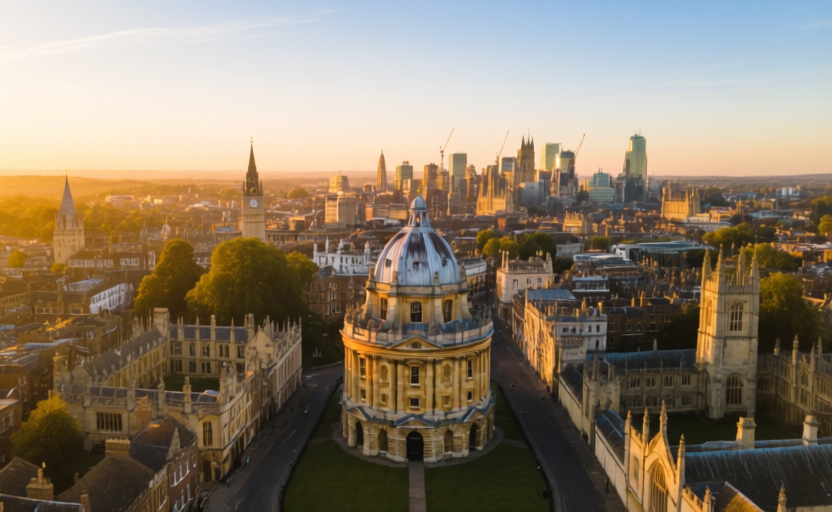
One of the oldest libraries in Europe and its circular eighteenth-century reading room, at the centre of a square of medieval and Baroque university buildings.
Local tip: You cannot get into the Camera without a reader's card, but the Divinity School and the Duke Humfrey's Library are open on paid tours and are the better rooms anyway. The Weston Library next door is free and its exhibition gallery is consistently good.
Headington and South Park
Culture · East, up the hill
The hospital district, with the best view back over the whole city from South Park and a fibreglass shark embedded head-first in the roof of a terraced house.
Local tip: The Headington Shark has been there since 1986 after a long planning fight the owner eventually won. It is on New High Street, it is free, and it is a better story than most of what the tour buses stop at.
The Oxford Canal towpath to Wolvercote
Hidden gemNature · North, from Jericho
A narrow towpath running from Jericho out past moored narrowboats, allotments and Port Meadow to the edge of the city — flat, traffic-free and almost entirely used by locals.
Local tip: Start behind Jericho and walk or cycle north. Within fifteen minutes you are out of the city with the meadow on one side and the boats on the other, and you can carry on to Kidlington if you want to. Almost no visitor ever finds it.
Emergency numbers in Oxford
Compare Oxford with…
Side-by-side cost of living, language, climate and careers — to help you choose.