Oman · Middle East
Moving to Muscat
Muscat quick facts
Oman at a glance
Middle East, North Africa, Afghanistan & Pakistan

Economy
World Bank · 2025Religion
% of populationCIA World Factbook / national censuses
Cost of living in Muscat
Can you move to Oman?
Pick your passport to see whether you can enter Oman — and what it takes to stay.
Entry rules come from github.com/imorte/passport-index-data, updated 17 February 2026. They change without notice — confirm with the official immigration service before booking.
Getting set up in Oman
Labour clearance, the employment visa, and the 30-day resident card clock
Two authorities in sequence: the Ministry of Labour issues labour clearance against the employer's Omanisation position, and the Royal Oman Police then issues the employment visa and the resident card. The resident card is the document everything else depends on, and you have a short window after arrival to obtain it — commonly stated as 30 days. Until it exists you cannot bank properly, hold a SIM in your name, convert a driving licence or register a tenancy.
Read the full step-by-step guideConverting a licence, the employer letter in Arabic, and driving a wadi city
If your licence comes from a country on the ROP's approved list, conversion is administrative: resident card, original licence, an eye test at an authorised optician, a blood group certificate, and — the step that catches everyone — a no-objection letter from your employer, in Arabic. Everyone else takes lessons and a test. Then there is Muscat itself: a fifty-kilometre strip with few alternatives to the main coastal highway, and a road network that crosses wadis which flood without warning.
Read the full step-by-step guideOpening an account, and the rial's three decimal places
The resident card is the prerequisite, and until it exists nothing happens. Once it does, opening is straightforward at any of the main banks with the card, passport, a salary certificate and a tenancy or address proof. Salaries for private-sector employees are paid into local accounts under the Wage Protection System, so the account is not optional. The thing to internalise early is the currency: the rial is worth about USD 2.60 and divides into a thousand baisa, so prices carry three decimals and small-looking numbers are large.
Read the full step-by-step guideDhamani, the hospitals, and a geography that changes what 'nearby' means
Oman is rolling out Dhamani, a mandatory health insurance scheme covering private-sector employees, expatriates and visitors, in phases — hospitals, clinics and pharmacies have been connected to its platform progressively rather than all at once. That phasing is the important part: what you are actually covered for depends on your employer's policy and on where the rollout has reached, not on a single national switch-on date. Establish your policy, tier and network in writing at onboarding.
Read the full step-by-step guideGetting a line, and the coverage that disappears in a wadi
Omani SIMs are registered against a verified identity and there is a cap on lines per identity. Visitors register on a passport; residents must move the line onto the resident card, because bank verification and government services authenticate against it. Coverage along the Muscat strip and the main highways is solid. The moment you leave them — into a wadi, up a mountain, out to a beach — it goes, and that is a safety consideration rather than an inconvenience.
Read the full step-by-step guide5% VAT now, and the GCC's first income tax in January 2028
Today Oman levies no personal income tax on salaries and there is no personal return to file. VAT is 5%, introduced in April 2021 and among the lowest in the region. Non-Omani employees do not contribute to the Omani social insurance pension scheme, though employers carry occupational-hazard obligations. The single fact that changes the picture is dated: Royal Decree 56/2025 introduces a 5% personal income tax on annual income above OMR 42,000 from 1 January 2028.
Read the full step-by-step guideEach guide has verified costs, timelines, required documents, and the non-obvious gotchas — sourced from official government pages. Last verified August 2026.
Essential Arabic phrases
Reading a list isn’t learning it. Globe Quest turns these into a trainer — hear each phrase spoken, drill them with spaced repetition, and get scored as you say them out loud.
What to know before you go
Muscat's rent rules are the Municipality's, and they are unusually favourable
CriticalTenancy in Muscat is governed by Muscat Municipality's own local ordinance rather than a purely national statute. Under it, rent cannot be increased at all for the first three years of a continuous tenancy, and after that an increase is capped at 7%. The tenancy must be registered with Muscat Municipality — unregistered agreements are referred to the Public Prosecution and carry real penalties for both parties. The practical consequence: a three-year rent freeze is a legal entitlement here, not a negotiation, and it only exists if the contract is registered.
Oman will levy personal income tax from 1 January 2028
CriticalRoyal Decree 56/2025, issued in June 2025, promulgates a Personal Income Tax Law taking effect on 1 January 2028 — the first in the GCC. The rate is 5% on annual income above OMR 42,000, and the Oman Tax Authority expects it to affect around 1% of the population. Nothing is payable before 2028 and most salaries fall well below the threshold, but a senior package signed now runs straight into it, and any five-year plan built on 'the Gulf is tax-free' needs revisiting. Watch for the executive regulations, which will define residency and the scope of taxable income.
Never drive into a flowing wadi, and check the forecast before a road trip
CriticalMuscat is built across wadi beds and several main roads cross them at grade. A short, intense rainfall in the Hajar mountains — often with no rain at all where you are standing — sends water down within minutes. Vehicles get swept away every year, and the Royal Oman Police campaign on this specifically. If water is moving across a road, turn around; depth is impossible to judge and the bed underneath may already have washed out. Cyclones from the Arabian Sea occasionally reach Oman, and when a warning is issued the correct response is to stay off the roads entirely.
Omanisation decides whether your job exists before you do
ImportantThe Ministry of Labour sets sector and occupation-level percentages of Omani nationals employers must meet, and periodically closes lists of occupations to expatriates altogether. This is a harder constraint than the equivalent schemes in the UAE or Bahrain, and it means the answer to 'can I get a job in Oman' often has nothing to do with your qualifications. Before you resign anywhere, get the employer to confirm they hold labour clearance for your specific occupation code, not just that they want to hire you.
There is no skyline because there is not allowed to be one
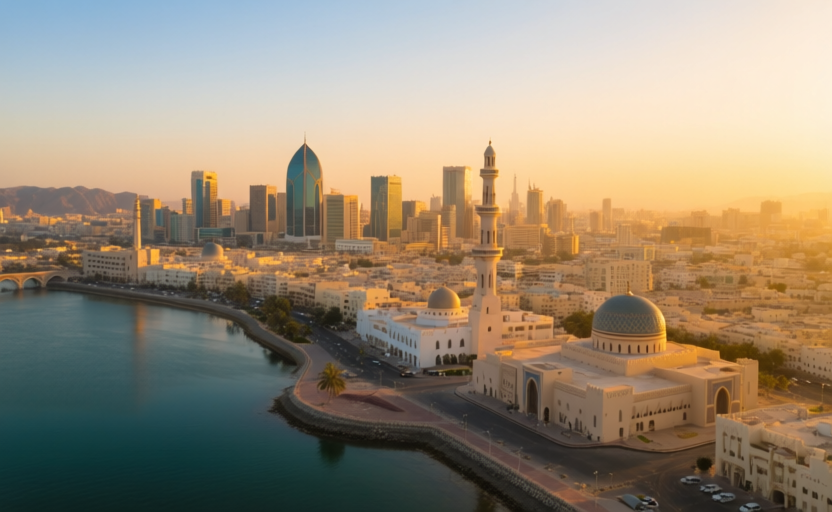
ImportantMuscat's planning rules restrict building heights and require a traditional, predominantly white, Islamic-influenced architectural idiom. The result is a capital that spreads for fifty kilometres along the coast and never rises above a handful of storeys — the opposite of Doha, Dubai or Kuwait City. It is genuinely beautiful and it has a cost: the city has no dense centre, no walkable core beyond Muttrah's corniche, and a car is not optional outside a couple of districts.
Swahili is a working language here, and Oman's history explains it
Good to knowOman ruled Zanzibar until 1964, and a large community returned to Oman afterwards. Swahili is genuinely spoken in Muscat — in shops, in government, in families — alongside Arabic, Baluchi and English. It is the clearest everyday sign that Oman's history is an Indian Ocean history rather than a purely Gulf one, and it is worth understanding if you want to read the country rather than just live in it.
Top industries & employers
Oil, gas & LNG
Petroleum Development Oman, Oman LNG, OQ, Daleel Petroleum
PDO alone accounts for a very large share of Omani production and is one of the country's biggest employers. Oman's fields are technically hard — heavy oil, enhanced recovery — which is why the technical hiring here skews more specialist than the reserves alone would suggest.
Ports, logistics & free zones
Port of Salalah, Sohar Port and Freezone, Asyad Group, Duqm SEZ
Oman's ports sit outside the Strait of Hormuz, which is a strategic fact rather than a marketing one, and Duqm is the largest single development project in the country.
Mining & minerals
Minerals Development Oman, Vale Oman, Mazoon Mining
The Hajar mountains carry copper, chromite, gypsum and limestone, and mining is one of the sectors Oman is genuinely growing rather than talking about growing.
Tourism & hospitality
Omran Group, Shangri-La Al Husn, Anantara Jabal Akhdar, Al Mouj
Oman deliberately positions itself as the region's landscape-and-heritage destination rather than a shopping-and-nightlife one, and the hiring reflects that — more expedition and cultural roles, fewer nightclub ones.
Renewables, hydrogen & utilities
Hydrom, OQ Alternative Energy, Nama Group, ACWA Power projects
Oman has committed serious land and policy to green hydrogen and is among the more credible players regionally. It is the fastest-growing professional hiring area in the country.
Banking & professional services
Bank Muscat, Sohar International, Central Bank of Oman, the Big Four
A smaller and more relationship-driven financial sector than Bahrain's or the UAE's, concentrated in Al Khuwair and the Central Business District in Ruwi.
Where to go in Muscat
Muttrah Corniche & Souq
Landmark · Muttrah
The old port waterfront and the covered souq behind it — frankincense, silver, textiles and ship chandlery, still trading rather than curated for visitors.
Local tip: Go at dusk when the fishing boats come in and the corniche fills up with families. The souq's alleys behind the main tourist run are where the Omani silver and the frankincense grades are actually sold; ask for hojari if you want the good resin and expect to be shown three qualities.
Sultan Qaboos Grand Mosque
Culture · Ghubra / Bausher
A vast, quietly restrained mosque with one of the world's largest hand-woven single-piece carpets and a Swarovski chandelier under the main dome.
Local tip: Open to non-Muslim visitors on weekday mornings only, with strict dress requirements — long sleeves, long trousers or skirt, and a headscarf for women, which you should bring rather than expect to borrow. Arrive at opening; the light through the main prayer hall in the first hour is the reason to come.
Royal Opera House Muscat
Culture · Shatti Al Qurum
The Gulf's first opera house, opened in 2011 — a serious international programme in a building of Omani stone rather than a glass statement.
Local tip: Tickets are far cheaper than an equivalent night in Europe and the acoustics are genuinely good. There is a dress code and it is enforced. Daytime building tours run when there is no rehearsal, and they are worth it even if opera is not your thing.
Old Muscat — Al Alam Palace, Jalali & Mirani
Landmark · Old Muscat
The ceremonial palace flanked by two 16th-century Portuguese forts, in a walled bay that was the entire city until the 20th century.
Local tip: The forts are not generally open, but the walk between them along the harbour wall is, and it takes twenty minutes. Come early morning: the bay faces east, the cliffs go gold, and by ten the light is flat and the heat is up.
Qurum Beach & Qurum Natural Park
Nature · Qurum
Muscat's main city beach, several kilometres of sand backed by a mangrove creek and one of the few large public parks in the capital.
Local tip: The mangrove lagoon behind the beach is a serious birding spot on the East African–West Asian flyway and almost nobody goes. Walk the beach at sunrise when the fishermen are hauling; swim modestly — this is a public beach in Oman, not a resort one.
Bandar Khayran & the Daymaniyat Islands
Hidden gemNature · Coast east and west of Muscat
A drowned network of fjord-like inlets east of the city, and a protected island archipelago offshore with the best diving and snorkelling in the Gulf of Oman.
Local tip: Bandar Khayran is twenty minutes by boat from Marina Bandar Al Rowdha and is essentially empty on a weekday — a kayak and a snorkel is a better day than most things you can pay for. The Daymaniyat Islands are a nature reserve with a seasonal closure to protect nesting turtles and birds; check the current dates and permit rules before booking anything.
Emergency numbers in Muscat
Compare Muscat with…
Side-by-side cost of living, language, climate and careers — to help you choose.