Pakistan · South Asia
Moving to Islamabad
Islamabad quick facts
Pakistan at a glance
Middle East, North Africa, Afghanistan & Pakistan

Economy
World BankReligion
% of populationPakistan Population and Housing Census 2023
Cost of living in Islamabad
Can you move to Pakistan?
Pick your passport to see whether you can enter Pakistan — and what it takes to stay.
Entry rules come from github.com/imorte/passport-index-data, updated 17 February 2026. They change without notice — confirm with the official immigration service before booking.
Getting set up in Pakistan
Work visa, POC, and doing immigration in the city where it is decided
Pakistan issues a short entry visa and does the substantive work at the extension, where a security clearance sits. Nothing accumulates toward permanent residence. Being in Islamabad helps at the margins — the deciding bodies are here and the Regional Passport Office is the federal one — but it does not change the underlying structure. The first question, as everywhere in Pakistan, is whether you have Pakistani ancestry, because a Pakistan Origin Card makes the visa question disappear entirely.
Read the full step-by-step guideThe ICT licence, the IDP counter, and the Pindi boundary
Islamabad is by a wide margin the easiest Pakistani city to drive in: wide roads, a legible grid, functioning signals and far less traffic than Karachi or Lahore. Licensing is an ICT matter rather than a provincial one, and the ICT Administration is also where Pakistan's International Driving Permit is issued. The trap is the boundary: if you live in Rawalpindi you are in Punjab, licensed through DLIMS, policed by Punjab Police and served by Punjab's Rescue 1122 — a different administrative world fifteen minutes down the road.
Read the full step-by-step guideOpening an account, exchange controls, and international-organisation salaries
The controlling question is resident or non-resident, because the State Bank runs non-resident rupee accounts as a separate regime with different documentation and different repatriation rights. Pakistan operates real exchange controls and the ability to move money out later depends on how it came in. Islamabad's advantage is that the branches here deal with foreign nationals constantly and know what to do; the disadvantage is that nothing about the underlying rules is any softer.
Read the full step-by-step guidePrivate hospitals, evacuation cover, and what 1122 means here
Islamabad has good private hospitals — Shifa International and the Pakistan Institute of Medical Sciences are the names people use, alongside Kulsum International and Maroof — and the city's small size means nothing is far away. It has the best air of Pakistan's three big cities. What it does not have is Karachi's Aga Khan, which means for a small set of serious conditions the realistic plan involves travelling, and medical evacuation cover is therefore worth more here than the premium suggests.
Read the full step-by-step guideBiometric SIM registration in the city where the regulator lives
Every Pakistani SIM is biometrically bound to an identity document at the point of sale, matched against NADRA in real time. Foreign nationals register against a passport through NADRA's foreigner verification route and are held to a much lower SIM ceiling than citizens. Islamabad has the best fixed broadband in Pakistan — Nayatel built fibre to the home across most of the sectors long before other cities had it — which is the single most under-appreciated practical advantage of living here.
Read the full step-by-step guideThe territory with no provincial revenue authority
Pakistan's tax year runs 1 July to 30 June and you are a resident individual on 183 days or more of presence within it, taxed on worldwide income. Filer status on the FBR's Active Taxpayers List materially reduces withholding on ordinary transactions and comes from filing on time, not from registering. Islamabad's structural peculiarity is the absence of a provincial layer: services taxed by the Punjab Revenue Authority in Lahore and the Sindh Revenue Board in Karachi fall under federal administration here.
Read the full step-by-step guideEach guide has verified costs, timelines, required documents, and the non-obvious gotchas — sourced from official government pages. Last verified August 2026.
Essential Urdu phrases
Reading a list isn’t learning it. Globe Quest turns these into a trainer — hear each phrase spoken, drill them with spaced repetition, and get scored as you say them out loud.
What to know before you go
Islamabad is not in a province, and that changes your tax and legal geography
CriticalThe Islamabad Capital Territory has no provincial revenue authority. Sales tax on services in Lahore goes to the Punjab Revenue Authority and in Karachi to the Sindh Revenue Board; in Islamabad it is administered federally. Tenancy, licensing and policing are likewise federal or ICT matters rather than provincial ones. The practical consequence is that guidance written for 'Pakistan' generally means Punjab or Sindh, and a consultant registered with the PRA is not thereby registered for ICT. Ask any adviser explicitly whether they handle Islamabad.
Living in Rawalpindi means living under Punjab law while working in the capital
CriticalRawalpindi is a fifteen-to-forty-minute drive from most of Islamabad, is substantially cheaper, and is in Punjab. That means tenancy runs under the Punjab Rented Premises Act 2009 with compulsory registration and Rent Tribunals, driving licences come from Punjab's DLIMS, and the police, the rescue service and the utility companies are all different from Islamabad's. This is not a problem — Punjab's tenancy law is better than most — but it is a genuinely different administrative life, and people cross the boundary without realising they have.
Check NICOP and POC before your employer opens a visa file
CriticalNADRA's Pakistan Origin Card gives foreign nationals of Pakistani descent — including foreign spouses — indefinite stay, exemption from police and foreigners' registration reporting, the right to buy and hold property anywhere in Pakistan, banking rights and eligibility for employment. A POC holder needs no work visa at all. NICOP is the different document, for people who remain Pakistani citizens. Islamabad's international-organisation and diplomatic-adjacent workforce contains a very large number of people who qualify for one of the two and have never checked.
The Diplomatic Enclave is a controlled area and getting in takes planning
ImportantSector G-5 houses most embassies and high commissions behind a security perimeter with controlled access. Visits generally require prior arrangement through the mission you are visiting, and vehicle access rules differ from pedestrian ones. If your work involves regular embassy contact, establish the access procedure with each mission early rather than discovering it at a barrier with an appointment in ten minutes.
Filing your return on time is what makes you a 'filer' — an NTN alone does not
ImportantThe FBR's Active Taxpayers List is the practical dividing line in Pakistani financial life, and non-filers pay materially higher withholding on property purchases, vehicle registration, dividends and certain banking transactions. Registering for a National Tax Number is only step one; you appear on the list after filing a return by the due date, and the list is rebuilt weekly. Islamabad's property market being what it is, this is a mechanism worth more than any deduction.
Islamabad's air is far better than Lahore's, but winter is not clean
Good to knowThe Margalla Hills, the elevation and the low industrial density give Islamabad the best air of Pakistan's three big cities by a clear margin, and its greenness is genuine rather than marketing. Winter inversions and transboundary haze from the Punjab plain still push readings into unhealthy territory for stretches of December and January. Buying a purifier for the bedroom is sensible; the wholesale seasonal reorganisation that Lahore requires is not.
Top industries & employers
Government & public policy
Federal ministries, the Federal Board of Revenue, the Planning Commission, regulators
Every federal ministry and regulator sits here, which makes Islamabad the only Pakistani city where public policy is a genuine career market rather than an adjunct to something else.
International organisations & development
United Nations agencies, World Bank, ADB, DFAT and FCDO programmes, major INGOs
The multilateral and bilateral donor presence is concentrated in Islamabad, and this is the largest single employer of foreign professionals in the city.
Diplomacy & consular services
Over eighty missions in and around the Diplomatic Enclave in G-5
The enclave is a controlled-access sector and the practical centre of gravity for anyone whose work touches visas, trade promotion or bilateral programmes.
Technology & software services
Contour Software, S&P Global, i2c, Ephlux, plus the Special Technology Zone at NSTP
Smaller than Lahore's cluster but growing, helped by the National Science and Technology Park at NUST and by companies wanting proximity to regulators. IT export earnings are taxed under a concessional regime.
Higher education & research
NUST, Quaid-i-Azam University, COMSATS, Air University, PIEAS
NUST and Quaid-i-Azam are among Pakistan's strongest research universities, and the concentration of federal research institutes here has no equivalent elsewhere in the country.
Telecoms & regulated sectors
Pakistan Telecommunication Authority, PTCL, Jazz and Telenor head offices, NEPRA, OGRA
Regulated industries put their government-relations and often their head offices in Islamabad because the regulators are here — telecoms, energy and financial services all follow this pattern.
Where to go in Islamabad
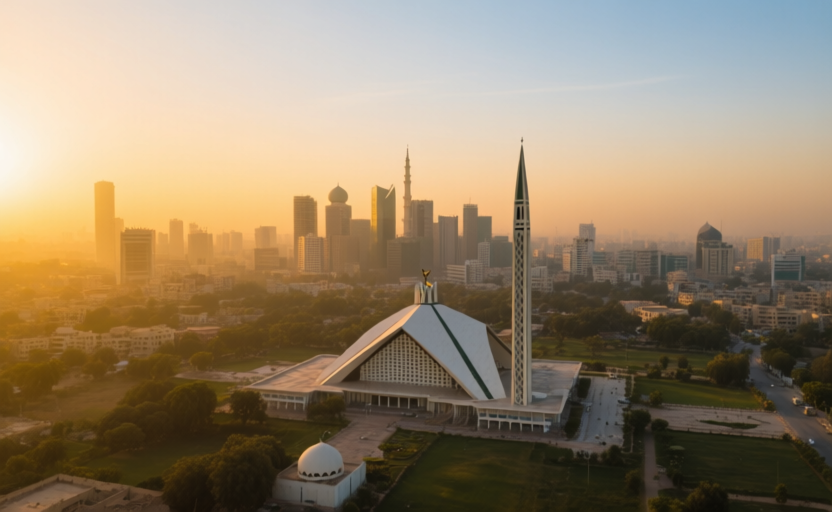
Faisal Mosque
Landmark · At the foot of the Margalla Hills, north of E-7
Vedat Dalokay's 1986 desert-tent design in white marble, one of the largest mosques in the world and the image of the city.
Local tip: Go at dusk when the marble takes the last light and the hills behind go blue. The courtyard is open to visitors outside prayer times; women should bring a scarf. Parking on the east side is easier.
Margalla Hills Trail 5 & Daman-e-Koh
Nature · Margalla Hills National Park, above F-6
A network of marked hill trails starting inside the city, rising into oak and pine forest with the whole grid laid out below.
Local tip: Trail 5 from the trailhead above F-6 is the one locals actually use — about an hour up to Pir Sohawa, busy at weekends and near-empty on a weekday morning. Trail 3 is steeper and shorter. Leopards are present in the park; go in daylight and not alone.
Saidpur Village
Culture · In a fold of the hills between F-6 and F-7
A pre-Mughal village absorbed by the city, with a Hindu temple, a Sikh gurdwara and a mosque within a few hundred metres.
Local tip: The restored quarter with the restaurants is pleasant and touristy; the reason to come is the temple complex above it, which is usually empty and is one of the few visible traces of the pre-1947 Potohar in the capital.
F-6 & F-7 Markaz
Neighborhood · Central Islamabad
The two oldest and most established sector centres — Kohsar Market, Jinnah Super, bookshops, cafés and the closest the city gets to street life.
Local tip: Kohsar Market in F-6 is where the international crowd actually gathers; Jinnah Super in F-7 is the bigger, more local version. Both are genuinely walkable, which almost nothing else in Islamabad is.
Rawal Lake & the Korang trail
Nature · East of the city, off Murree Road
The city's reservoir, with a lakeside park, birdlife and a walking track along the Korang stream feeding it.
Local tip: The lake viewpoint is the usual stop; the better walk is upstream along the Korang toward Bari Imam, which almost no visitors do and which is the quietest green space near the city.
Rawalpindi's Raja Bazaar & Saddar
Hidden gemFood · Rawalpindi, 20–40 minutes south
The dense, chaotic old city Islamabad was built to avoid — bazaars, colonial-era buildings and the food the capital does not have.
Local tip: Islamabad has no old city and no street food culture worth the name; Pindi has both, fifteen minutes away. Go to Kalma Chowk and the streets off Raja Bazaar in the evening for the paye and the chapli kebab. Take a taxi and leave the car.
Emergency numbers in Islamabad
Compare Islamabad with…
Side-by-side cost of living, language, climate and careers — to help you choose.