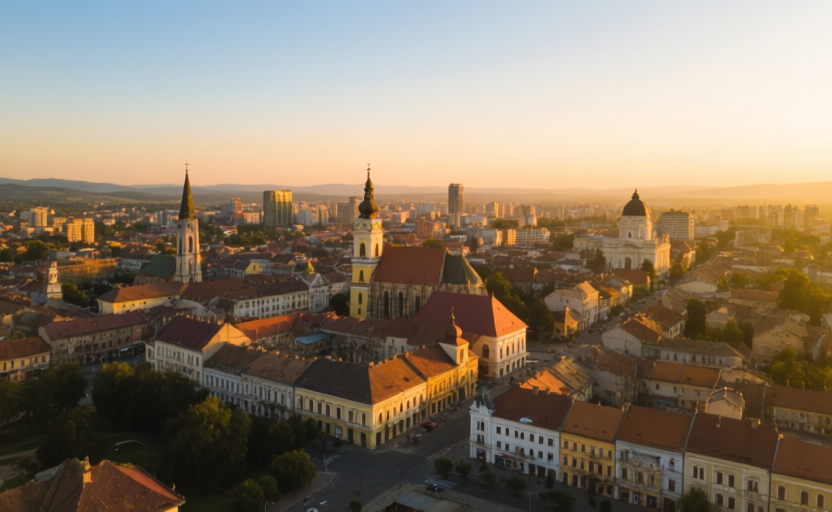
Romania · Europe
Moving to Cluj-Napoca
Cluj-Napoca quick facts
Romania at a glance
Europe & Central Asia

Economy
World BankReligion
% of populationRomania Census 2021 (shares of those who declared a religion)
Cost of living in Cluj-Napoca
Can you move to Romania?
Pick your passport to see whether you can enter Romania — and what it takes to stay.
Entry rules come from github.com/imorte/passport-index-data, updated 17 February 2026. They change without notice — confirm with the official immigration service before booking.
Getting set up in Romania
The aviz, the visa, the permit — and a single IGI office for the whole county
The Romanian sequence is fixed and cannot be reordered: your employer obtains an employment approval (aviz de angajare) from IGI against the annual national quota, you apply for a D-series long-stay visa at a Romanian mission abroad, you travel, and you apply to IGI Cluj for the residence permit within the visa's 90 days. The 2026 quota is 90,000 non-EU work permits, down from 100,000 in 2025. Cluj's advantage over Bucharest is that its IGI office serves a county rather than a capital, so appointment pressure is lower — but it is also a single office, so a bad week is a bad week.
Read the full step-by-step guideExchanging a licence, the rovinietă, and a city being dug up for a metro
EU and EEA licences are valid and exchangeable without a test. Some third countries have reciprocal arrangements permitting exchange, in several cases after a theory examination; everything else means the full Romanian test, in Romanian. Owning a car brings the rovinietă road charge, compulsory RCA insurance, the ITP roadworthiness inspection and a local vehicle tax — paid, refreshingly, to a single city hall rather than to one of six sectors. What makes Cluj harder than its size suggests is metro construction along the western corridor and a valley road network with limited alternatives.
Read the full step-by-step guideOpening a Romanian account in a city that prices its rent in euro
Romanian retail banking is app-first, cheap and near-universally accepted, and Cluj's concentration of international employers means bank branches here handle foreign customers routinely. The gate is the CNP, which arrives with the residence permit; before that, several banks will open a restricted non-resident account on a passport. Rents are quoted in euro and settled in lei, so a euro sub-account is standard rather than optional.
Read the full step-by-step guideCNAS, the family doctor, and a city that is Romania's second clinical centre
If you are employed in Romania, 10% of gross salary goes to health insurance and you are in the state system automatically, with a registered family doctor as the gateway to everything else. Cluj is unusual within Romania: the Iuliu Hațieganu medical university and the county emergency hospital make it the country's second clinical centre after Bucharest, so the public system here is genuinely strong at the specialist end. Most professionals still hold an employer-provided private subscription for routine outpatient care.
Read the full step-by-step guideSIM cards, and the fibre that is the reason the tech sector is here
Romania has among the fastest and cheapest fixed broadband in the world, and Cluj is thoroughly fibred — gigabit connections in ordinary blocks at prices Western Europeans disbelieve. This is not incidental to the city's tech economy; it is part of why the sector took root here. Mobile is similarly cheap. The sequence is a prepaid SIM on day one, a postpaid plan once the residence permit and bank account exist, and a fibre installation that in most blocks is a matter of days.
Read the full step-by-step guideThe IT exemption that built this city, and what replaced it
Romania levies a flat 10% personal income tax on a base already reduced by employee social contributions of 25% for pensions and 10% for health — so the combined bite on gross is around 45%. Employees rarely file; the employer withholds and reports. The defining local fact is that the IT salary exemption, which was central to Cluj's growth as a tech city, was repealed with effect from 1 January 2025 and the microenterprise regime that many contractors used has been narrowed twice since.
Read the full step-by-step guideEach guide has verified costs, timelines, required documents, and the non-obvious gotchas — sourced from official government pages. Last verified August 2026.
Essential Romanian phrases
Reading a list isn’t learning it. Globe Quest turns these into a trainer — hear each phrase spoken, drill them with spaced repetition, and get scored as you say them out loud.
What to know before you go
Cluj has no sectors, and that is a genuine simplification over Bucharest
ImportantBucharest is six sectors with six mayors, six local tax offices and six sets of counters, and a document issued by one will not be processed by another. Cluj-Napoca is a single municipality with a single city hall and a single local tax administration. Property tax, vehicle declarations, parking permits and local certificates all go to one place. If you have read Bucharest advice about establishing your sector before doing anything, none of it applies here — and the administrative overhead of living in Cluj is meaningfully lower as a result.
Housing here is the most expensive in Romania and the reason is supply, not demand alone
CriticalCluj held the highest average price per square metre in the country for years — around €3,200 per square metre in early 2026 — and while Bucharest has recently overtaken it on new-build asking prices, Cluj remains extraordinarily expensive relative to the city's size and to Romanian incomes. The reason is geography as much as tech money: the city sits in a valley ringed by hills and protected forest, and the buildable area is genuinely constrained. New supply has largely gone to Florești and the outer communes, which is why the metro is being built toward them.
Romania's IT income tax exemption — the thing that built Cluj — was repealed from January 2025
CriticalFor roughly two decades, employees doing software development work in Romania paid no personal income tax on that salary. It is a large part of why Cluj became a tech city rather than a university town. The exemption was narrowed in 2023 and 2024 and removed entirely with effect from 1 January 2025. Engineers now pay the ordinary flat 10% on the post-contribution base like everyone else. Any Cluj salary calculator, recruiter spreadsheet or relocation article showing an IT net figure without income tax is describing the pre-2025 world, and the real net is lower.
September is a different city, and so is the first week of August
CriticalCluj hosts roughly 100,000 students across Babeș-Bolyai, the Technical University and the medical university, in a city of under 300,000. In September they all arrive at once and the studio and one-bedroom market clears in days at prices set by the peak. In the first week of August, Untold takes over the Cluj Arena and the centre, accommodation prices multiply and the city becomes genuinely impassable. Both are predictable and both are the wrong weeks to be looking for a flat or trying to complete an administrative errand.
The metro is being built and the timelines have moved
ImportantCluj is building Romania's second metro — a 21-kilometre driverless line with 19 stations, running from Florești through the city. Tunnelling began in 2025 and the first phase of around seven stations was targeted for 2026, with full completion projected toward the early 2030s. Romanian infrastructure timelines slip, and this one has already. What it means practically is that Florești and the western corridor are being priced today on an expectation of connectivity that does not yet exist, and that construction disruption along the route is a live housing consideration.
This is a genuinely bilingual city and it is not a museum piece
Good to knowAround a sixth of Cluj's population is Hungarian, street signage in the centre is bilingual, and Babeș-Bolyai University teaches in Romanian, Hungarian and German as a matter of institutional structure rather than as an accommodation. Hungarian-language schooling runs from kindergarten to doctorate. For a newcomer this mostly registers as a second set of names for everything and a noticeably more Central European feel than Bucharest — but if you have Hungarian, it opens a whole parallel social and professional layer that does not exist elsewhere in Romania.
Top industries & employers
Software & IT services
Yardi Romania, Bosch Engineering Center, Accesa, Fortech, Arobs, Endava, NTT Data, Emerson
Cluj has one of the highest concentrations of IT employment per head in central Europe, and Arobs — headquartered here — is one of the few Romanian technology companies listed on the Bucharest exchange.
Automotive & industrial engineering
Bosch, Emerson, De'Longhi, Ursus Breweries, Terapia
The Bosch engineering centre and the Jucu industrial park east of the city anchor a manufacturing and R&D base that predates the software boom and still employs heavily.
Higher education
Babeș-Bolyai University, Technical University of Cluj-Napoca, Iuliu Hațieganu Medical University, USAMV
Babeș-Bolyai is the largest university in Romania and teaches in Romanian, Hungarian and German; the medical university runs large English and French-language cohorts that bring students from across Europe and the Middle East.
Medical & pharmaceuticals
Terapia (Sun Pharma), Regina Maria, Medlife, Cluj county emergency hospital
Terapia has manufactured in Cluj since 1921 and is one of Romania's largest generic producers; the city's medical university makes it the country's second clinical centre after Bucharest.
Creative & events
Untold, Electric Castle, Transilvania International Film Festival
Cluj built a genuine events economy — TIFF has run since 2002 and Untold draws hundreds of thousands each August, which is a substantial share of the city's summer economy.
Business services
Genpact, Wipro, Office Depot, Steelcase, Betfair Romania
Cluj competes with Bucharest and Timișoara for shared-service work, generally winning on engineering talent and losing on scale and on flight connections.
Where to go in Cluj-Napoca
Piața Unirii & St Michael's Church
Landmark · Central
The main square, dominated by a fourteenth-century Gothic church and the equestrian statue of Matthias Corvinus, who was born a few streets away.
Local tip: Matthias Corvinus was king of Hungary and was born in Cluj in 1443; his birth house survives on Strada Matei Corvin and is largely ignored. The square's bilingual plaques are the quickest introduction to how this city thinks about its own history.
Cetățuia hill
Nature · North of the centre, across the Someș
The fortress hill above the river, with the best view over the old town and the Someș valley.
Local tip: Fifteen minutes up the steps from the river and almost entirely locals. Go at sunset. The Habsburg fortress at the top is mostly gone but the terrace and the walk are the point.
Central Park & Chios casino
Nature · Central, along the Someș
The city's main park, with a lake, the restored nineteenth-century casino building and the Cluj Arena at its western end.
Local tip: The park is where the whole city goes on a summer evening. The Someș riverside redevelopment is gradually extending the walkable riverbank west from here, and the finished stretches are already the best public space in the city.
Central Market & Piața Mihai Viteazu
Food · Central, north of Piața Unirii
The main produce market, with Transylvanian cheeses, smoked meats and the surrounding streets of small food shops.
Local tip: The dairy stalls at the back sell Transylvanian sheep cheeses that do not travel and are not sold in supermarkets. Go before ten on a Saturday. Cash is still easier here than card.
Botanical Garden
Nature · South of the centre
A fourteen-hectare garden laid out in 1920, with a Japanese garden, a Roman section and greenhouses, in the middle of the city.
Local tip: It belongs to the university and is one of the largest botanical gardens in south-eastern Europe. Almost no visitors to Cluj find it despite it being fifteen minutes from Piața Unirii, and the Japanese garden in autumn is the best hour in the city.
Hoia-Baciu forest
Hidden gemNature · North-west edge of the city
A forest on the city's edge, internationally known for a circular clearing where nothing grows and for a stand of inexplicably crooked trees.
Local tip: It has an entire paranormal tourism industry attached to it, which is nonsense, and it is also a genuinely strange and beautiful piece of woodland fifteen minutes from the centre with marked trails and a mountain-bike network. Go for the trees, ignore the ghost tours, and be back before dark because the trails are unlit.
Emergency numbers in Cluj-Napoca
Compare Cluj-Napoca with…
Side-by-side cost of living, language, climate and careers — to help you choose.