Croatia · Europe
Moving to Zagreb
Zagreb quick facts
Croatia at a glance
Europe & Central Asia
Economy
World BankReligion
% of populationCroatia Census 2021
Cost of living in Zagreb
Can you move to Croatia?
Pick your passport to see whether you can enter Croatia — and what it takes to stay.
Entry rules come from github.com/imorte/passport-index-data, updated 17 February 2026. They change without notice — confirm with the official immigration service before booking.
Getting set up in Croatia
The OIB, the three-day registration, and the June 2026 rewrite
Croatia's mainstream route is the combined residence and work permit, granted after a labour market test and a positive Croatian Employment Service opinion unless the role is on the shortage list. Two things gate everything else: the OIB personal identification number, without which you cannot rent, bank or be employed, and address registration with the police within three days of entry. Substantial Aliens Act amendments came into force on 4 June 2026 and changed permit geography, employer mobility, processing times and renewal requirements.
Read the full step-by-step guideExchanging a licence, the coastal motorway toll, and a tram city
EU and EEA licences are valid and exchangeable without a test. Licences from countries with which Croatia has a reciprocal arrangement can generally be exchanged, in some cases after a test; others require the full Croatian examination. Croatian motorways are tolled per journey rather than by vignette, which matters because the coast is a three-hour drive and the summer traffic on that route is the country's defining road problem. Zagreb itself runs on trams and a car is optional in the central districts.
Read the full step-by-step guideOpening a Croatian account, and the OIB that comes first
Croatian retail banking is straightforward and Croatia has been in the euro area since 2023, so there is no currency question and cross-border euro transfers are SEPA payments. The prerequisite is the OIB — the personal identification number — which banks require from foreign customers alongside a passport and residence documentation. Card acceptance is close to universal in Zagreb; cash remains more common on the coast and in small businesses.
Read the full step-by-step guideHZZO, the chosen doctor, and supplementary insurance that most people buy
Employment in Croatia brings compulsory health insurance through HZZO and entitlement to treatment through a chosen general practitioner. The distinctive Croatian feature is the participation charge: basic HZZO cover leaves the patient paying a percentage of many treatment costs, which is why the great majority of residents also buy supplementary insurance (dopunsko osiguranje) to cover it. That supplementary policy is cheap and is close to universal — treating it as optional is the most common newcomer mistake here.
Read the full step-by-step guideSIM cards, home internet, and a building that may be under scaffolding
Croatia has three mobile operators — Hrvatski Telekom, A1 and Telemach — and prices sit around the European middle. Prepaid SIMs are easy; postpaid wants the OIB, a residence permit and usually a Croatian bank account. Fixed broadband in Zagreb is generally good, with fibre widespread in the newer districts. The Zagreb-specific complication is that a building under post-earthquake reconstruction may have works affecting installation, and in some cases the renovation itself disrupts service.
Read the full step-by-step guideThe city that sets its own rate, and the nomad exemption underneath it
Croatia abolished the municipal surtax from 1 January 2024 and instead let each local authority set its own personal income tax rates within a national band. Zagreb applies the maximum — 23% on the lower band and 33% on the upper. Pension contributions come out of gross before the tax base is calculated and a personal allowance applies. The distinctive feature of the Croatian system is Article 9 of the Personal Income Tax Act, which exempts a digital nomad permit holder's foreign employment income entirely.
Read the full step-by-step guideEach guide has verified costs, timelines, required documents, and the non-obvious gotchas — sourced from official government pages. Last verified August 2026.
Essential Croatian phrases
Reading a list isn’t learning it. Globe Quest turns these into a trainer — hear each phrase spoken, drill them with spaced repetition, and get scored as you say them out loud.
What to know before you go
Check the building's post-earthquake status before you rent
CriticalThe 22 March 2020 earthquake damaged tens of thousands of buildings in Zagreb, concentrated in the historic centre where the stock is unreinforced masonry. Every affected building was inspected and given a coloured sticker — green for usable, yellow for restricted use, red for unusable. Reconstruction has been running since and the government's stated target is completing all works by 2030, with thousands of locations finished and hundreds still under way. In practice that means scaffolding, netting, ongoing works and the possibility of a building being emptied for renovation mid-tenancy. Ask what the sticker says, whether the building is in the reconstruction programme, and what the timetable is.
Zagreb sets its own income tax rates, and it sets them at the top
CriticalCroatia abolished the municipal surtax (prirez) from 1 January 2024 and instead let each local authority set its own personal income tax rates within a nationally prescribed band. The effect is that the rate genuinely varies by where you live: Zagreb applies 23% and 33%, at the top of the permitted range, while smaller municipalities can go as low as 15% and 25%. Someone living just outside the city boundary and commuting in can pay a materially lower rate on the same salary. This is not a rounding difference and it is not widely explained to newcomers.
Register your address within three days of arriving
CriticalCroatian law requires foreign nationals to register their address with the police within three days of entering the country, and again whenever they move. Hotels and registered accommodation do it automatically. In a private flat it falls to you and your landlord, and it needs the lease and the owner's property documentation. It is a short procedure and a real obligation, and it is one of the prerequisites for everything that follows.
The Aliens Act changed substantially in June 2026 — including a language exam at renewal
CriticalAmendments published in the Official Gazette on 27 May 2026 came into force on 4 June 2026. Work permits granted on a labour market test are now valid only in the administrative zone where the test was conducted. Workers may change employer after six months rather than restarting the process. There are grace periods after job loss — three months for shorter-tenure holders, six for longer. Standard processing lengthened to 90 days. And renewals after a year of residence now require a Croatian language certificate at A1.1. That last one is new, has a booking queue, and arrives exactly when your permit is expiring.
The euro arrived in 2023 and the price adjustment was real
ImportantCroatia adopted the euro on 1 January 2023 at 7.53450 kuna to the euro, alongside joining Schengen on the same day. The government ran a dual-display period and named companies that rounded up, but Croatian inflation ran ahead of the euro-area average through 2023 and consumer perception of a step change in prices was widespread and largely justified. Six years on, Zagreb is no longer meaningfully cheaper than the cheaper parts of the euro area — the days of it being a bargain relative to Vienna have narrowed considerably.
The nomad permit's tax exemption is real, narrow, and not available to employees
ImportantArticle 9 of the Croatian Personal Income Tax Act excludes from Croatian income tax the receipts of a person with digital nomad status earned from dependent or independent work for an employer not registered in Croatia. That exemption holds even past 183 days, which is unusual and genuinely valuable. But it applies only to holders of that specific status, only to earned income from the foreign employer, and not to passive income or to anyone on an ordinary work permit. If you take a Zagreb job, you pay Zagreb's 23% and 33% like everyone else.
Top industries & employers
Software & IT
Infobip, Rimac Technology, Photomath, Verne, Span, King ICT, Five
Infobip became Croatia's first technology unicorn and Rimac's electric hypercar and component business, based just outside Zagreb, is the country's most internationally visible engineering story.
Pharmaceuticals
Pliva (Teva), Belupo, JGL, Genera
Pliva discovered azithromycin in Zagreb in the 1980s — one of the most commercially successful antibiotics ever developed, and the reason the city has a serious pharmaceutical research base.
Banking & finance
Zagrebačka banka (UniCredit), PBZ (Intesa), Erste, OTP, Croatian National Bank
The Croatian National Bank and the Zagreb Stock Exchange are both here, and the sector went through a full euro conversion in 2023 that reshaped its systems and products.
Tourism services & hospitality tech
Adriatic hospitality groups, Valamar, Plava Laguna head offices
Croatia's tourism economy is on the coast but its head offices, booking platforms and seasonal recruitment operations are in Zagreb, which is why the seasonal labour market is run from here.
Engineering & manufacturing
Končar, AD Plastik, Rimac, Kraš
Končar has built electrical equipment, trams and rail vehicles in Zagreb since 1921 and still supplies the city's own tram fleet.
Higher education & research
University of Zagreb, Ruđer Bošković Institute, Faculty of Electrical Engineering and Computing
The University of Zagreb dates from 1669 and the FER engineering faculty supplies most of the country's software workforce; the Ruđer Bošković Institute is the largest research institute in Croatia.
Where to go in Zagreb
Gornji Grad & Kaptol
Landmark · Upper Town, central
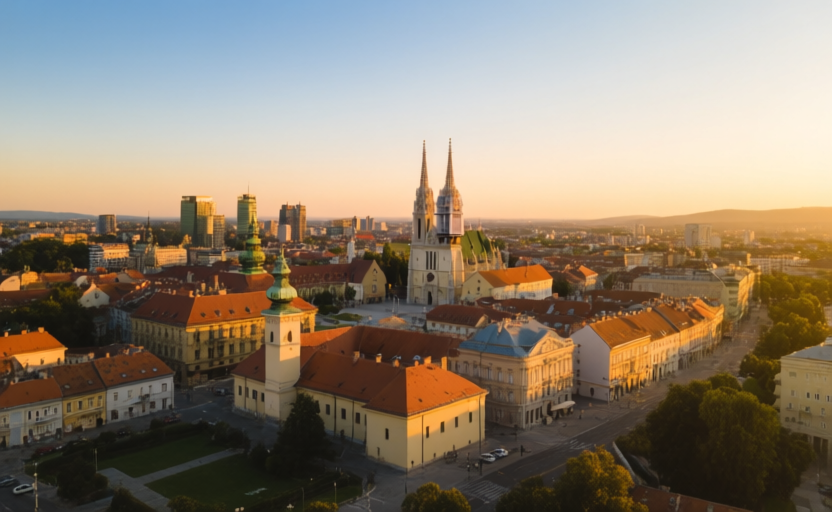
The mediaeval hilltop core — St Mark's tiled roof, the cathedral, the funicular and the noon cannon from the Lotrščak tower.
Local tip: The cathedral's spires came down in the 2020 earthquake and its reconstruction is the most visible ongoing project in the city. The Grič cannon has been fired at noon every day since 1877, and the crowd for it is a fraction of what it should be.
Tkalčićeva & the špica
Nightlife · Between the Upper and Lower Towns
The pedestrian street of bars and terraces running along a filled-in stream bed, and the centre of Zagreb's Saturday coffee ritual.
Local tip: Špica is a genuine institution: Saturday mid-morning, everyone dresses up, occupies a terrace and stays for two hours. Doing it wrong means arriving at eleven and leaving at half past. Sit down properly.
Dolac market
Food · Directly above Ban Jelačić square
The red-umbrella open market on a terrace above the main square, with a covered hall of butchers and fishmongers below it.
Local tip: The upper terrace is produce and the covered level below is meat, fish and dairy — most visitors never find the lower hall. Go before ten; by noon the good stalls are packing up.
Maksimir Park
Nature · East of the centre
A large English-style landscape park from 1794, with lakes, meadows, woodland and the city zoo inside it.
Local tip: It was one of the first public parks in this part of Europe, laid out before most Western capitals had theirs. The eastern half beyond the lakes is proper woodland and is empty on a weekday morning.
Sljeme & Medvednica
Nature · North of the city, on the mountain
The 1,033-metre peak above Zagreb, with a cable car, ski runs in winter and marked hiking trails the rest of the year.
Local tip: The cable car cuts the climb dramatically, but the classic approach is on foot from Šestine and takes about two hours through beech forest. The mediaeval Medvedgrad fortress halfway up has the best view of the city and almost no visitors.
The Museum of Broken Relationships
Hidden gemCulture · Upper Town
A museum of objects donated by people after a relationship ended, each with the donor's own account of what it meant.
Local tip: It started as a travelling art project by two Zagreb artists and won a European museum award. It sounds like a gimmick and is in fact the most affecting hour available in the city — a genuinely original idea that Zagreb exported to the world rather than imported.
Emergency numbers in Zagreb
Compare Zagreb with…
Side-by-side cost of living, language, climate and careers — to help you choose.