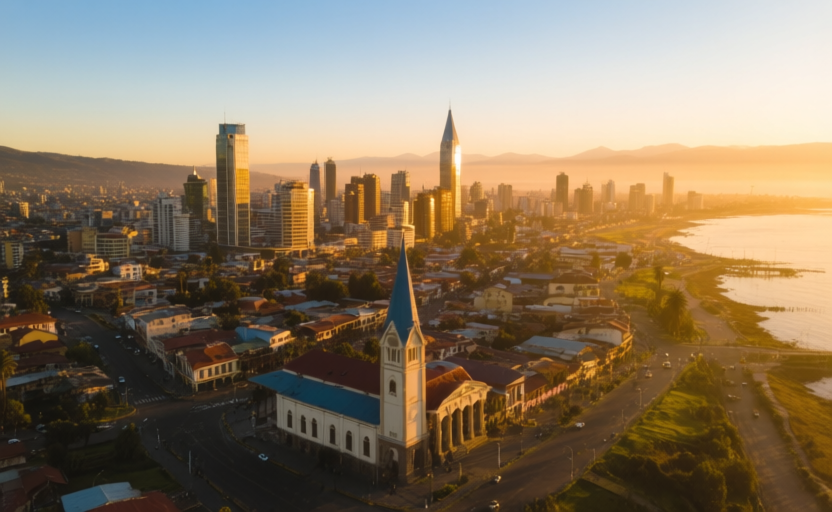
Chile · Latin America
Moving to Valparaiso
Valparaiso quick facts
Chile at a glance
Latin America & Caribbean

Economy
World Bank · 2025Religion
% of populationCIA World Factbook / national censuses
Cost of living in Valparaiso
Can you move to Chile?
Pick your passport to see whether you can enter Chile — and what it takes to stay.
Entry rules come from github.com/imorte/passport-index-data, updated 17 February 2026. They change without notice — confirm with the official immigration service before booking.
Getting set up in Chile
Residencia Temporal from abroad, the provisional RUT, and the cédula
Since Ley 21.325 you apply for temporary residence from outside Chile through SERMIG's online portal, and arriving as a tourist to convert in-country is closed to new arrivals bar narrow exceptions. Once granted, you enter as a resident, register with the Policía de Investigaciones and apply for your cédula at the Registro Civil. The provisional RUT from the SII is what lets you actually function while the cédula is in process, and getting it early is the single highest-value errand available.
Read the full step-by-step guideA municipal licence, four exams, and a city that punishes clutches
Chile has straight exchange agreements with only six countries — Spain, South Korea, Peru, Ecuador, Argentina and Paraguay. From anywhere else you sit medical, psychotechnical, theory and practical exams, all four, all in Spanish. The exams and the fee are set by your comuna. Beyond that, Valparaíso is a city where the gradients, the one-way stair-like streets and the parking make owning a car a genuine question rather than a default.
Read the full step-by-step guideCuentaRUT, the cédula requirement, and getting paid from abroad
Chilean banks are reluctant to open accounts for recent arrivals, and several effectively want a couple of years of residency plus income history. BancoEstado's CuentaRUT is the pressure valve: a cuenta vista opened on a valid cédula alone, no income test and no credit history. The trade is hard caps on balance and monthly deposits, which bite quickly on a professional salary.
Read the full step-by-step guideFONASA, ISAPRE, the 7%, and where a hillside city sends the ambulance
Every formal worker in Chile contributes 7% of taxable monthly income to either FONASA, the public insurer, or an ISAPRE, one of the private ones. It is compulsory, so the choice is where the money goes rather than whether to pay. You cannot join either without residency, and FONASA then applies affiliation and contribution thresholds, so international insurance is the standard bridge. In Valparaíso the practical extra is that a lot of private capacity sits in Viña del Mar rather than in the city itself.
Read the full step-by-step guideA Chilean number, SAE emergency alerts, and coverage on a hillside
Prepaid SIMs are cheap and available everywhere, and Chilean law requires them to be registered to an identity document. Postpaid needs a RUT, a Chilean bank account and usually a credit check, which is another reason to get the provisional RUT early. Two Valparaíso-specific points: coverage varies noticeably between the plan and the deep cerros and quebradas, and you want the SAE emergency alert system working on your handset from day one.
Read the full step-by-step guideThe three-year clock that starts at the border, and the extension nobody mentions
Chile gives new residents three years of being taxed only on Chilean-source income, and article 3 of the income tax law counts those three years from your entry into Chile rather than from the day you became tax resident. Residency itself is more than 183 days in any rolling twelve months. The extension beyond three years exists but is discretionary, must be applied for before the initial window closes, and nobody sends a reminder.
Read the full step-by-step guideEach guide has verified costs, timelines, required documents, and the non-obvious gotchas — sourced from official government pages. Last verified August 2026.
Essential Spanish phrases
Reading a list isn’t learning it. Globe Quest turns these into a trainer — hear each phrase spoken, drill them with spaced repetition, and get scored as you say them out loud.
What to know before you go
Where you live is a risk decision here in a way it is not in Santiago
CriticalValparaíso's flat commercial plan sits inside the tsunami inundation zone; the reference line for evacuation is broadly the 30-metre contour, and below it the instruction is to go uphill on foot. Higher up, the exposure inverts: the upper hills and the informal settlements at their edges are where the 2014 fire killed fifteen people and destroyed thousands of homes, because steep slopes and ravines act as chimneys and the access roads are too narrow for engines. There is no part of the city with no exposure, and the right response is not to be frightened but to know which of the two applies to your street, where your evacuation route runs, and whether the quebrada near you is clear. Ask the seller or landlord directly — porteños answer this question as a matter of course.
You must apply for residency from outside Chile, and this has been true since 2021
CriticalUnder Ley 21.325, temporary residence applications are lodged from abroad through SERMIG's Portal de Trámites Digitales. Arriving as a tourist and converting in-country is closed to new arrivals, surviving only for people who entered before 12 February 2022, for narrow family-tie subcategories where you are related to a Chilean or a permanent resident, and on humanitarian grounds. Valparaíso's cheapness and its student population make it a place people drift into on a tourist stamp and then try to regularise. Unless one of those exceptions describes you, that path no longer exists, and a great deal of advice online still describes the abolished process.
Three tax-free years on foreign income — counted from when you first entered Chile
CriticalArticle 3 of the income tax law taxes new residents only on Chilean-source income for three years 'desde su ingreso a Chile'. That clock starts at your first entry, not at the day you became tax resident, so a scouting trip or a few tourist months have already been spending it. It can be extended, but only by application to the SII's Director Regional in qualified cases — six years is what practice commonly reaches, not what the statute promises — and it cannot be applied for retrospectively. Work out the real deadline from your first entry stamp and put a reminder in year two.
Congress sits here, not in Santiago, and it shapes the city's rhythm
ImportantBoth chambers of Chile's National Congress have met in Valparaíso since 1990. The building is a vast concrete block at the edge of the plan, and the consequence for a resident is a weekly tide: legislators, staff, journalists and lobbyists arrive for the sitting week and the city's hotels, restaurants and traffic respond. It also means a professional layer — parliamentary staff, policy people, press — that a port city of this size would not otherwise have, and it is a real source of work for anyone with a public-affairs or research background.
Rents are a fraction of Santiago's, and so are the salaries
ImportantA one-bedroom flat here commonly runs well below the equivalent in Providencia or Ñuñoa, and the gap is genuine rather than a quality trade. The catch is the local job market: the formal economy is port, public administration, four universities and tourism, and professional salaries are lower than the capital's. Valparaíso works extremely well for someone paid from elsewhere — remote workers, academics on national contracts, people commuting to Santiago a couple of days a week — and less well for someone job-hunting locally. Be honest about which you are.
The funiculars are national monuments, and most of them are not running
Good to knowSixteen ascensores were declared national historic monuments in 1998. In 2026 roughly seven were carrying passengers, with others closed for heritage restoration on timelines that slip. They are cheap, charming and genuinely useful where they work — but do not choose a flat on the assumption that the ascensor at the bottom of your street will be operating, because the list of which ones run changes from year to year. Check the current status, and walk the stairs once before you sign.
Top industries & employers
Port & logistics
Terminal Pacífico Sur, Puerto Valparaíso (EPV), shipping agencies and customs brokers
One of Chile's two main container ports and the historic reason the city exists. The Servicio Nacional de Aduanas is headquartered here too, which concentrates customs and trade-compliance work in Valparaíso rather than in the capital.
Government & the legislature
Congreso Nacional, the Valparaíso regional government, Armada de Chile headquarters
Both chambers of Congress have sat here since 1990 and the Chilean Navy is headquartered in the city. Between them they support a substantial professional layer of staff, analysts, journalists and public-affairs people.
Higher education & research
Pontificia Universidad Católica de Valparaíso, Universidad de Valparaíso, Universidad Técnica Federico Santa María, Universidad de Playa Ancha
Four universities in one small city, with UTFSM in particular a serious engineering school. Students are a large share of the population and a large share of the rental demand, which is why the academic calendar moves the housing market here.
Tourism & heritage
Boutique hotels across Cerro Alegre and Concepción, tour operators, the cruise terminal
The UNESCO listing in 2003 turned the hills above the port into a hospitality economy. It is also the source of the city's central tension between heritage protection and the cost of actually maintaining the buildings.
Creative & cultural
Independent galleries, muralists, theatre companies, the Parque Cultural de Valparaíso
Valparaíso has a genuine and long-standing bohemian economy rather than a marketed one — the murals are not a tourism project, and the cultural centre occupies a former prison on Cerro Cárcel.
Wine & agriculture in the interior
Casablanca Valley wineries, Aconcagua Valley producers
Half an hour inland the Casablanca Valley is Chile's cool-climate white wine region, and the Aconcagua beyond it is serious red country — a meaningful employer in viticulture, oenology and export logistics through the port itself.
Where to go in Valparaiso
Cerro Alegre & Cerro Concepción
Neighborhood · Above the plan, reached by the El Peral and Reina Victoria ascensores
The UNESCO core — painted houses, corrugated iron facades, mural-covered stairways and the paseos looking out over the bay.
Local tip: Paseo Gervasoni and Paseo Atkinson are the postcard views and they are busy. Walk the connecting stairways instead — Pasaje Bavestrello and the alleys off Templeman — where the murals are better and the crowds thin out completely within one block.
Congreso Nacional
Landmark · Edge of the plan, near Avenida Pedro Montt
The seat of both chambers of Chile's legislature since 1990 — a monumental concrete building that everyone in the city has an opinion about.
Local tip: Public galleries and guided visits let you watch sessions when the chambers are sitting, and the sitting weeks are published. It is genuinely worth doing once, and it is the fastest way to understand why this city has a professional class it would not otherwise have.
Ascensor Artillería & Paseo 21 de Mayo
Landmark · Cerro Artillería, west end of the plan
An 1893 funicular climbing to a promenade above the naval school with the definitive view down onto the port and the container terminal.
Local tip: The ascensor has spent long stretches closed for heritage restoration, so check before relying on it — the stairs are there and they are not that bad. Go late afternoon when the sun is on the cranes, and eat at the small seafood places along the paseo rather than in the plan.
Mercado Cardonal
Food · Plan, near Avenida Argentina
The working produce and fish market that actually feeds the city, over two floors and spilling into the streets around it.
Local tip: The upstairs cocinerías are where you eat, not the restaurants aimed at visitors down in the plan — plates are large, cheap and excellent. Saturday is the big day, when the Avenida Argentina feria fills the central reservation with produce for several blocks.
La Sebastiana
Culture · Cerro Bellavista
Pablo Neruda's Valparaíso house, built into the hillside over five narrow floors, kept as he left it and full of his collections.
Local tip: The best of Neruda's three houses and the least crowded. Go on a weekday morning, take the audio guide, and afterwards walk down through the Museo a Cielo Abierto — the open-air mural route on the same hill, which is free and mostly empty.
Playa Ancha and the Laguna Verde road
Hidden gemNature · West of the city, beyond Cerro Playa Ancha
The coastal road running south out of the city past cliffs, wild beaches and eucalyptus, ending at a fishing cove.
Local tip: Almost every visitor goes north to Viña and Reñaca. Going south instead gets you an empty coastline within twenty minutes of the plan — Laguna Verde is a small fishing village with a beach, and the road there is one of the best short drives or cycle routes in central Chile.
Emergency numbers in Valparaiso
Compare Valparaiso with…
Side-by-side cost of living, language, climate and careers — to help you choose.