Netherlands · Europe
Moving to The Hague
The Hague quick facts
Netherlands at a glance
Europe & Central Asia
Economy
World Bank · 2025Religion
% of populationCIA World Factbook / national censuses
Cost of living in The Hague
Can you move to Netherlands?
Pick your passport to see whether you can enter Netherlands — and what it takes to stay.
Entry rules come from github.com/imorte/passport-index-data, updated 17 February 2026. They change without notice — confirm with the official immigration service before booking.
Getting set up in Netherlands
Two parallel routes: the ordinary residence permit, and privileged status
For ordinary movers the chain is the same as anywhere in the Netherlands: an IND residence permit for non-EU nationals, usually the employer-filed kennismigrant permit, then registration in the Basisregistratie Personen which produces the BSN that unlocks salary, banking, insurance and DigiD. The Hague concentrates all of this at The Hague International Centre, which hosts both the municipal desk and an IND desk. Alongside it runs an entirely separate track: privileged persons receive an MFA identity card in place of a residence permit and a BSN issued by the ministry, and are not subject to the IND at all.
Read the full step-by-step guideThe 185-day driving window, diplomatic plates, and two different low-emission zones
For ordinary residents the clock starts at BRP registration: a non-EU/EEA licence lets you drive here for 185 days from that date, and after it you may not drive until the Dutch licence is actually issued. EU and EEA licences are not on that clock and stay valid much longer. Non-EU licences swap without a test only from a designated country, often for car category B alone. Holders of the 30% ruling, with their partner and adult children at the same address, may exchange any valid licence with no test. Privileged staff run a separate route through the ministry, including CD and BN registration plates. Locally there are two distinct zones: a milieuzone in the city centre that bars older diesel cars, and a zero-emission zone for vans and lorries that was extended to the coastal districts on 1 January 2026.
Read the full step-by-step guideA Dutch IBAN, the BSN chain, and a country that quietly stopped taking cash
Dutch banks must hold your BSN, which normally comes from municipal registration, so the account and the registration are chained. The standard workaround is a Dutch-IBAN fintech opened before you land, with the BSN added within the grace period. Privileged staff have a valid BSN from day one but one that is not listed in the municipal register, which some automated onboarding flows reject — a branch or expat desk usually solves it. Whatever bank you end up with, the real adjustment is cultural: this is a debit and iDEAL country and a foreign credit card is not a payment method.
Read the full step-by-step guideCompulsory private insurance — unless you are one of the people who must not buy it
The Dutch model surprises almost everyone: no employer plan, no free service at the point of need, and a legal obligation on you personally to buy cover within four months of becoming insurable. The policy backdates to that date, so buying late means paying for months of cover you never had. The basic package is set by law and identical at every insurer. A €385 own-risk excess sits on top for 2026. The Hague exception is large and genuinely confusing: privileged staff are generally not insurable under the Dutch scheme at all, must not buy a basisverzekering, and are not entitled to zorgtoeslag.
Read the full step-by-step guideMobile and broadband: instant prepaid, and the pre-war streets fibre never reached
There is no SIM-registration regime in the Netherlands, so prepaid is genuinely instant — a supermarket, a phone shop or a station kiosk, cash accepted, working number in minutes. A monthly SIM-only contract is much better value but needs a Dutch IBAN for the direct debit and usually a BSN, so it waits until registration and banking are done. Use an MVNO rather than a flagship store; they resell the same three networks. On broadband, The Hague's conservation areas are the catch: Statenkwartier, Archipelbuurt and Duinoord have listed streetscapes where digging is restricted and coverage is uneven building by building.
Read the full step-by-step guideBoxes 1, 2 and 3, the shrinking expat ruling, and the treaty exemptions that override both
Employees are taxed at source through loonheffing, so the annual return is normally a reconciliation. Income is sorted into boxes: box 1 for salary and your own home, box 2 for substantial shareholdings, box 3 for savings and investments — and box 3 taxes an assumed return rather than a real one. The 30% expat ruling stays at 30% through 2026 and steps down to a flat 27% from 1 January 2027 for rulings granted from 2024 onward. In The Hague there is a third layer: treaty exemptions that remove the organisation's salary from Dutch tax entirely, while leaving other income and other household members exposed.
Read the full step-by-step guideEach guide has verified costs, timelines, required documents, and the non-obvious gotchas — sourced from official government pages. Last verified August 2026.
Essential Dutch phrases
Reading a list isn’t learning it. Globe Quest turns these into a trainer — hear each phrase spoken, drill them with spaced repetition, and get scored as you say them out loud.
What to know before you go
If you work for a mission or a treaty organisation, none of the standard advice applies to you
CriticalStaff of embassies and international organisations in The Hague hold privileged status: no residence permit, an MFA identity card that doubles as your residence document, and a BSN issued by the Ministry of Foreign Affairs rather than the city. Your salary from the organisation is normally exempt from Dutch income tax under the headquarters agreement, you are usually outside Dutch social security, and — critically — you are generally exempt from compulsory Dutch health insurance and are not entitled to zorgtoeslag. Buying a basisverzekering you are not permitted to hold is a common and expensive error.
Book The Hague International Centre before you arrive — the BSN gates everything
CriticalEveryone else registers in the Basisregistratie Personen at The Hague International Centre, which combines the municipal desk with the IND for biometrics and permit collection. Registration is legally due within five days of arrival, but appointments run several weeks out, which is the real constraint. Until the BSN exists you cannot be paid a Dutch salary, buy health insurance, complete a bank account or apply for DigiD. Privileged staff use the same centre to activate their MFA-issued BSN in the BRP, which is worth doing because many local services check the BRP rather than the ministry.
Health insurance is something you buy yourself, and it backdates whether you like it or not
CriticalThere is no employer plan and no free care at the point of need. Within four months of becoming insurable you must buy a basisverzekering from a Dutch insurer, and the policy starts from the date you became insurable, not the date you signed — so a late purchase means paying premiums for months of cover you could not use. On top sits a €385 own-risk excess for 2026 that you fund before the insurer pays for anything except GP visits. The basic package is defined by law and identical everywhere.
Use the state-subsidised international schools before pricing the private ones
ImportantThe Hague has the country's densest cluster of Dutch international schools — state-subsidised international streams attached to Dutch schools, charging roughly €5,000-9,000 a year against €20,000-30,000 at a fully private international school. Eligibility is about mobility and language, not income: broadly, a child holding a non-Dutch passport whose parent is here temporarily, or a family that has lived abroad recently and expects to leave again. Families routinely pay private fees without ever discovering the subsidised route existed, and places fill a year ahead.
Box 3 taxes a return the state assumes you made, not the one you actually made
CriticalDutch income tax sorts income into three boxes: box 1 for salary and your own home, box 2 for substantial shareholdings, box 3 for savings and investments. Box 3 does not look at your real gains. It applies fixed assumed percentages to your assets above a tax-free allowance and taxes the notional result at 36%. Cash savers and investors in a losing year are both taxed on returns they never received. A counter-proof route lets you evidence a lower actual return, and a bill to tax real returns from 2028 — the Wet werkelijk rendement box 3 — passed the Tweede Kamer in February 2026 and is still before the Eerste Kamer.
The seat of government is not the capital, and the city divides along an old geological line
Good to knowParliament, the ministries, the Supreme Court, the Council of State and the King's working palace are all here, while Amsterdam remains the constitutional capital — a split that confuses newcomers and quietly shapes the job market. Locally the more useful division is zand and veen: the sandy dune side to the north-west with the villas, the embassies and the international schools, and the peat side to the south-east that is denser, cheaper and more working-class. The boundary is roughly the Laan van Meerdervoort.
Top industries & employers
Government & public administration
Tweede Kamer, the ministries, Raad van State, Hoge Raad, Belastingdienst
The Hague is the seat of Dutch government though not the capital, and central administration is the single largest employer. Recruitment is largely Dutch-language, which is the practical catch for internationals.
International law, justice & peace institutions
International Court of Justice, International Criminal Court, OPCW, Europol, Eurojust
Around 200 international organisations sit here, most of their staff on privileged status under headquarters agreements rather than on Dutch residence permits — a parallel legal and tax world inside the same city.
Energy & offshore
Shell Nederland, TotalEnergies EP Nederland, EBN, Van Oord offshore wind
The administrative centre of Dutch North Sea oil and gas for decades, now pivoting into offshore wind and hydrogen. Much of the technical work sits offshore or in Rotterdam; the decisions are made here.
Security, cyber & defence
The Hague Security Delta, NCSC, Europol, NATO Communications and Information Agency
The Hague markets itself as the international city of peace and justice, and the security cluster is the commercial side of that — cyber, forensics and investigations built around the institutions.
Insurance & pensions
Aegon, NN Group, Nationale-Nederlanden, a.s.r. operations
Two of the largest Dutch insurers are headquartered here, and the pensions sector gives the city a substantial actuarial and asset-management labour market that is easy to overlook next to the institutions.
Higher education & research
Leiden University Campus The Hague, The Hague University of Applied Sciences, Institute of Social Studies, TNO
Leiden's Hague campus concentrates on governance, security and international relations rather than a full faculty spread, which makes it unusually well plugged into the institutions next door.
Where to go in The Hague
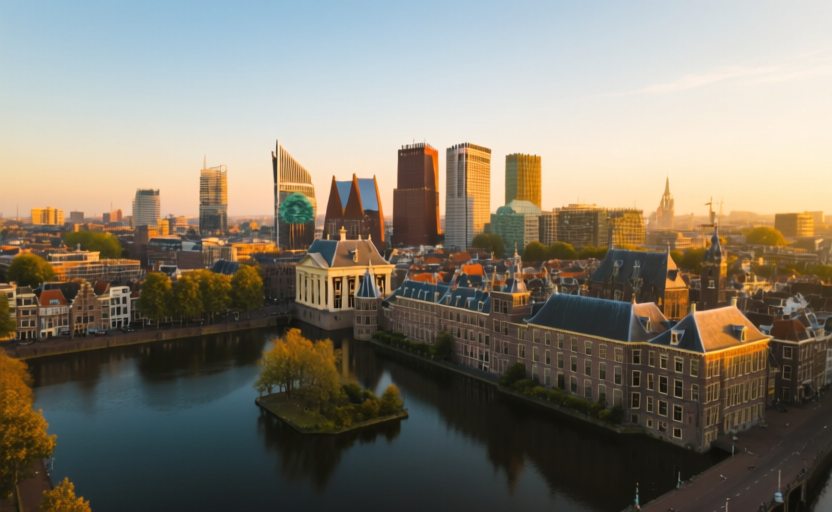
Binnenhof & the Hofvijver
Landmark · Centrum
A thirteenth-century courtyard on a rectangular pond that has housed Dutch government for seven centuries.
Local tip: The complex is closed for a long structural restoration and parliament is sitting elsewhere in the city, so the interior tours are not running. The Hofvijver walk and the view from Lange Vijverberg are unaffected and still the best five minutes in the centre.
Mauritshuis
Culture · Centrum, beside the Hofvijver
A small seventeenth-century palace holding the Girl with a Pearl Earring, the Goldfinch and Rembrandt's anatomy lesson.
Local tip: It is genuinely small — two floors and about 800 works — so it is an hour, not a day, and far less punishing than the Rijksmuseum. Book a timed slot and go late in the afternoon when the tour groups have moved on.
Scheveningen & Westduinpark
Nature · North-west coast
Eleven kilometres of North Sea beach with a pier at one end and protected dune reserve behind it.
Local tip: Scheveningen Bad is the pier, the crowds and the fairground; walk twenty minutes south-west into Westduinpark and Kijkduin and it is dunes, Highland cattle and almost nobody. Winter storms here are a legitimate reason to go to the beach.
Haagse Markt
Food · Transvaal
One of the largest open-air markets in Europe — over 500 stalls, four days a week, in the most multicultural quarter of the city.
Local tip: Go on a Wednesday or Saturday morning for the full thing. Prices are a fraction of the supermarket for fruit, vegetables, fish and fabric, and the Turkish, Surinamese and Moroccan food stalls are the reason locals cross the city for it.
Zeeheldenkwartier & Prins Hendrikstraat
Nightlife · West of the centre
The nineteenth-century quarter where the city actually goes out — independent bars, small restaurants and no tourists.
Local tip: The Grote Markt is where students drink and Zeeheldenkwartier is where everyone else does. Reinkenstraat and Prins Hendrikstraat between them cover most of the good small restaurants in the city.
Panorama Mesdag
Hidden gemCulture · Zeestraat, near the international zone
A 14-metre-high, 120-metre circumference painting of 1881 Scheveningen, viewed from a platform in the middle of it.
Local tip: It is the largest surviving nineteenth-century panorama in the world and it has never been moved from the purpose-built rotunda it was painted in. From an unremarkable door on Zeestraat you walk up a stair and are suddenly standing on a dune. Twenty minutes, and almost nobody who lives here has been.
Emergency numbers in The Hague
Compare The Hague with…
Side-by-side cost of living, language, climate and careers — to help you choose.