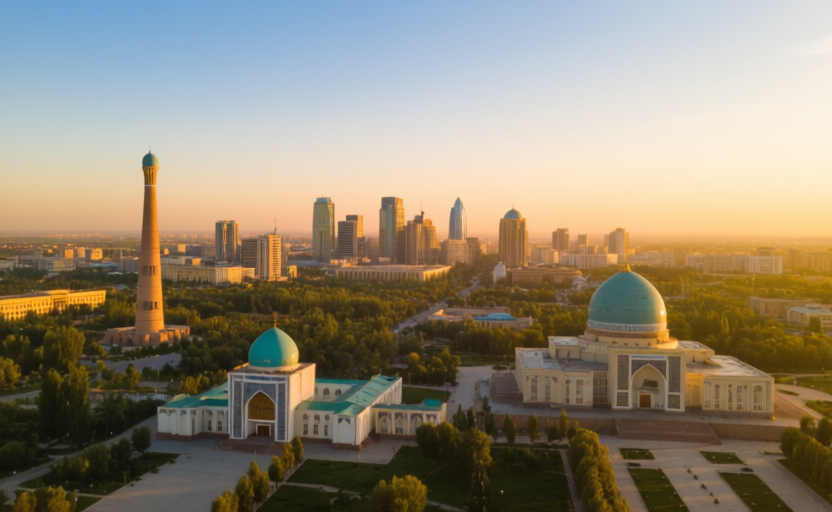
Uzbekistan · Central Asia
Moving to Tashkent
Tashkent quick facts
Uzbekistan at a glance
Europe & Central Asia
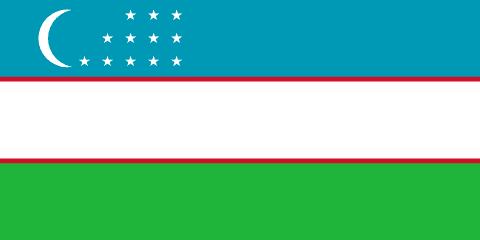
Economy
World BankReligion
% of populationCIA World Factbook / national censuses
Cost of living in Tashkent
Can you move to Uzbekistan?
Pick your passport to see whether you can enter Uzbekistan — and what it takes to stay.
Entry rules come from github.com/imorte/passport-index-data, updated 17 February 2026. They change without notice — confirm with the official immigration service before booking.
Getting set up in Uzbekistan
Visas & Residency
Around 90 countries enter visa-free for up to 30 days, with US citizens added from 1 January 2026; everyone else uses the e-visa at e-visa.gov.uz. Registration of your place of stay is compulsory within three working days. For longer stays the standout instrument is the three-year IT Visa, which removes the work-permit requirement and the re-registration obligation for qualifying IT people. There is no digital nomad visa.
Read the full step-by-step guideGetting Around & Driving
Uzbekistan drives on the RIGHT. Tashkent's metro is the oldest in Central Asia, cheap and genuinely beautiful — UZS 1,700 tapped with an ATTO card against UZS 3,000 for a paper QR ticket. Yandex Go dominates ride-hailing and fares are very low. The city was rebuilt after the 1966 earthquake on enormous boulevards, which makes it easy to drive and surprisingly hard to walk.
Read the full step-by-step guideOpening a Bank Account
Uzbek banking opened up substantially during the reform period and the domestic payment layer — Uzcard and Humo cards, with Click, Payme and Uzum on top — is genuinely good. The gate is the PINFL, the personal identification number, plus a local mobile number. Currency was liberalised from 2017 and the som is convertible, but banks still document large cross-border movements carefully.
Read the full step-by-step guideHealthcare & Insurance
Uzbekistan's state system provides emergency care and a defined package; foreign residents in practice use private clinics and private insurance, both of which are inexpensive by any regional comparison. Tashkent holds essentially all of the country's advanced capacity. IT Visa holders and their dependants have access to public education and health services, which is a meaningful and underpublicised benefit of that route.
Read the full step-by-step guideMobile & Internet (SIM)
Four main operators — Ucell, Beeline, Uzmobile and Mobiuz — sell SIMs cheaply with mandatory passport registration. Data is among the cheapest in this dataset. The historical weak point was international bandwidth and occasional service restrictions rather than local coverage, which is now good across Tashkent; check current conditions rather than assuming either the old reputation or a clean bill of health.
Read the full step-by-step guideTaxes & the IT Park Regime
Uzbekistan's headline rates are simple: a flat 12% personal income tax for residents and non-residents alike, plus a 1% employee pension contribution, with employers paying 12% social tax in the private sector. Two special regimes matter. IT Park residency gives 0% corporate income tax, 0% social tax and 7.5% employee income tax, extended to 1 January 2040 for qualifying exporters. Decree UP-180, in force from 1 January 2026, exempts foreign-source income from personal income tax for a one-off USD 50,000 fee.
Read the full step-by-step guideEach guide has verified costs, timelines, required documents, and the non-obvious gotchas — sourced from official government pages. Last verified August 2026.
Essential Uzbek phrases
Reading a list isn’t learning it. Globe Quest turns these into a trainer — hear each phrase spoken, drill them with spaced repetition, and get scored as you say them out loud.
What to know before you go
Register your place of stay within three working days — the hotel trap
CriticalEvery foreign national must register their place of stay within three working days of entering Uzbekistan. If you are in a hotel it is done automatically through the electronic system and you never see it happen. The moment you move into a rented flat the obligation restarts and lands on you and your landlord, who may not know it is theirs. File it yourself on my.gov.uz through the unified registration system. This is the same trap that catches people in Azerbaijan and Kazakhstan, and it surfaces at exit or at your next permit application rather than at the time.
The '0% tax for foreigners' headline costs US$50,000 — read the decree
CriticalPresidential Decree No. UP-180 of 4 October 2025, in force from 1 January 2026, does exempt foreign citizens' income from sources OUTSIDE Uzbekistan from personal income tax. To use it you pay a one-off special fee of USD 50,000, open an account at an authorised Uzbek bank or a wallet on a licensed crypto exchange, hold housing here, and spend more than 30 days in any twelve months. Uzbek-source income is still taxed at the standard flat 12%. Any write-up that leads with 'no income tax and easy residency' and omits the fee is describing the benefit without the price.
The IT Visa is the real prize, and it is a qualification, not a nomad scheme
CriticalUzbekistan's IT Visa runs three years, lets the holder work here WITHOUT a work permit, and lets them live anywhere in the country without re-registering their place of stay every time they move — which sidesteps the three-day rule entirely. It is gated: you need an IT qualification plus either employment by an IT Park resident company or documented income from IT work of at least US$30,000 over the previous twelve months. Decisions target three business days. Uzbekistan has no digital nomad visa; this is the nearest instrument and it is much better than one.
IT Park incentives are real, extended to 2040 — and being narrowed
ImportantIT Park resident companies get 0% corporate income tax and 0% social tax, and their employees pay 7.5% personal income tax instead of the standard 12%. Those benefits (excluding VAT) are extended to 1 January 2040 for companies with export revenue above the threshold and for IT education providers. But the regime is tightening, not loosening: payment providers, marketplaces and microfinance organisations lose eligibility from 1 April 2026, and residents must hit rising export-share tests to keep the reduced administration fee. Confirm your business model still qualifies before building a plan on it.
Tashkent is the cheapest of the region's capitals, and the som is stable enough to plan in
ImportantThe som traded around UZS 12,000 to the dollar in mid-2026, and Tashkent is meaningfully cheaper than Almaty, Baku, Yerevan or Tbilisi across rent, food and transport — a metro ride tapped with an ATTO card costs UZS 1,700, roughly 14 US cents. Currency rules were substantially liberalised from 2017 and the som is convertible, but banks still want documentation on large cross-border movements, so bring the paper trail rather than assuming the liberalisation removed all friction.
Photograph the metro — the ban was only lifted in June 2018
Good to knowThe Tashkent metro opened in 1977, is the oldest in Central Asia, and was built to double as a nuclear shelter, which is why it was classified as a military facility and photography inside was forbidden for over forty years. The ban lifted in June 2018 and the stations — each with its own theme in engraved metal, glass, marble and ceramic — are now one of the city's genuine attractions. Kosmonavtlar and Alisher Navoi are the ones to see first.
Top industries & employers
IT & Software Export
IT Park resident companies, EPAM Uzbekistan, outsourcing and product firms
The fastest-growing sector and the one the state has actively engineered, through IT Park residency, the IT Visa and tax incentives running to 2040. Software export is a national policy priority, not just a business.
Textiles & Manufacturing
Uztextile group companies, silk and cotton processors
Uzbekistan is a major cotton producer and has moved deliberately up the value chain from raw export into spinning, weaving and garment manufacture.
Mining, Gas & Energy
Navoi Mining and Metallurgical Combinat, Almalyk MMC, Uzbekneftegaz
Gold, copper, uranium and natural gas underpin the export economy. Head offices and technical services sit in Tashkent; the operations are in Navoi and Almalyk.
Banking & Fintech
Kapitalbank, Ipoteka Bank, TBC Uzbekistan, Click, Payme, Uzum
A rapidly digitising sector opened to foreign investment during the reform period. Uzcard and Humo are the domestic card rails and the payment apps built on them are ubiquitous.
Higher Education & Branch Campuses
Westminster International University, Inha University, MDIS, Turin Polytechnic
A cluster of foreign branch campuses teaching in English has made Tashkent a regional education destination and a common route in for academic staff.
Tourism & Hospitality
International hotel groups, Silk Road tour operators, Samarkand and Bukhara circuits
Visa liberalisation transformed the sector after 2018. Tashkent is the gateway to Samarkand, Bukhara and Khiva and the base for most of the country's tour operations.
Where to go in Tashkent
The metro's showcase stations
Landmark · Across the city
Central Asia's oldest metro, opened 1977, with stations themed in engraved metal, marble, ceramic and glass — a subterranean museum that was off-limits to cameras until 2018.
Local tip: Kosmonavtlar for the space-flight portraits in blue glass, Alisher Navoi for the domed ceilings, Pakhtakor for the cotton mosaics. One ATTO tap lets you ride between them; go mid-morning when they are empty.
Chorsu Bazaar
Hidden gemFood · Old City
The great blue-domed market at the edge of the old town — spice pyramids, dried fruit, horse sausage, non bread from the tandir, and the city's cheapest lunch.
Local tip: Go up to the mezzanine above the meat hall for the view down into the dome, then eat non straight from the bread bakers on the outer ring. Cash or a local card; bargain gently.
Khast Imam complex
Culture · Old City
The religious heart of Tashkent — madrasas, a mosque, and a library holding what is claimed to be the world's oldest Quran, the Uthman codex.
Local tip: The manuscript room is small and photography is restricted. Come on a Friday morning for the atmosphere, and walk the surrounding mahalla lanes afterwards — that low-rise old Tashkent barely survives elsewhere.
Amir Timur Square & the Hotel Uzbekistan
Landmark · Central
The ceremonial centre of the Soviet master plan — a circular park of chinar trees ringed by monumental buildings, including the brutalist Hotel Uzbekistan.
Local tip: This is the clearest single view of what the 1966 earthquake reconstruction produced: enormous boulevards, deliberate green space and monumental scale. The State Museum of the Timurids next door is worth an hour.
Tashkent City Park
Neighborhood · Central
The new-build business district and park driven through the central city — towers, fountains, restaurants and a very visible statement of where the country is heading.
Local tip: Contentious locally because of the mahalla housing cleared to build it. Worth seeing precisely for that: it is the sharpest edge of Tashkent's modernisation, and locals have strong and divided views.
Chimgan & Charvak (day trip)
Hidden gemNature · ~80-100 km north-east
The Western Tian Shan foothills — a turquoise reservoir, chairlifts, hiking in summer and modest skiing in winter, all within a couple of hours of the city.
Local tip: Charvak in summer and Chimgan in winter; shared taxis from the northern edge of the city are cheap if you split them. Signal thins in the valleys, so download maps before you leave.
Emergency numbers in Tashkent
Compare Tashkent with…
Side-by-side cost of living, language, climate and careers — to help you choose.