Taiwan · East Asia
Moving to Taipei
Taipei quick facts
Cost of living in Taipei
Getting set up in Taiwan
Visas & Residency
Most Western and developed-Asia passport holders enter Taiwan visa-free for 90 days, extendable once to 180 days, but that grants no work or residency rights. To live here you need an Alien Resident Certificate (ARC): the fastest self-sponsored route is the Employment Gold Card, a 3-in-1 work permit + resident visa + ARC valid 1-3 years with open work rights and no employer needed. Traditional employer-sponsored work permits also lead to an ARC. As of 2026 Taiwan does have a Digital Nomad Visitor Visa (launched Jan 2025, now up to 2 years), but it is a visitor visa with no local-employer work rights and does not lead to an ARC. After residing legally for 5 years (3 for many professionals under the Jan-2026 Talent Act reforms) you can apply for permanent residency (APRC).
Read the full step-by-step guideGetting Around & Driving
You almost certainly do NOT need a car in Taipei. The MRT metro is world-class — clean, punctual, NT$20-65 per ride — and an EasyCard (悠遊卡) taps you onto MRT, buses, YouBike bikes, and even convenience-store purchases. Buses fill the gaps, YouBike 2.0 covers the last mile (first 30 min effectively free in Taipei City), and Uber plus local Taiwan Taxi / LINE Taxi handle the rest. Scooters dominate the streetscape — if you want one, note the licence is a separate exam from the car licence. To drive legally long-term you either run on a foreign licence + IDP short-term, or convert to a Taiwan licence at a Motor Vehicles Office (監理站): a flat NT$200 fee, no road test if your country/US state is reciprocal, written + road test if not.
Read the full step-by-step guideOpening a Bank Account
The single fact that decides your experience: an account is straightforward WITH an ARC (Alien Resident Certificate) and painful without one. With an ARC you walk into almost any branch — E.SUN, CTBC, Cathay United, Fubon — and open a NT$-and-foreign-currency account the same day, or open Taishin's Richart digital bank fully online in English. Without an ARC you are limited to a 'Record of ID No.'-based basic account (mainly Chunghwa Post / 郵局), which gives bare-bones services and is frequently declined. Account opening is essentially free: ~NT$1,000 initial deposit at a commercial bank (~NT$100 at the post bank), an optional ~NT$100 personal seal (chop / 印章), and a few small per-transaction fees. Bring a Taiwanese phone number — nothing activates without it.
Read the full step-by-step guideHealthcare & Insurance
Taiwan's National Health Insurance (NHI / 健保) is one of the world's best and cheapest universal systems — minimal premiums, tiny copays, no gatekeeper, and same-day specialist access. The one trap for newcomers: unless an employer enrols you on day 1, you must wait 6 months of continuous residence before you can join, so you need private cover for the gap.
Read the full step-by-step guideMobile & Internet (SIM)
Taiwan has excellent, cheap mobile data and near-universal 5G across three majors — Chunghwa Telecom (best coverage), Taiwan Mobile, and FarEasTone (which absorbed Asia Pacific/T-Star in Dec 2023). The real catch is the two-ID rule and the fact that postpaid plans and HiNet fibre are gated behind your ARC.
Read the full step-by-step guideTaxes
Taiwan taxes on a territorial basis, and your entire tax life hinges on one number: 183 days of physical presence in a calendar year. Under 183 days you are a non-resident, taxed at a flat ~18% withholding on Taiwan-source salary with zero deductions. Cross 183 days and you become a resident on the progressive 5%-40% scale with exemptions and deductions — and any over-withholding is refunded. Foreign-source income generally stays outside the regular income tax (it only surfaces in the 20% Alternative Minimum Tax, which carries a generous NT$7.5M exemption), so remote workers paid from abroad are often very lightly taxed. Personal returns are filed each May for the prior calendar year via the eTax portal or the National Taxation Bureau of Taipei.
Read the full step-by-step guideEach guide has verified costs, timelines, required documents, and the non-obvious gotchas — sourced from official government pages. Last verified 2026-06-29.
Essential Mandarin Chinese phrases
What to know before you go
The Employment Gold Card is the cheat code — self-sponsored residency, no employer needed
CriticalTaiwan has no true digital-nomad residency, but the Gold Card is better: a 3-in-1 open work permit + resident visa + ARC you apply for online yourself under one of eight professional fields. The ~NT$160,000/month salary route is only one door — many qualify on credentials (a top-500-university degree, senior tech/finance/arts experience) instead. It's valid 1-3 years, lets you work for anyone or freelance, and unlocks a 5-year tax break on high salaries. For most remote workers and founders eyeing Taipei, this is the move.
National Health Insurance is world-class — but you wait 6 months unless an employer enrols you
CriticalTaiwan's NHI is one of the planet's best and cheapest systems: tiny premiums (~NT$800-1,300/mo for a Gold Card holder), a ~NT$50-170 copay to see almost any doctor same-day, no GP gatekeeper. The catch for the self-employed and Gold Card crowd: you can't join until 6 months of continuous residence. An employer enrols you from day 1. Bridge the gap with private/travel insurance (SafetyWing, Cigna Global) or you're exposed.
Your whole tax life hinges on the 183-day rule — and the first-year 18% trap
ImportantSpend 183+ days in a calendar year and you're a resident on the progressive 5-40% scale with deductions. Under that, you're a non-resident taxed at a flat ~18% on Taiwan-source salary with zero deductions. The trap: new arrivals are withheld at 18% until they physically cross 183 days, so early paychecks get docked — but you reclaim the excess when you file in May. Foreign-source income is generally outside the regular tax (it only touches the AMT, which has a ~NT$7.5M exemption), which is why remote workers paid from abroad often pay very little. Get advice on source rules.
The EasyCard is your whole life — and you almost never need a car
ImportantOne 悠遊卡 taps you onto the spotless MRT (NT$20-65/ride), buses, YouBike bikes, taxis, and pays at every 7-Eleven and FamilyMart. The MRT reaches almost everywhere; parking is scarce and pricey. Scooters rule the streets, but their licence is a separate exam from the car licence — and riding a scooter on only a car licence voids your insurance. Most residents never buy a car.
Eating out is cheaper than cooking — and convenience stores are infrastructure
Good to knowA night-market dinner or a lunchbox (便當) runs NT$80-150; bubble tea NT$50-70. Taipei has the world's densest 7-Eleven/FamilyMart network, and they're genuinely useful: pay bills, receive parcels, buy MRT top-ups, ATM, hot meals, ship luggage. Many small flats have minimal kitchens because nobody cooks. Lean into the food culture — it's a feature.
Subtropical, seismic and storm-prone — read the weather and the building
Good to knowSummers (Jun-Sep) are hot and brutally humid with afternoon downpours; typhoon season runs roughly June-October and can shut the city for a 'typhoon day'. Earthquakes are frequent and usually minor — Taiwan's building codes are excellent, but check your flat. When renting, two safety items matter: gas water heaters must be OUTDOORS (indoor ones cause carbon-monoxide deaths every winter), and beware cheap illegal rooftop add-ons (頂樓加蓋) — hot, leak-prone and unpermitted.
Top industries & employers
Semiconductors & Hardware
TSMC, MediaTek, ASE, Foxconn/Hon Hai, ASUS, Acer, Quanta
Taiwan is the beating heart of the global chip and electronics supply chain. The fabs cluster in Hsinchu/Tainan, but corporate HQs, design houses and the ICT supply chain anchor greater Taipei — the deepest hardware ecosystem on earth.
Finance & Banking
Cathay, Fubon, CTBC, E.SUN, Taishin, Mega — clustered in Xinyi
Taipei is Taiwan's financial capital; the Xinyi district around Taipei 101 is the banking and insurance core. Strong in retail banking, insurance and an increasingly digital fintech scene (Richart, LINE Bank).
Software, Startups & Remote Work
Appier, Gogolook, KKday, iKala, Dcard, plus a large Gold Card founder scene
Taipei's startup and SaaS scene has matured fast, helped by the Gold Card pulling in international founders and engineers. AI, travel-tech and consumer apps lead; English-friendly coworking and meetups are plentiful.
Biotech & Healthcare
TaiMed, PharmaEssentia, Bora, the major medical centres (NTU, Veterans General)
A government-prioritised growth sector — drug development, medical devices and a world-class hospital system that also draws medical and dental tourists for high-quality, low-cost care.
Media, Gaming & Creative
HTC (VIVE), XPEC, International Games System, a vibrant design/content scene
Taiwan punches above its weight in gaming, VR and design. Mandarin-language media, streaming and a strong indie creative culture make Taipei a content hub for the Chinese-speaking world.
Education & English Teaching
Public schools, cram schools (補習班), international schools (Taipei American School)
A long-standing entry point for foreigners: licensed English teaching pays well and sponsors work permits/ARCs. Demand is steady, though a degree and (often) a teaching cert are required.
Where to go in Taipei
Taipei 101 & Xinyi
Landmark · Xinyi
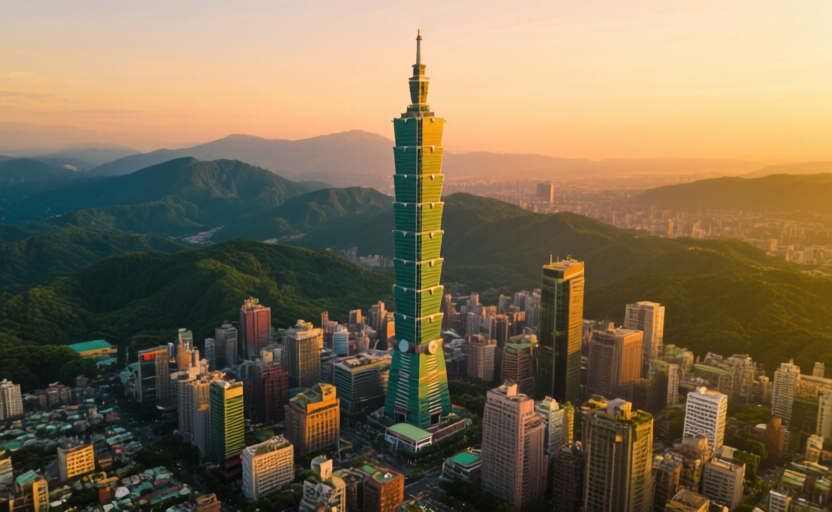
The 508m green-glass icon that was once the world's tallest building, ringed by Taipei's glossiest malls, department stores and nightlife.
Local tip: Skip the pricey observatory queue and go up to the bar/restaurants instead, or — best of all — climb Elephant Mountain opposite for the postcard shot of 101 for free. New Year's Eve fireworks launch off the tower itself.
Elephant Mountain (Xiangshan)
Nature · Xinyi (Xiangshan MRT)
A short, steep stone-step hike straight off the MRT that delivers the definitive skyline view of Taipei 101 and the basin beyond.
Local tip: Go ~90 minutes before sunset to grab a rock platform and watch the city light up. It's busy at golden hour; carry water — it's a sweaty 20-minute climb in summer. Free, open 24h.
Shilin & Raohe Night Markets
Food · Shilin / Songshan
The temples of Taiwanese street food — oyster omelettes, stinky tofu, pepper buns, bubble tea and games, packed shoulder-to-shoulder after dark.
Local tip: Raohe (by Songshan station) is more compact and local than tourist-heavy Shilin — start at the Fuzhou pepper-bun stall by the temple entrance. Bring cash and an empty stomach; come hungry, graze widely.
Yongkang Street & Da'an
Neighborhood · Da'an
The leafy, walkable heart of expat Taipei — Din Tai Fung's original home, mango-shaved-ice institutions, specialty coffee, boutiques and Da'an Forest Park.
Local tip: Queue at the original Din Tai Fung for xiao long bao, then cool off with mango shaved ice at Smoothie House. The lanes off Yongkang hide the city's best independent cafés and the calmest café-work spots.
Beitou Hot Springs
Hidden gemNature · Beitou (north Taipei)
A geothermal valley of steaming public and private hot-spring baths, a Japanese-era bathhouse museum and the milky-blue Thermal Valley — all on the MRT.
Local tip: The public Millennium Hot Spring is a bargain (~NT$60, bring a swimsuit); for privacy book a room at a hot-spring hotel. Pair with the Beitou Library and a stroll — an easy, restorative half-day from downtown.
Jiufen & the Northeast Coast
Hidden gemCulture · Day trip (~1 hr northeast)
A former gold-mining town of red lanterns, teahouses and stepped alleys clinging to a mountainside over the sea — atmospheric, misty and cinematic.
Local tip: Go on a weekday and arrive late afternoon to see the lanterns glow after the tour buses leave; have tea on a balcony at the A-Mei Teahouse. Combine with Shifen (sky lanterns) or the Yinyang Sea by local bus/train.
Emergency numbers in Taipei
Compare Taipei with…
Side-by-side cost of living, language, climate and careers — to help you choose.