China · East Asia
Moving to Suzhou
Suzhou quick facts
China at a glance
East Asia & Pacific
Economy
World BankReligion
% of populationCIA World Factbook / national censuses
Cost of living in Suzhou
Can you move to China?
Pick your passport to see whether you can enter China — and what it takes to stay.
Entry rules come from github.com/imorte/passport-index-data, updated 17 February 2026. They change without notice — confirm with the official immigration service before booking.
Getting set up in China
Work permit, residence permit, and which authority you actually deal with
The national sequence is fixed: Notification Letter of Foreigner's Work Permit obtained by your employer, Z visa at a Chinese mission abroad, entry, work permit card, then a residence permit within 30 days of entry, plus a police registration within 24 hours of moving into a private flat. What is distinctive here is administrative rather than legal. Suzhou Industrial Park was built on a Singaporean public administration model and runs its own one-stop service centre with a reputation for being unusually efficient by Chinese standards. Knowing whether you are a Park case or a municipal case saves a great deal of time.
Read the full step-by-step guideConverting a licence, and a flat city built for bicycles
A foreign licence is not valid in mainland China and the International Driving Permit is not recognised. Conversion means a translation, a medical and the hundred-question written theory test, with practical tests waived for ordinary car categories. Unlike its neighbours, Suzhou does not ration number plates — you can buy a car and register it. Whether you should is another matter: the city is completely flat, the Industrial Park is well laid out for cycling, and the metro plus a bike covers most lives here.
Read the full step-by-step guideOpening an account, and the Park's one-stop advantage
Alipay and WeChat Pay accept foreign Visa and Mastercard up to USD 5,000 per transaction and USD 50,000 a year after verification, which covers a visit. Living here needs a local account, and the account needs a Chinese mobile number registered against your passport. The Suzhou-specific point is that the Industrial Park's banking branches are used to foreign engineers and researchers in a way that a branch in the old town may not be — go to the one your colleagues used.
Read the full step-by-step guideSocial insurance, the Park's health infrastructure, and Shanghai as backup
Suzhou has good provincial-tier hospitals and, in the Industrial Park, an unusually developed private and international medical layer for a city of its size — a legacy of thirty years of multinational employers. What it does not have is the tertiary specialist depth of Shanghai, which is twenty-five minutes away by high-speed train and is where serious cases go. Social insurance enrolment is compulsory for foreign employees; the Park's provident fund arrangements are a separate and genuinely local question.
Read the full step-by-step guideReal-name SIM, broadband, and the internet in a manufacturing city
A SIM takes twenty minutes and a passport, and should be your first errand because the number gates the bank account and the payment apps. The blocked-services position is the same as everywhere on the mainland. What is specific to Suzhou is that a very large share of foreign residents here work for German, Japanese, Korean or American parent companies whose engineering and quality systems sit outside China — so the question of how those systems are reached is an employer question with a concrete answer, and one you should ask before accepting.
Read the full step-by-step guideIIT, the six-year rule, and the trap of working across a boundary
The national rules apply: monthly withholding, an annual reconciliation between March and June, a 183-day residence test, and a six-year rule on worldwide income that resets with a single absence of more than thirty consecutive days. Foreign nationals elect annually between the expatriate fringe-benefit exemptions and the standard itemised deductions. What is worth particular attention in Suzhou is the number of people who work across the Shanghai boundary or across the Park boundary and assume the administration follows them — it does not.
Read the full step-by-step guideEach guide has verified costs, timelines, required documents, and the non-obvious gotchas — sourced from official government pages. Last verified August 2026.
Essential Mandarin Chinese phrases
Reading a list isn’t learning it. Globe Quest turns these into a trainer — hear each phrase spoken, drill them with spaced repetition, and get scored as you say them out loud.
What to know before you go
Suzhou Industrial Park is administratively different from the rest of the city, and it matters practically
CriticalSIP was launched in 1994 as a government-to-government project between China and Singapore, and Singapore transferred not just capital but public administration — planning, labour management, transparent permitting, and in 1997 a provident fund scheme with no Chinese precedent at the time. Nearly thirty years on, the Park still runs its own administrative committee, its own one-stop service centre, and social insurance and provident fund arrangements that do not exactly match the rest of Suzhou. If your employer is in the Park, your registrations, your provident fund position and often your service counters are the Park's rather than the municipality's. Ask your HR which body you are actually dealing with, because the answer changes where you queue.
Register with the police within 24 hours of moving into a flat
CriticalArticle 39 of the Exit and Entry Administration Law requires anyone staying outside a hotel to register with the local public security organ within 24 hours of arrival. Hotels file it invisibly; private landlords do not. Take passport, visa, lease and landlord to the neighbourhood station and keep the slip, because it is requested again at your residence permit application and every renewal. In the Industrial Park the service is well organised and used to foreign residents; in the old town or the outer districts it may be less familiar, so allow time.
Suzhou is the only Chinese city whose metro connects directly to another city's
ImportantSuzhou Metro Line 11 opened in June 2023 and terminates at Huaqiao in Kunshan, where it meets Shanghai Metro Line 11. It is the first time two Chinese cities' urban metro systems have been physically joined, and it means you can travel from Suzhou Industrial Park to central Shanghai entirely on metro fares — slowly, at around fifty-seven minutes just for the Suzhou half, but for a fraction of the rail fare. The high-speed train from Suzhou station to Shanghai Hongqiao remains the fast option at around twenty-five minutes. Both matter: a very large number of people here work in one city and live in the other.
Deciding between the Park and the old town is the local version of Pudong versus Puxi
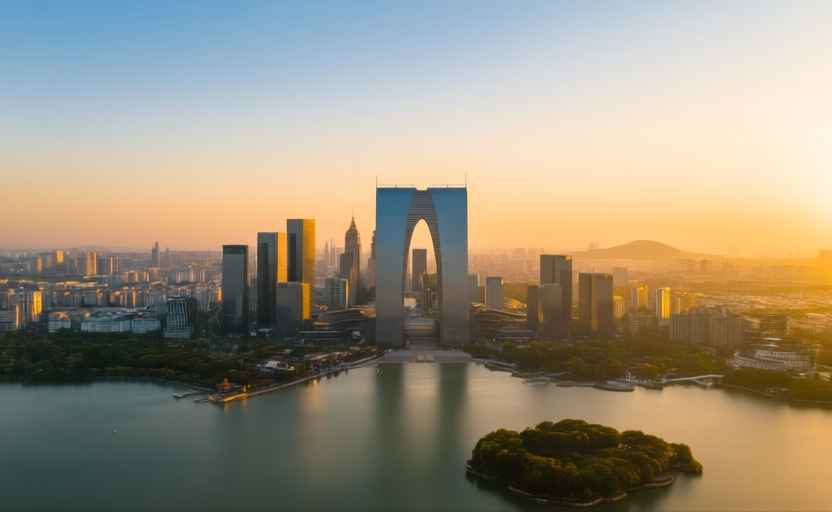
ImportantSuzhou Industrial Park east of the old town is planned, low-density, tree-lined and built around Jinji Lake, with the international schools, the multinational offices and most of the foreign community. The old town is a Song-dynasty canal grid with height restrictions, the UNESCO gardens, the food and almost none of the international infrastructure. Suzhou New District to the west is the third option — older industrial, cheaper, less polished. People with children almost always end up in the Park; people who came for the city almost always regret not living in the old town. Decide deliberately.
This is one of China's largest manufacturing economies, and the work is not what the gardens suggest
ImportantSuzhou's industrial output is among the highest of any Chinese city, and the foreign employment here is overwhelmingly in electronics, precision manufacturing, biomedicine and nanotechnology rather than in finance or consumer tech. BioBAY in the Park is one of China's most significant life sciences clusters, and the nanotech and semiconductor supply chain is deep. If you are coming as an engineer, a quality manager or a scientist, this is a stronger market than Shanghai. If you are coming in marketing or finance, it is a much thinner one, and Shanghai is twenty-five minutes away for a reason.
The old town has a height limit, and it is why Suzhou still looks like Suzhou
Good to knowBuilding heights in the historic canal city are restricted to protect the setting of the classical gardens and the pagodas, which is why the skyline is somewhere else — across the lake in the Park, where the towers are. This is not decorative: it means the old town's housing stock is genuinely old and low, that renovation is constrained, and that a canal-side flat is scarce and permanently so. It also means the gardens work as they were designed to, with borrowed views uninterrupted by anything modern.
Top industries & employers
Electronics & semiconductors
Suzhou Industrial Park tenants, Samsung, Bosch, Foxconn, nanotech cluster firms
Suzhou is one of China's largest electronics manufacturing bases, and SIP's nanotechnology cluster around Dushu Lake is a national priority zone with a deep supplier and research base.
Biomedicine & life sciences
BioBAY tenants, Innovent Biologics, Eli Lilly and Roche operations
BioBAY in Suzhou Industrial Park is among the most significant biotech incubator clusters in China, and Innovent is one of the country's leading biologics companies.
Precision manufacturing & automotive parts
Bosch, Continental, Delphi, Schaeffler, Suzhou-based tier-one suppliers
The German and Japanese automotive supply chains have deep Suzhou operations, which is why the city has an unusually large European and Japanese engineering community.
Chemicals & materials
BASF, Dow, Suzhou Industrial Park chemical zone firms
The Park's chemical and advanced materials tenants form a substantial industrial base with a strong safety and environmental regime by Chinese standards, a legacy of the Singapore governance model.
Silk, textiles & traditional crafts
Suzhou embroidery workshops, silk manufacturers, the Suzhou Silk Museum
Suzhou has been China's silk capital for a millennium, and Su embroidery is one of the four great embroidery traditions. It survives as a real craft economy alongside the industrial one.
Higher education & research
Xi'an Jiaotong–Liverpool University, Soochow University, Dushu Lake Higher Education Town
XJTLU in the Park is one of China's largest Sino-foreign joint venture universities and teaches in English, which supports an unusually large academic foreign community for a city this size.
Where to go in Suzhou
Humble Administrator's Garden
Culture · Old town, north-east
The largest of the UNESCO-inscribed classical gardens, laid out in the sixteenth century around a series of ponds and pavilions.
Local tip: Buy the annual garden pass rather than single tickets — it costs less than two visits and covers most of the classical gardens in the city. Then go to the Humble Administrator's Garden on a wet Tuesday morning, which is exactly the weather and the emptiness it was designed for.
Pingjiang Road & the canal grid
Neighborhood · Old town, eastern half
A canal-side lane running the length of the eastern old town, with whitewashed houses, teahouses and pingtan performance rooms.
Local tip: Pingjiang Road itself is busy. The point is the lanes running east and west off it — Niujia Xiang, Datong Xiang — where the same canal grid is ordinary housing, laundry on poles over the water and old men playing cards. This is the medieval city plan still functioning.
Jinji Lake & the Park waterfront
Nature · Suzhou Industrial Park
A large lake at the centre of the Industrial Park, ringed by a continuous promenade, parks and the modern skyline.
Local tip: The eastern shore is where the Park's residents actually walk and run, and it is largely empty on weekday mornings. The Ligongdi bar strip on the western shore is where the Park's social life happens in the evening.
Tiger Hill (Huqiu)
Landmark · North-west of the old town
A wooded hill with a leaning brick pagoda from 961 AD, and the traditional burial site of the king who founded the city.
Local tip: Su Dongpo wrote that it would be a lifelong regret to visit Suzhou and not see Tiger Hill, and it is still true. The pagoda leans more than three degrees. Go at opening or an hour before closing; the crowds in between are substantial.
Shantang Street
Food · North-west, running from Tiger Hill toward the old town
A 1,100-year-old canal street with restaurants, snack shops and boats, quieter at the western end than the eastern.
Local tip: Suzhou food is sweeter and gentler than anything around it — squirrel mandarin fish, biluochun tea-smoked dishes, and the seasonal hairy crab from nearby Yangcheng Lake in autumn. Walk west from the tourist end and the prices halve.
Tongli & the water towns
Hidden gemNeighborhood · ≈20 km south-east, Wujiang district
One of the classic Jiangnan canal towns, with the UNESCO-inscribed Retreat and Reflection Garden at its centre.
Local tip: Zhouzhuang gets the coaches; Tongli is quieter and has the better garden. But the genuine secret is staying overnight — every water town empties completely after the last coach leaves around five, and the canals at night with nobody on them are a different place entirely.
Emergency numbers in Suzhou
Compare Suzhou with…
Side-by-side cost of living, language, climate and careers — to help you choose.