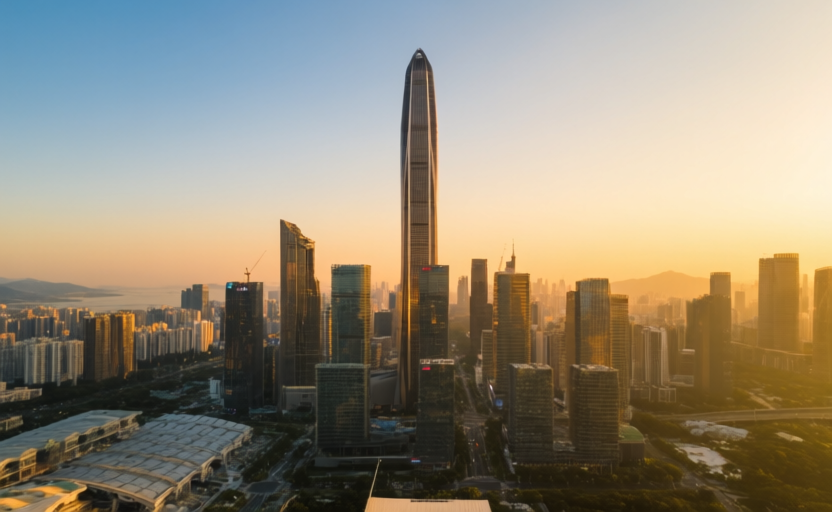
China · East Asia
Moving to Shenzhen
Shenzhen quick facts
China at a glance
East Asia & Pacific

Economy
World BankReligion
% of populationCIA World Factbook / national censuses
Cost of living in Shenzhen
Can you move to China?
Pick your passport to see whether you can enter China — and what it takes to stay.
Entry rules come from github.com/imorte/passport-index-data, updated 17 February 2026. They change without notice — confirm with the official immigration service before booking.
Getting set up in China
Work permit, residence permit, and the Bay Area's looser rules
The national sequence applies: Notification Letter of Foreigner's Work Permit obtained by your employer, Z visa at a Chinese mission abroad, entry, work permit card, then a residence permit within 30 days of entry — plus police registration within 24 hours of moving into a private flat. What Shenzhen adds is the Greater Bay Area regime, under which age and experience tests are relaxed, longer permits are available for some profiles, and permits are mutually recognised across the nine mainland GBA cities so a move within the delta is a transfer rather than a fresh application.
Read the full step-by-step guideConverting a licence, plate control, and why nobody here needs a car
A foreign licence is not valid in mainland China and the International Driving Permit is not recognised — China is not party to the 1968 Vienna Convention. Conversion means a translation, a medical and the hundred-question written theory test, with the practical tests waived for ordinary car categories. Shenzhen rations number plates through a quota allocated by a mix of lottery and auction, restricts out-of-town plates on some roads at peak times, and has one of the best metro systems in China — which is why very few foreign residents here bother.
Read the full step-by-step guideOpening an account, and the Hong Kong account across the border
Alipay and WeChat Pay accept foreign Visa and Mastercard up to USD 5,000 per transaction and USD 50,000 a year after verification, which covers a visit. Living here needs a local account, which needs a Chinese mobile number registered against your passport. Shenzhen's particular advantage is that a Hong Kong account is a forty-minute journey away, and many people here maintain both — the mainland account for daily life and the Hong Kong one as an unrestricted link to the rest of the world.
Read the full step-by-step guideSocial insurance, young hospitals, and Hong Kong as a second option
Shenzhen's hospitals are newer than Beijing's or Shanghai's and generally better equipped, but the city has fewer of the century-old tertiary institutions that draw the country's most senior specialists — several major hospitals here are branches of Guangzhou or Beijing parents. For routine care that is fine and often better. For something unusual, people go to Guangzhou, or across the border to Hong Kong. Social insurance enrolment is compulsory, and Shenzhen also participates in the Greater Bay Area income tax subsidy that changes the economics of a package here considerably.
Read the full step-by-step guideReal-name SIM, broadband, and a Hong Kong number in your other slot
A Chinese SIM takes twenty minutes and a passport and should be your first errand, because the number is what unlocks the bank account and the payment apps. What Shenzhen adds is that a Hong Kong SIM in a second slot or an eSIM is a genuinely practical option: Hong Kong numbers roam on mainland networks and give unrestricted internet access, and plenty of people here run both. The blocked-services problem is the same as everywhere in China; the workaround is simply closer to hand.
Read the full step-by-step guideIIT, the six-year rule, and the Bay Area's 15% ceiling
The national rules are the same as everywhere in China: monthly withholding, an annual reconciliation between March and June, a 183-day residence test, and a six-year rule on worldwide income that resets with a single absence of more than thirty consecutive days. What Shenzhen adds is the Greater Bay Area subsidy, which refunds individual income tax paid above a 15% effective rate for qualifying overseas talent and runs to 31 December 2027. Between that, the expatriate fringe-benefit exemptions and the six-year rule, the tax planning available here is unusually rich — and almost all of it requires action from you rather than from payroll.
Read the full step-by-step guideEach guide has verified costs, timelines, required documents, and the non-obvious gotchas — sourced from official government pages. Last verified August 2026.
Essential Mandarin Chinese phrases
Reading a list isn’t learning it. Globe Quest turns these into a trainer — hear each phrase spoken, drill them with spaced repetition, and get scored as you say them out loud.
What to know before you go
The Greater Bay Area caps your effective income tax at 15% — if you qualify and if you apply
CriticalA Ministry of Finance circular continues a preferential individual income tax policy across the nine mainland Greater Bay Area cities, Shenzhen among them, through to 31 December 2027. Qualifying overseas high-end talent and talent in short supply have the individual income tax paid above a 15% effective rate refunded by the municipal government, and the subsidy itself is exempt from tax. This is worth an enormous amount against China's 45% top band. The catch is that it is a subsidy you apply for through the municipal human resources bureau within an annual window, and the definitions of 'high-end' and 'in short supply' are set locally and revised. Ask your employer's HR in your first month, not in your fourth year.
Register with the police within 24 hours of moving into a flat
CriticalArticle 39 of the Exit and Entry Administration Law requires anyone staying somewhere other than a hotel to register with the local public security organ within 24 hours. Hotels file it invisibly, which is exactly why people who go straight into a rented flat never learn the rule exists. Take your passport, visa, lease and landlord to the neighbourhood station and keep the slip — it is requested again at the residence permit application and at every renewal. The fine is up to RMB 2,000, but the real cost is the delay when you need the slip and do not have it.
Work permits are mutually recognised across the Greater Bay Area, and the rules are looser here
ImportantThe GBA runs an optimised work permit regime that other parts of China do not: age limits raised to 65 for urgently needed skills and major project staff, experience requirements waived for young specialists in priority science programmes, longer permits available, and mutual recognition so that a permit obtained in another mainland GBA city can be transferred without resubmitting the whole file. If you are choosing between a Chinese city and are marginal on age or experience, the Bay Area is measurably the most accessible mainland option.
Hong Kong is forty minutes away and it is a different jurisdiction in every way that matters
ImportantFutian, Luohu and Shenzhen Bay crossings put Hong Kong within an hour of most of the city, and plenty of people cross weekly for banking, unrestricted internet, medicine and shopping. Treat each crossing as a genuine immigration event: your Chinese residence permit does not cover Hong Kong, you need whatever entry permission your passport requires there, and re-entering mainland China requires your Chinese residence permit to still be valid and multi-entry. People with single-entry status have stranded themselves on the wrong side of a forty-minute journey.
Shenzhen is young in a way no other Chinese city is, and it changes what living here feels like
Good to knowThe city was a county of fishing and farming villages until the Special Economic Zone was created in 1980, and it now has well over seventeen million people, almost all of whom moved here. The median age is among the lowest of any major Chinese city, essentially nobody's parents live nearby, and the default social assumption is that everyone is new. That makes it unusually easy to arrive into — colleagues become your social circle because that is how it works for locals too — and unusually rootless. There is very little old city, and the history you are surrounded by is forty years deep, not four hundred.
Urban villages are how Shenzhen stays affordable, and they are being demolished
Good to knowThe chéngzhōngcūn are dense, informally built neighbourhoods that the city grew around rather than through — cheap rents, street food, tiny shops, handshake-distance buildings. They house a very large share of Shenzhen's working population and are the reason a city with Shenzhen's salaries still has anywhere cheap to live. They are also being systematically redeveloped, and a village that exists when you sign a two-year lease may be behind hoardings when it ends. Ask about redevelopment plans before you commit.
Top industries & employers
Telecoms & hardware
Huawei, ZTE, DJI, TCL, Transsion
Huawei's Longgang campus and DJI's headquarters are here, and the surrounding supply chain in Shenzhen and neighbouring Dongguan is why the city is the default place on earth to build physical products.
Internet & gaming
Tencent, Kingdee, Meitu operations
Tencent is headquartered in Nanshan and is one of the largest technology companies in the world. Its presence is why Shenzhen has a serious software labour market alongside the hardware one.
Electric vehicles & batteries
BYD, CATL operations, Xpeng in nearby Guangzhou
BYD began in Shenzhen as a battery maker and is now among the world's largest electric vehicle manufacturers. The city's entire taxi and bus fleet was electrified early, which is why it is noticeably quieter than other Chinese cities.
Finance & insurance
Ping An, China Merchants Bank, Shenzhen Stock Exchange
The Shenzhen Stock Exchange is China's growth-company market, and Ping An and China Merchants Bank are both headquartered here — a substantial financial sector distinct from Shanghai's.
Biotech & genomics
BGI Genomics, Mindray, Shenzhen Bay laboratories
BGI is one of the world's largest genome sequencing organisations and Mindray a major medical device manufacturer, anchoring a research cluster around Shenzhen Bay and the Guangming science city.
Logistics, trade & manufacturing services
SF Express, Yantian International Container Terminals, China Merchants Port
Yantian is one of the busiest container terminals in the world and SF Express is China's leading express carrier. Shenzhen's port and customs infrastructure is a large employer in its own right.
Where to go in Shenzhen
Huaqiangbei electronics markets
Landmark · Futian, central
Several city blocks of multi-storey markets selling every component, tool, module and counterfeit gadget in existence.
Local tip: The ground floors sell finished goods to visitors. The interesting floors are upstairs and at the back — component vendors, repair benches and prototype shops, where the people who actually build things go. Bring a specific part number and you will be astonished at what happens next.
Shekou & Sea World
Neighborhood · Western Nanshan, on the bay
The original foreign enclave — a former industrial port turned into a waterfront district of bars, restaurants and international schools around a beached cruise ship.
Local tip: Shekou is where most of Shenzhen's foreign residents landed first and many never left. The ferry terminal here runs directly to Hong Kong airport, which is genuinely the fastest way to fly long-haul out of Shenzhen.
OCT-LOFT & Nanshan cultural district
Culture · Overseas Chinese Town, Nanshan
A converted 1980s factory complex holding independent bookshops, galleries, design studios and the city's best small music venues.
Local tip: The northern half is the good half — quieter, more studios, fewer chain cafés. The B10 live house here is the most serious independent music room in the Pearl River Delta.
Dongmen Old Street
Food · Luohu, near the Hong Kong border
The closest thing Shenzhen has to an old commercial quarter — dense pedestrian shopping streets and a deep concentration of regional Chinese food.
Local tip: Shenzhen has no native cuisine because it has almost no natives; what it has instead is every provincial cuisine in China cooked by people who grew up eating it. Dongmen is where that is most concentrated — Chaoshan beef hotpot, Hunanese, Northeastern, all within a few streets.
Shenzhen Bay Park & the mangrove reserve
Nature · Nanshan, along the bay facing Hong Kong
A long waterfront park along the bay with Hong Kong's hills directly across the water, and a protected mangrove wetland at its eastern end.
Local tip: The Futian mangrove reserve is on the East Asian–Australasian flyway and takes tens of thousands of migratory birds each winter — black-faced spoonbills among them. Access to the reserve proper is controlled, but the park path beside it gives you most of it for free.
Wutong Mountain & the eastern coast
Hidden gemNature · Eastern Shenzhen, Yantian and Dapeng
The city's highest peak at around 944 metres, with the Dapeng peninsula's beaches, coves and a walled Ming garrison town beyond it.
Local tip: Almost every visitor thinks Shenzhen is only towers. Dapeng peninsula, an hour east, has clear water, good coastal walking and Dapeng Fortress — a genuinely old walled town that predates the city around it by four hundred years. Go on a weekday; the beaches are packed at weekends.
Emergency numbers in Shenzhen
Compare Shenzhen with…
Side-by-side cost of living, language, climate and careers — to help you choose.