Saudi Arabia · Middle East
Moving to Riyadh
Riyadh quick facts
Cost of living in Riyadh
Getting set up in Saudi Arabia
Work visa, Iqama & sponsorship (kafala)
Your Iqama (residence permit) is the master key to Saudi life — no bank account, postpaid SIM, driving licence, lease or family sponsorship happens without it. It is issued by your employer after you arrive and pass the medical, not at the embassy. Here is the real sequence and what trips people up.
Read the full step-by-step guideGetting or converting a driving licence
If your home licence is from one of roughly 47 approved countries, you do not sit a road test in Saudi Arabia. You book a 'Replace Foreign Driving Licence' appointment on the Absher app, get a certified Arabic translation of your licence, pass an Efada medical (eye test plus a blood-type check that gets printed on the card), pay the fee and collect a Saudi licence. Dallah is the go-to for men in Riyadh; women typically use the Saudi Driving School at Princess Nourah University. Licences from non-approved countries need an assessment and a short course instead. You need your Iqama first.
Read the full step-by-step guideOpening a bank account
A resident bank account in Saudi Arabia is gated on your Iqama (residence permit) — without it, you are limited to a tiny transfer cap for your first 90 days. Once your Iqama is issued, the major banks (Al Rajhi, SNB, Riyad Bank, SABB, Alinma) let you open a current account end-to-end in their app in 10-15 minutes, with identity checked through Nafath (the national digital-ID layer over Absher). The account is closely tied to your job: your employer pays you through it under the government's Wage Protection System (WPS), and you spend with a mada debit card.
Read the full step-by-step guideHealthcare & mandatory health insurance
In Saudi Arabia, private cooperative health insurance is mandatory for every expat and is your employer's legal responsibility to provide. It is regulated by the Council of Health Insurance (CHI, formerly CCHI) and tied to your Iqama: the residency permit cannot be issued or renewed without a valid policy on the CHI register. With that policy you use private hospitals (Dr Sulaiman Al Habib, Kingdom Hospital, etc.); public Ministry of Health facilities are primarily for Saudi citizens, though anyone is treated in a genuine emergency. For an ambulance call the Saudi Red Crescent on 997, or 911 in Riyadh.
Read the full step-by-step guideGetting a SIM / mobile plan
Saudi Arabia runs strict real-name SIM registration policed by the CST (Communications, Space & Technology Commission, formerly CITC). Every line — prepaid, postpaid, even a tourist eSIM — is tied to a verified identity via fingerprint/biometric capture at the point of sale, and you are capped at a small number of lines per ID. As a visitor you can buy a prepaid SIM on your passport and visa; as a resident you register against your Iqama, and a postpaid contract only becomes available once that Iqama is active. Register every line in your own name: a mismatch between the number's owner and your ID quietly breaks Nafath logins and banking.
Read the full step-by-step guidePersonal tax & your salary
Your Riyadh salary arrives with zero income tax deducted — Saudi Arabia has no personal income tax, so the figure on your offer letter is broadly what reaches your account, and there is no personal tax return to file here. The catches: GOSI social insurance takes a real bite from Saudi nationals (~21.5% combined) but for non-Saudi expats it is only a 2% occupational-hazard premium paid entirely by your employer — nothing off your pay. Meanwhile a 15% VAT (one of the highest in the Gulf) quietly taxes your spending, and US citizens still file back home.
Read the full step-by-step guideEach guide has verified costs, timelines, required documents, and the non-obvious gotchas — sourced from official government pages.
Essential Arabic phrases
What to know before you go
Plan around the five daily prayers
CriticalShops, restaurants and many offices pause for ~20-30 minutes at each prayer (salah). Enforcement has eased, but it's still widespread — check a prayer-times app and time your errands so you're not caught mid-shop.
Dress modestly — but the rules have relaxed
ImportantAbayas are no longer legally required for women and the religious police no longer police dress, yet modest clothing (shoulders and knees covered) is respected. Men avoid shorts in formal or government settings.
The work week is Sunday-Thursday
ImportantThe weekend is Friday-Saturday, and Friday is the holy day (jumuʿah) when things start late. Schedule meetings Sunday to Thursday.
Ramadan reshapes the day
CriticalDon't eat, drink or smoke in public during daylight in Ramadan, even if you're not fasting. Work hours shorten, and the city comes alive at night after iftar.
Alcohol is illegal — coffee is the social default
CriticalSaudi Arabia bans alcohol; don't bring it or seek it out. Social life runs on Saudi coffee (qahwa), karak tea and a serious specialty-cafe scene instead.
Go cashless with mada and Apple Pay
Good to knowRiyadh is highly cashless — the mada debit network and Apple Pay are accepted almost everywhere, often even by small vendors. You'll rarely need cash.
Top industries & employers
Energy
Saudi Aramco, SABIC
The world's largest oil company anchors the economy; petrochemicals and downstream are huge employers.
Sovereign wealth & finance
PIF (Public Investment Fund), Saudi National Bank, Tadawul
PIF is reshaping global investment and funding Vision 2030; Riyadh is the kingdom's financial centre.
Giga-projects & construction
NEOM, Roshn, Diriyah, Qiddiya, New Murabba
A once-in-a-generation construction boom driving demand for engineers, PMs and designers.
Technology & startups
STC, noon, Lucid, a fast-growing VC scene
Heavy investment in digital, AI and gaming; the LEAP conference has become a global tech fixture.
Government & Vision 2030
Ministries, the Regional HQ (RHQ) programme
Multinationals must base their Middle East HQ in Riyadh to win government contracts — a major draw for talent.
Healthcare & education
King Faisal Specialist Hospital, KFSH&RC, universities
World-class medical and research institutions and a steady employer of international professionals.
Where to go in Riyadh
At-Turaif, Diriyah
Landmark · Diriyah
The UNESCO-listed mud-brick birthplace of the Saudi state, beautifully restored alongside the Bujairi Terrace dining district.
Local tip: Go in the evening when Bujairi lights up and the heat drops — book a table on the terrace overlooking the old city.
Kingdom Centre Sky Bridge
Landmark · Al Olaya
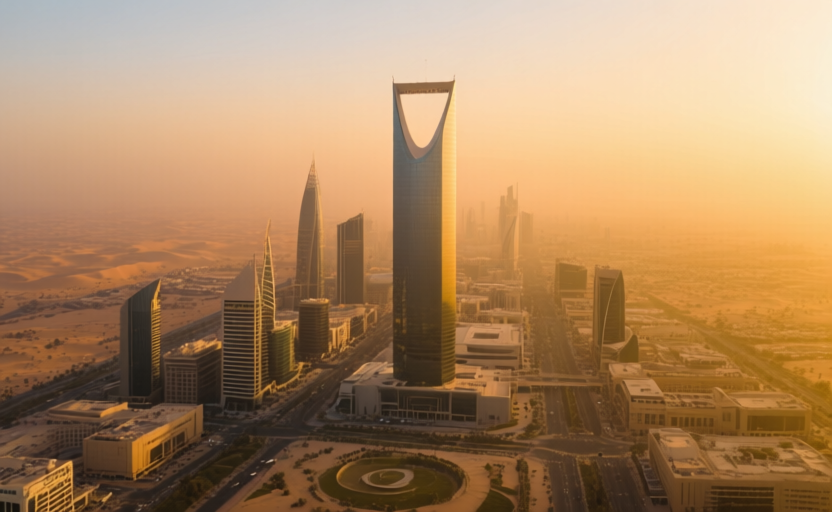
The 'bottle-opener' tower with a top-floor sky bridge giving the classic panorama over Riyadh.
Local tip: Take the sunset slot for the best light, and book ahead — it sells out on weekends.
Edge of the World (Jebel Fihrayn)
Nature · ~90 min northwest
Dramatic cliffs dropping away over an ancient seabed — the region's signature desert day-trip.
Local tip: Go with a 4x4 or a tour, take plenty of water, and head back before dark; there's no lighting or signal.
King Abdullah Financial District (KAFD)
Neighborhood · Al Aqeeq
A futuristic business district with its own monorail and a fast-growing cluster of restaurants and cafes.
Local tip: The newest dining and the weekend brunch scene concentrate here — wander after office hours.
Souq Al Zal & Masmak Fortress
Hidden gemCulture · Old Riyadh (Deira)
The old town's traditional souq for carpets, antiques and oud perfumes, next to the historic Masmak clay fortress.
Local tip: Haggle, and pair it with the National Museum nearby for the city's origin story.
Al Bujairi & Wadi Hanifah
Hidden gemNature · Diriyah
A green valley with parks and walking paths threading along Wadi Hanifah, a cool escape from the city grid.
Local tip: Locals picnic here on weekend evenings; the stretches near Diriyah are the prettiest.