Iceland · Europe
Moving to Reykjavík
Reykjavík quick facts
Iceland at a glance
Europe & Central Asia
Economy
World BankReligion
% of populationCIA World Factbook / national censuses
Cost of living in Reykjavík
Can you move to Iceland?
Pick your passport to see whether you can enter Iceland — and what it takes to stay.
Entry rules come from github.com/imorte/passport-index-data, updated 17 February 2026. They change without notice — confirm with the official immigration service before booking.
Getting set up in Iceland
Two agencies, one permit, and the legal domicile that follows it
Iceland splits the decision between two agencies: the Directorate of Immigration issues the residence permit and forwards the work permit application to the Directorate of Labour, which issues that. Your employer applies for the work permit, not you. The main non-EEA routes are the qualified professional permit — the only one with an expedited service, targeting 30 days — and the shortage-of-labour permit, where the employer must show no Icelandic or EEA worker was available. Once here, registering legal domicile with Registers Iceland is the step that starts your healthcare clock.
Read the full step-by-step guideLicence exchange, studded tyre dates, and the weather that closes roads
EEA licences are valid and exchangeable. Licences from a defined set of other countries can be exchanged, sometimes with a test; the rest mean taking the Icelandic licence. What actually matters here is not the paperwork but the conditions: studded tyres are permitted only within a fixed seasonal window, wind regularly reaches speeds that damage vehicles, and roads outside the capital close without much notice. Checking road.is and vedur.is before every drive is normal behaviour, not caution.
Read the full step-by-step guideElectronic ID, three banks, and a very small currency
Iceland has essentially three retail banks, and opening an account requires a kennitala and an in-person identity check. What you are really obtaining is rafræn skilríki — electronic ID held on your SIM or in an app — because that is how you log into Ísland.is, the tax authority, your health records and everything else. Card payment is universal to the point that cash is genuinely unusual, and the króna is a very small currency with a history of sharp movement, which is worth thinking about before you hold all your savings in it.
Read the full step-by-step guideThe waiting period that just changed, 1700, and one hospital
Icelandic Health Insurance covers you after a waiting period that begins when you register legal domicile, not when you arrive. For arrivals from outside the EEA that period was six months and was halved to three under legislation whose main provisions took effect on 1 August 2026 — a change recent enough that almost nothing published describes it. EEA arrivals can bridge the gap with an EHIC or an S1 form. Everyone else needs private cover. Once inside, care is delivered through a heilsugæsla primary care centre, with 1700 for advice, 1770 for the out-of-hours doctor, and Landspítali as effectively the country's only major hospital.
Read the full step-by-step guideA SIM that carries your legal identity, and coverage that stops
Prepaid SIMs are sold in petrol stations and supermarkets and work immediately, and mobile data is inexpensive with good 4G and 5G coverage across the populated areas. The specifically Icelandic feature is that your SIM can carry rafræn skilríki, the electronic ID used to log into Ísland.is, your bank and your health records — which makes changing operator a bigger decision than it looks. Coverage in the interior and on mountain roads is genuinely patchy, and that is a safety matter rather than an inconvenience.
Read the full step-by-step guideBanded income tax, the municipal share, and the expert deduction through Rannís
Iceland combines a banded national income tax with a flat municipal rate set by your municipality, both withheld at source through the staðgreiðsla system, and reduces the bill by a monthly personal tax credit that everyone receives. Pension contribution is compulsory and substantial. The one genuinely valuable relief for a newcomer is the foreign expert deduction, which exempts 25% of a qualifying specialist's income for three years and is applied for through Rannís rather than through the tax authority.
Read the full step-by-step guideEach guide has verified costs, timelines, required documents, and the non-obvious gotchas — sourced from official government pages. Last verified August 2026.
Essential Icelandic phrases
Reading a list isn’t learning it. Globe Quest turns these into a trainer — hear each phrase spoken, drill them with spaced repetition, and get scored as you say them out loud.
What to know before you go
The kennitala and the legal domicile are different, and the second one matters more
CriticalRegisters Iceland can issue a kennitala without registering a legal domicile — a system number, enough to be paid and taxed. Registering lögheimili is the separate act that makes you a resident for the purposes of healthcare, municipal services and school places. Employers, banks and landlords ask for the kennitala and everyone talks about it, so newcomers assume it is the whole thing. Check on Ísland.is which you actually have, because the healthcare waiting period runs from the domicile registration and not from your arrival.
There is a waiting period before you are health insured, and it was shortened on 1 August 2026
CriticalIcelandic Health Insurance covers you only after a waiting period following registration of legal domicile. For people arriving from outside the EEA that period was six months and was reduced to three under legislation whose main provisions took effect on 1 August 2026. EEA arrivals can bridge the gap with an EHIC or an S1 form from their home system. Everyone else needs private cover for the interval, and it is a genuine interval, not a formality — confirm the current position directly with Sjúkratryggingar Íslands, because this changed days ago.
Housing is the binding constraint on moving here, not the visa
CriticalReykjavík has the tightest housing market in the Nordics. Supply is small in absolute terms, short-term letting absorbed a large part of the central stock before it was restricted, and construction has not kept pace with immigration. Landlords routinely require a kennitala, an Icelandic employment contract and references before showing a flat, and the residence permit process wants an address. Start the search before you commit to anything and treat employer-assisted housing as a serious factor when comparing offers.
Apply for the foreign expert tax deduction through Rannís, and check the 60-month rule
ImportantIceland exempts 25% of a qualifying foreign expert's salary from income tax for the first three years of employment. It is administered by Rannís, the Icelandic Centre for Research, and both employee and employer can apply. The conditions are specific: you must not have been resident or domiciled in Iceland in the 60 months before the employment began, your expertise must be unavailable or scarce in Iceland, and the work must be in research, development, innovation, teaching, specialised projects or a role essential to the company's operations. It is worth a substantial amount and it is not automatic.
The labour market is small enough that changing jobs can mean changing career
ImportantIceland has under 400,000 people and Reykjavík's metropolitan area holds about two thirds of them. For most specialised fields that means a handful of employers, sometimes one. A permit tied to a specific employer is therefore a stronger constraint here than the same permit would be in Stockholm or Copenhagen, and a falling-out with an employer has consequences beyond the job. It also means networks matter disproportionately and hiring runs on personal recommendation to a degree that surprises people from larger markets.
The weather is not cold, it is violent, and the warnings are real
ImportantReykjavík is milder in winter than Oslo, Helsinki or Stockholm — the Gulf Stream keeps it near freezing rather than well below. What it has instead is wind. Storms close roads, ground flights and occasionally shut schools, and the Icelandic Met Office's colour-coded warnings are issued because people have died ignoring them. Car doors are torn off by gusts often enough that some rental insurance excludes it. Check vedur.is and the road authority's site before any drive outside the capital area, every time, in every season.
Top industries & employers
Tourism & hospitality
Icelandair, Play, Blue Lagoon, Arctic Adventures, Icelandia
Tourism overtook fishing as Iceland's largest export earner in the 2010s and reshaped Reykjavík's economy, its housing stock and its labour market in about a decade.
Fisheries & marine technology
Brim, Samherji, Marel, Hampiðjan, Skaginn 3X
Iceland's fishing industry is small in headcount but exceptionally productive, and Marel — spun out of the University of Iceland — became a global leader in food processing equipment on the back of it.
Energy-intensive industry
Rio Tinto ISAL, Norðurál, Alcoa Fjarðaál, PCC BakkiSilicon
Cheap geothermal and hydroelectric power made Iceland a site for aluminium smelting and silicon production, and these plants consume the majority of the country's electricity.
Energy & data centres
Landsvirkjun, Orkuveita Reykjavíkur, atNorth, Verne Global
Almost all Icelandic electricity is renewable and Reykjavík is heated geothermally, which is why data centres and high-performance computing found their way here — cold air, cheap green power and short latency to both continents.
Pharmaceuticals & biotech
Alvotech, deCODE genetics, Coripharma, Kerecis
deCODE built one of the world's most complete population genetics datasets from Iceland's unusually documented ancestry, and Alvotech is a substantial biosimilars manufacturer headquartered here.
Software & gaming
CCP Games, Controlant, Meniga, Videntifier
CCP has run EVE Online from Reykjavík since 2003 and is the anchor of a small but real software scene, alongside supply-chain and fintech companies exporting from an island of 400,000 people.
Where to go in Reykjavík
Hallgrímskirkja & the old centre
Landmark · Central Reykjavík
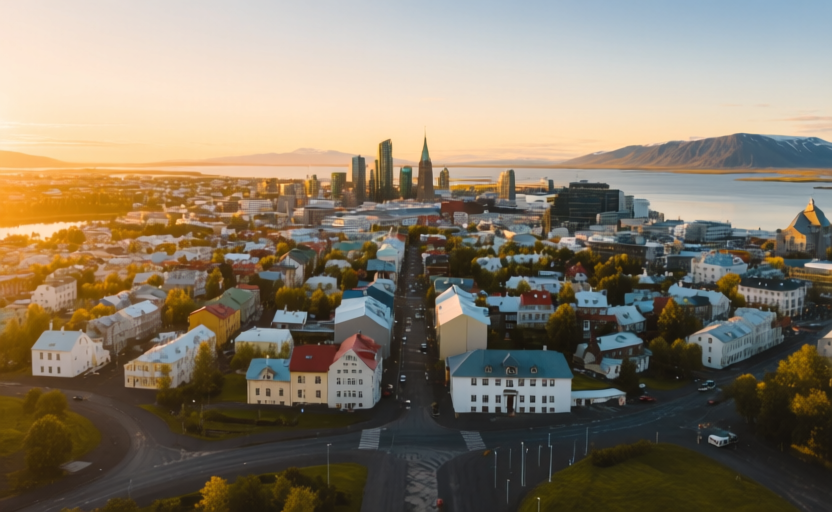
The concrete expressionist church on the hill above the centre, with the best view over the coloured roofs to the sea and the mountains.
Local tip: The tower lift is worth the fee once, on a clear day, and the church's design is meant to evoke basalt columns rather than anything ecclesiastical. Walk down Skólavörðustígur afterwards rather than back the way you came.
Sundlaugar — the geothermal pools
Nature · Every neighbourhood
Outdoor geothermal swimming pools with hot tubs, open year-round, in essentially every district — Laugardalslaug is the largest, Vesturbæjarlaug and Sundhöllin the most loved.
Local tip: This is the actual social institution of Icelandic life, not a tourist attraction. The showering rules before entry are strict, unsigned in places, and taken entirely seriously — wash thoroughly and without a swimsuit, or expect to be told. A monthly or annual pass costs a fraction of the single entry.
Grótta & Seltjarnarnes
Nature · The peninsula tip, 30 minutes' walk west
A lighthouse on a tidal island at the end of the peninsula, with a hot foot bath, seabirds and open North Atlantic.
Local tip: The causeway floods at high tide and people get stranded every year — check the tide table before walking out. It is one of the best places inside the city to see the northern lights, because the municipality dims the streetlights there for exactly that reason.
Reykjadalur hot river
Nature · About 45 minutes east, near Hveragerði
A geothermal river in a steaming valley, warm enough to lie in, reached by an hour's uphill walk.
Local tip: The walk is genuinely uphill and the weather turns fast — this is a real hike, not a stroll, and people underestimate it in trainers. Go upstream past the first duckboards, where the water is hotter and the crowd thins.
Harpa & the old harbour
Culture · Waterfront
A concert hall of glass honeycomb cells on the harbour front, with the fishing docks, whale-watching boats and the best fish restaurants alongside.
Local tip: Harpa was half-built when the banks collapsed in 2008 and the state finished it because stopping would have been worse — Icelanders' feelings about the building are still complicated. The foyer is free to walk into and the light through the cells changes completely with the weather.
Öskjuhlíð & Nauthólsvík
Hidden gemNature · The wooded hill south of the centre
A forested hill of hot water tanks with wartime bunkers in the trees, and a geothermally warmed beach with white imported sand at its foot.
Local tip: Nauthólsvík is an artificial beach where geothermal water is pumped into a lagoon to make North Atlantic swimming survivable, and locals use it all winter. The woods on the hill above hide British and American wartime installations that almost no visitor knows are there.
Emergency numbers in Reykjavík
Compare Reykjavík with…
Side-by-side cost of living, language, climate and careers — to help you choose.