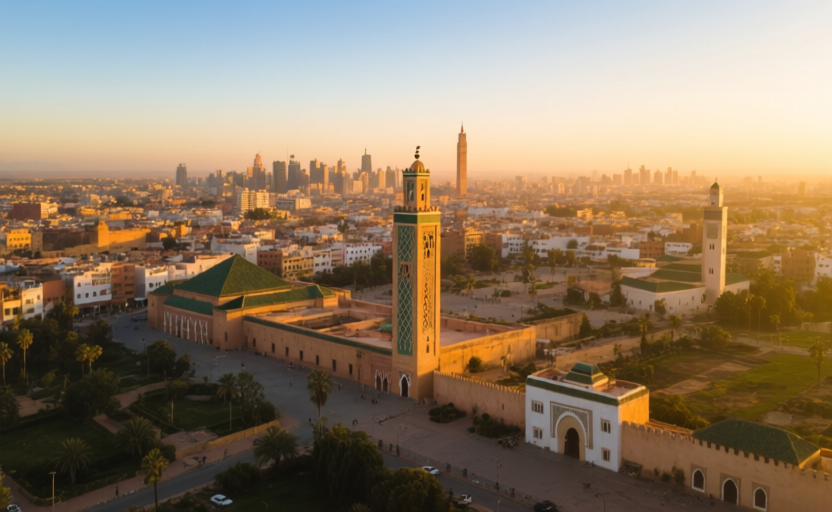
Morocco · Africa
Moving to Rabat
Rabat quick facts
Morocco at a glance
Middle East, North Africa, Afghanistan & Pakistan
Economy
World BankReligion
% of populationCIA World Factbook / national censuses
Cost of living in Rabat
Can you move to Morocco?
Pick your passport to see whether you can enter Morocco — and what it takes to stay.
Entry rules come from github.com/imorte/passport-index-data, updated 17 February 2026. They change without notice — confirm with the official immigration service before booking.
Getting set up in Morocco
The carte de séjour, and the document advantage of living in the capital
Beyond three months you must hold a carte d'immatriculation carrying a mention describing why you are here. The card is cheap and issues in around thirty-five days once accepted; the delay is entirely in the file. Rabat's advantage is that everything the file depends on — ministries, embassies, central registries, the apostille and legalisation machinery — is in the same city, which is why people from Casablanca and Marrakech come here for single signatures.
Read the full step-by-step guideLicence exchange, and the one Moroccan city where you may not need a car
A foreign licence is valid for twelve months from taking up residence. NARSA will exchange it for a Moroccan one within that window where reciprocity exists — France, Spain, Belgium, Italy and Germany among the countries where it does. Otherwise you sit the Moroccan tests. Rabat is the Moroccan city where the answer might genuinely be not to bother: two tram lines, a compact centre, a functioning bus network and Al Boraq high-speed rail to Casablanca and Tangier from Rabat-Agdal.
Read the full step-by-step guideConvertible dirhams, and the question every internationally-paid resident has to answer
The dirham is not freely convertible, so the account you open determines whether your money can leave again. A convertible-dirham or foreign-currency account, funded from currency imported through the banking system with the exchange receipts retained, keeps its right to be transferred abroad. An ordinary resident dirham account does not. If your salary arrives from outside Morocco, this is the most consequential decision you will make here and it is very hard to unwind.
Read the full step-by-step guideCNSS and AMO, the mission schemes, and the referral to Casablanca
Employment with a Moroccan employer means compulsory CNSS registration from day one and AMO cover deducted from payroll. Everyone else buys private cover. Rabat has the country's flagship public hospitals and a solid private sector, but for the deepest specialist care the referral pathway still points to Casablanca, an hour away by high-speed train. Anyone on an institutional scheme should read what it actually covers locally rather than assuming.
Read the full step-by-step guideRegistered SIMs, good fibre, and the Ramadan clock
Every SIM in Morocco is registered against an identity document, so you buy in an operator shop with your physical passport. Prepaid is cheap and immediate; postpaid wants a residence card and a Moroccan bank account. Rabat's fixed-line infrastructure is among the best in the country — the administrative districts, Agdal and Hay Riad are well served — and the practical annoyance is not connectivity but the clock, which moves for Ramadan every year.
Read the full step-by-step guideResidence under article 23, treaty relief, and the diplomatic exception
Article 23 of the Code Général des Impôts makes you a Moroccan tax resident if you have your permanent home here, your centre of economic interests here, or you spend more than 183 days here over any rolling 365. Residents are taxable on worldwide income, with relief under the applicable double-taxation treaty. Rabat's complication is that a large share of its foreign population sits under exemptions — diplomatic, consular or headquarters-agreement — and those exemptions are narrower and more personal than the people relying on them usually think.
Read the full step-by-step guideEach guide has verified costs, timelines, required documents, and the non-obvious gotchas — sourced from official government pages. Last verified August 2026.
Essential Arabic phrases
Reading a list isn’t learning it. Globe Quest turns these into a trainer — hear each phrase spoken, drill them with spaced repetition, and get scored as you say them out loud.
What to know before you go
Living in the capital makes every document problem smaller
ImportantRabat holds the ministries, the central administrations and almost every embassy in Morocco. A criminal-record extract to be legalised, a degree to be authenticated, a marriage to be transcribed, a consular appointment, a ministry stamp — all of it is a bus ride rather than a day trip and an overnight. People in Casablanca and Marrakech routinely come here for a single signature. If your move involves a lot of paperwork, and most do, this is the most underrated practical advantage Rabat has.
Get your home-country documents apostilled before you leave, not legalised after you arrive
CriticalMorocco has been a party to the Hague Apostille Convention since 14 August 2016. If your country is too, a public document — police certificate, birth or marriage certificate, degree — carrying an apostille from your own authorities is accepted here without consular legalisation. That turns a multi-week consular errand into a same-week one done at home. People still queue at Moroccan consulates for legalisation they no longer need.
The carte de séjour is applied for at your local commissariat, and the file is what delays you
CriticalBeyond three months you must hold one. The card costs around MAD 100 and issues in about thirty-five days once accepted; the delay is the file — a legalised lease or attestation d'hébergement, an attestation de résidence from the local authority, a medical certificate under three months old, and a criminal-record extract from your country of origin. Rabat's prefectures are comparatively orderly, which helps only if you turn up complete.
Decide convertible versus ordinary dirhams before you open a bank account
CriticalThe dirham is not freely convertible. Money in an ordinary resident dirham account can be spent in Morocco but not sent back out; a convertible-dirham or foreign-currency account, funded from currency imported from abroad with the exchange receipts kept, retains its right to leave. If you are paid by an international organisation, an embassy or a foreign employer — which describes a lot of Rabat — this is the decision that matters most, and it is effectively irreversible.
Live on the tram line, and the city becomes small
ImportantThe Rabat-Salé tramway runs two lines linking Salé across the Bouregreg to central Rabat and out to Agdal, with extensions toward Hay Riad. It is clean, frequent and cheap, and it connects the ministries, both main stations, the universities and most of the districts a newcomer would consider. Rabat is one of very few Moroccan cities where a car is genuinely optional, but only if you choose an address with that in mind.
Rabat is quieter than its size suggests, and that cuts both ways
Good to knowIt is green, walkable, coastal, comparatively unhurried, and safe in a way that surprises people who only know Casablanca. It is also administrative rather than commercial: the private-sector job market is a fraction of Casablanca's, restaurants close earlier, and the social scene revolves around institutions — embassies, the UN agencies, the universities, the international schools. People who came for the calm love it; people who came for the career often end up commuting.
Top industries & employers
Government & public administration
Ministries, Bank Al-Maghrib, national agencies and regulators
The entire Moroccan state apparatus is headquartered here, which shapes the labour market, the property market and the calendar — August in Rabat is noticeably emptier because the administration takes its leave.
Diplomacy & international organisations
Embassies, UN agencies, World Bank, GIZ, AFD, the EU delegation
Rabat has the diplomatic and development sector of the country. It is also the largest employer of foreigners here, and it comes with its own parallel systems for schooling, housing and healthcare.
Telecoms, IT & cybersecurity
Maroc Telecom, ANRT, Technopolis Rabat-Salé, INPT graduates
Technopolis in Salé hosts offshoring and IT operations, and Rabat's engineering schools — the INPT in particular — supply the sector. Regulatory and security-adjacent work clusters here rather than in Casablanca.
Higher education & research
Université Mohammed V, INPT, IAV Hassan II, ENSIAS, the Académie Hassan II des Sciences
Morocco's oldest and most established university system is in Rabat, along with the agronomy and engineering institutes. Academic and research careers concentrate here in a way they do not elsewhere in the country.
Culture & heritage
Musée Mohammed VI d'Art Moderne, Bibliothèque Nationale, Théâtre Mohammed VI, the Bouregreg valley institutions
Rabat is a UNESCO World Heritage site and has invested heavily in cultural infrastructure along the Bouregreg — the modern art museum and the new Zaha Hadid theatre are both national firsts.
Construction & urban development
Agence pour l'Aménagement de la Vallée du Bouregreg, Al Omrane, major contractors
The Bouregreg valley redevelopment between Rabat and Salé has been one of Morocco's largest sustained urban projects, and much of the professional construction and planning work sits with agencies based here.
Where to go in Rabat
Kasbah des Oudayas
Landmark · River mouth, above the Bouregreg
A twelfth-century Almohad fort turned blue-and-white walled village, with an Andalusian garden and a terrace over the Atlantic.
Local tip: Free to enter and residential — people live here. Go in late afternoon when the light turns the walls gold and the Salé ferry is running. The café at the far end has the best terrace view in Rabat and charges accordingly; the garden below it is free and better.
Chellah
Culture · South of the centre, on the Bouregreg slope
A Roman town that became a Merinid necropolis, now half-ruin and half-garden, with a resident colony of storks.
Local tip: It is the most atmospheric place in Rabat and almost nobody comes on a weekday morning. The Roman forum and the Merinid tombs are in the same enclosure, which is unusual anywhere. The storks nesting on the minaret are permanent and unbothered.
Agdal
Neighborhood · South-west of the centre
The modern middle-class heart of Rabat — avenues of cafés and shops, the university, and where much of the professional city lives.
Local tip: Avenue Fal Ould Oumeir and the streets around it are where Rabat actually spends its evenings. It is far livelier than the administrative centre and much better value than Souissi. The tram runs through it, which is the whole point.
Salé medina & the Bouregreg
Neighborhood · Across the river
Rabat's older, larger and much less visited twin — a walled medina, a working port, and the marina development between them.
Local tip: Take the small rowing boats that still ferry people across the river mouth for a few dirhams rather than the tram — it is a two-minute crossing that has run for centuries. Salé's medina has the souks Rabat's lost, and prices to match.
Rabat beach & the Corniche
Nature · North-west, below the Oudayas
A working Atlantic beach beneath the kasbah walls, with a surf break and a long coastal road running south.
Local tip: The beach directly below the Oudayas is where Rabat swims and where the local surf school operates — it is genuinely used, not decorative. The water is cold year-round and the current is real; ask the lifeguards which end is safe on the day.
Jardins exotiques de Bouknadel
Hidden gemNature · 20 minutes north along the coast
A 1950s botanical folly of themed gardens — Brazilian, Congolese, Japanese, Polynesian — built by a French engineer and restored.
Local tip: Half an hour from the centre and almost entirely unknown to foreigners here. It is shaded, cool, full of birds and effectively empty on a weekday. Combine it with the beach at Bouknadel and the Plage des Nations, which is where Rabat goes on a hot Sunday.
Emergency numbers in Rabat
Compare Rabat with…
Side-by-side cost of living, language, climate and careers — to help you choose.