Spain · Europe
Moving to Palma de Mallorca
Palma de Mallorca quick facts
Spain at a glance
Europe & Central Asia

Economy
World Bank · 2025Religion
% of populationCIA World Factbook / national censuses
Cost of living in Palma de Mallorca
Can you move to Spain?
Pick your passport to see whether you can enter Spain — and what it takes to stay.
Entry rules come from github.com/imorte/passport-index-data, updated 17 February 2026. They change without notice — confirm with the official immigration service before booking.
Getting set up in Spain
NIE, TIE, and the padrón that pays for itself in flights
Spanish residency runs in a fixed order: a NIE number, then registration on the padrón, then the TIE card, then social security, then the Balearic health card. Each step needs a cita previa. The Balearic difference is at the padrón: registration here is also what proves entitlement to the 75% resident travel discount, so it is worth real money on top of the usual reasons — and it is harder to obtain, because it needs an address in the tightest housing market in Spain.
Read the full step-by-step guideExchanging a licence, and the paperwork of bringing a car to an island
EU and EEA licences exchange straightforwardly and the UK has been covered by a bilateral agreement since March 2023. For everyone else it depends on whether Spain has an agreement with the issuing country. The six-month clock runs from residency. The Balearic-specific issue is the car itself: once you are resident, a foreign-plated vehicle must be re-registered in Spain, and the exemption from matriculation tax on a change of residence has conditions that are easy to fall foul of when your car arrives on a ferry weeks after you do.
Read the full step-by-step guideOpening a Spanish account in a city built around non-resident owners
Spanish banks distinguish sharply between resident and non-resident accounts. The non-resident version costs more and depends on a certificate that must be renewed or the account is restricted. In Palma the branch's instinct is the non-resident product, and correcting that takes a padrón certificate and an explicit request. Beyond the account itself, an island move brings two recurring money questions: currency transfer and the paperwork that follows a large property purchase.
Read the full step-by-step guideIB-Salut, the Balearic card, and a health service squeezed by rent
The sequence is padrón, then social security registration, then the Balearic health card. Care is good and free at the point of use once you are in it, and Palma is well equipped for a city of its size — Son Espases is a large modern teaching hospital. Two island-specific things shape the experience: some highly specialised treatment means travelling to the peninsula, and the service has a persistent recruitment and retention problem that professionals themselves attribute to housing costs.
Read the full step-by-step guideGetting a Spanish SIM, and the finca that has no line
There is no anonymous pay-as-you-go in Spain. A prepaid SIM activates on a passport, which is what to do on arrival; contract tariffs — better value and usually bundled with fibre — need a NIE and a Spanish IBAN. Palma itself has excellent, cheap fibre. The Balearic exception is everything outside the towns: rustic land, the Tramuntana villages and the fincas people move here for can have poor fixed connectivity and patchy mobile coverage, and the fix is not always available at any price.
Read the full step-by-step guideIRPF, a three-million-euro wealth tax floor, and the property taxes that actually hurt
You become a Spanish tax resident by spending more than 183 days in Spain in a calendar year or by having your main economic interests here, and Spanish tax residency is worldwide. The Balearics are counterintuitive: the wealth tax is not rebated but its exempt minimum is the highest in Spain at three million euros, so ordinary and even substantial wealth pays nothing — while the property transfer tax on buying is the steepest in the country, reaching 13% at the top of a progressive scale. The expensive part of being here is acquiring property, not holding it.
Read the full step-by-step guideEach guide has verified costs, timelines, required documents, and the non-obvious gotchas — sourced from official government pages. Last verified August 2026.
Essential Spanish phrases
Reading a list isn’t learning it. Globe Quest turns these into a trainer — hear each phrase spoken, drill them with spaced repetition, and get scored as you say them out loud.
What to know before you go
There is no ban on non-residents buying property in the Balearics — it was proposed and rejected
CriticalThis is the most misreported thing about Mallorca. A proposal to let municipalities with 'pressured' housing markets temporarily restrict purchases by non-residents, and to bar acquisitions by legal entities, went to the Balearic parliament in February 2026 and was voted down. Nothing is in force and no procedure is under way. Separately, the Spanish government's proposed surcharge on purchases of second-hand homes by non-EU non-residents — the widely reported '100% tax' — is a bill, not law, and has not been approved. What is genuinely in force is much older and narrower: under Ley 8/1975 the Balearic Islands are a restricted-access zone, so a non-EU or non-EEA buyer needs Ministry of Defence authorisation to acquire rustic, non-developable land. Urban property is unaffected by it.
The tourist-letting rules, by contrast, are real, enforced and tightening
CriticalPalma banned new tourist-letting licences in multi-family buildings in 2018 — the first Spanish city to do so — and the Tribunal Supremo upheld the ban in 2023. Since April 2025 the Balearic government's tourism containment decree has frozen new tourist places in multi-family buildings across the whole archipelago, leaving detached and terraced houses as the exception. Licences come in distinct classes with different terms and, for multi-family stock, require the community of owners' agreement. Unlicensed letting carries penalties running into the hundreds of thousands of euros. If a seller or agent implies a flat 'can be' holiday-let, ask to see the licence, not a plan.
The Balearics have the highest wealth tax exempt minimum in Spain
CriticalThis surprises people who expect the expensive region to be the punitive one. The Balearics apply wealth tax with no general rebate, but the regional exempt minimum is 3,000,000 euros — against the 700,000 default and the 1,000,000 the Comunitat Valenciana now applies — plus a larger-than-standard allowance for a main home. The design is deliberate: the state's solidarity levy on large fortunes bites above roughly the same threshold, so keeping the regional tax alive at that level retains revenue locally rather than surrendering it to Madrid. The practical effect is that ordinary and even substantial wealth pays nothing here, and the bite starts only at the top.
Register on the padrón immediately — here it is worth actual money
CriticalEverywhere in Spain the padrón unlocks the health card, school places, your TIE and the licence exchange. In the Balearics it does one more thing: it is what proves entitlement to the 75% resident discount on flights and ferries to the peninsula and between the islands. For a household that flies to the mainland even occasionally, that discount is worth more each year than most of the other paperwork combined. The obstacle is that you need an address to register, and this is the tightest housing market in Spain — which is why paying more for a first month with a proper contract is a good decision here, not a wasteful one.
Buying costs more here than anywhere in Spain, and the young-buyer relief has a residence condition
ImportantThe Balearics run the steepest progressive property transfer tax in the country, rising through several bands from 8% to 13% on the highest-value purchases, so the tax on an expensive property is a very large number in its own right. There is a full transfer-tax exemption for a first habitual home bought by a young buyer under a price ceiling — but it requires habitual residence in the Balearics for the years immediately before the purchase, which by definition excludes someone who has just arrived. Rates and thresholds here have moved repeatedly; confirm the current position with the Agència Tributària de les Illes Balears before budgeting.
Everything arrives by boat, and the health system feels the housing crisis directly
ImportantGroceries, fuel, building materials and cars all carry an island premium, and the winter and summer versions of Palma are almost different cities. The consequence people do not anticipate is in public services: Balearic hospitals and health centres have struggled to recruit and retain nurses and doctors, and the reason repeatedly given by the professionals leaving is that they cannot afford to live here. Care in Palma is good, but waiting times and staffing are shaped by a housing market rather than by a health budget.
Top industries & employers
Hotel groups & hospitality
Meliá Hotels International, Iberostar, RIU, Barceló, Grupo Piñero
An extraordinary concentration: several of the world's largest hotel groups were founded in Mallorca and are still headquartered here, so Palma holds corporate head-office jobs rather than only seasonal service ones.
Travel technology
HBX Group (Hotelbeds), Logitravel, Smart Rooms Company, Wiber, TUI regional operations
The hotel groups' presence seeded one of Europe's denser travel-technology clusters, with bed-bank, distribution and booking platforms headquartered in and around Palma.
Aviation
Air Europa, Globalia, Iberojet, Aena Son Sant Joan
Palma's Son Sant Joan is among Europe's busiest airports in the summer months, and Air Europa is headquartered on the island — so aviation here is an employer as well as a piece of infrastructure.
Nautical & superyacht refit
STP Shipyard Palma, Astilleros de Mallorca, Port Adriano, Marina Port de Mallorca
Palma is one of the Mediterranean's principal superyacht refit and wintering centres, supporting a year-round base of engineers, carpenters, riggers, painters and crew agencies.
Health, education & public sector
IB-Salut, Hospital Universitari Son Espases, Universitat de les Illes Balears, Govern de les Illes Balears
The Balearic regional government, its health service and the island's university are among the largest employers, and the health service in particular recruits internationally and continuously.
Agri-food & wine
Binissalem and Pla i Llevant wineries, Oli de Mallorca producers, Sóller citrus cooperatives, Flor de Sal d'Es Trenc
Small in employment terms but disproportionately visible — the island has protected designations for its wine, olive oil and sobrassada, and a serious domestic market for all three.
Where to go in Palma de Mallorca
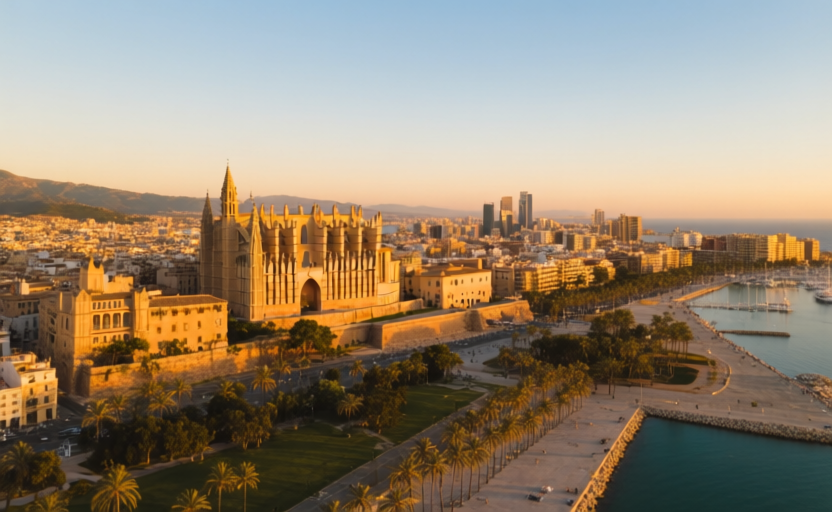
La Seu & the Parc de la Mar
Landmark · On the seafront below the old town
The Gothic cathedral standing directly above a reflecting lake, with a Gaudí intervention inside and a Barceló ceramic chapel.
Local tip: Go on a morning between eleven and noon in early November or February, when the light through the great rose window projects a second image of it onto the west wall beneath — a phenomenon the cathedral publishes dates for and locals turn up to watch. The Parc de la Mar below is the free version and the best evening walk in the city.
Santa Catalina
Nightlife · West of the old town, above the port
The old fishermen's and windmill quarter turned into Palma's densest concentration of bars, restaurants and small terraces.
Local tip: The market hall is the anchor and the streets around it are where the city eats and drinks. It is also the most internationalised barrio in Palma, which cuts both ways — you will find your people quickly and you will hear less Catalan than anywhere else in the city.
Mercat de l'Olivar
Food · Central, off Plaça d'Espanya
Palma's main covered market — fish, meat, island produce and a first-floor row of stalls that cook what you point at.
Local tip: The fish floor is where the city actually shops and prices are normal. Buy at a counter and take it upstairs to be cooked, which is the local move and costs a fraction of a restaurant. Go before noon; by two the good fish is gone.
Portixol & Es Molinar
Neighborhood · East along the seafront, 25 minutes on foot from the centre
A former fishing village absorbed by the city — low houses, a small harbour and a seafront promenade that carries on for kilometres.
Local tip: The cycle and walking path along the front runs from here all the way past the port to Cala Major, and it is the best piece of everyday infrastructure in Palma. The village itself has gentrified hard, but walk five minutes inland and Es Molinar is still an ordinary neighbourhood.
The Serra de Tramuntana & the Sóller train
Nature · North-west of the city
A UNESCO-listed cultural landscape of dry-stone terraces, olive groves and mountain villages, reached by a 1912 narrow-gauge railway from Palma.
Local tip: The train is a tourist ride and worth doing once. What residents do is drive or bus to Sóller, take the tram to the port, and walk a section of the GR-221 dry-stone route — the stage between Deià and Sóller is the accessible one. Winter and early spring are the good seasons; the mountain is unpleasant in August.
Castell de Bellver & its pine wood
Hidden gemCulture · On the hill west of the centre
A fourteenth-century circular Gothic castle — the only one of its shape in Europe — inside a public pine wood above the bay.
Local tip: Almost every visitor photographs the cathedral and never comes up here, which is why it is the best hour in Palma. Entry is free on Sundays. The wood around it is where the city runs and walks its dogs, and the terrace view takes in the whole bay, the port and the Tramuntana behind it.
Emergency numbers in Palma de Mallorca
Compare Palma de Mallorca with…
Side-by-side cost of living, language, climate and careers — to help you choose.