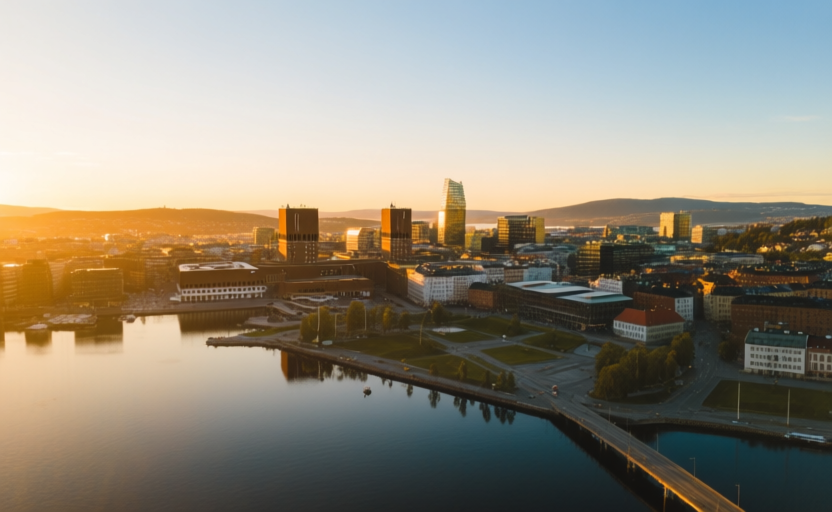
Norway · Europe
Moving to Oslo
Oslo quick facts
Norway at a glance
Europe & Central Asia
Economy
World BankReligion
% of populationCIA World Factbook / national censuses
Cost of living in Oslo
Can you move to Norway?
Pick your passport to see whether you can enter Norway — and what it takes to stay.
Entry rules come from github.com/imorte/passport-index-data, updated 17 February 2026. They change without notice — confirm with the official immigration service before booking.
Getting set up in Norway
The skilled worker permit, and the ID check that gates everything
Norway's skilled worker permit tests two things: that you are qualified, and that the job genuinely requires those qualifications. Pay must match the collective agreement where one applies, and where none does, at least NOK 545,400 a year for a post needing a bachelor's degree or NOK 624,700 for a master's — levels in force since 1 May 2026. Once here, everything waits on an in-person identity check at a tax office, which produces the number the rest of Norwegian life runs on.
Read the full step-by-step guideThe twelve-month licence window, studded tyres and toll rings
A non-EEA licence must be exchanged within twelve months of taking up residence, and after that window it cannot be exchanged at all — you start the full Norwegian licence process instead. Which country issued the licence determines whether you need only a practical test or the complete course. Oslo layers on its own costs: an electronic toll ring around and inside the city with time-varying rates, a seasonal charge for using studded winter tyres, and residential parking permits by district.
Read the full step-by-step guideGetting BankID, Vipps, and the deposit account the law requires
A Norwegian bank account requires an identity number, which requires the Skatteetaten identity check. What you actually need from the bank is BankID — the electronic identity used by tax, health, insurance and public services — and Vipps, the payment app that Norwegians use for everything between individuals. There is a third thing specific to Norway: renting requires a depositumskonto, a locked deposit account in your name that only the bank can release, and your bank sets it up.
Read the full step-by-step guideFolketrygden, your fastlege, and the frikort that caps the year
Norwegian healthcare runs through membership of folketrygden, which normally follows from being registered as resident or from employment here. Members are assigned a fastlege — a regular GP — who is the gatekeeper for specialists, referrals and sick notes. You pay a modest patient charge per consultation until your total for the calendar year reaches a ceiling, at which point a frikort exemption card is issued automatically and the rest of the year is free. Out-of-hours care is the legevakt, reached on 116 117.
Read the full step-by-step guideSIMs, coverage that reaches the forest, and EEA roaming that surprises people
Prepaid SIMs are sold in supermarkets and kiosks and work immediately, which makes a Norwegian number one of the few things obtainable before the identity number exists. Postpaid contracts need an identity number and a Norwegian payment method. Mobile prices are high by European standards but coverage is genuinely exceptional, including deep into the Marka forest and along most hiking routes — which is a safety consideration rather than a convenience one. Home broadband is fast and, in apartment buildings, frequently bundled into the joint costs.
Read the full step-by-step guidePAYE at a flat rate, national insurance, and Norway's wealth tax
Most foreign workers spend their first year in Norway under the PAYE scheme (kildeskatt på lønn): a flat 25% of gross salary, or 17.4% in 2026 if you are exempt from Norwegian national insurance, with no deductions and no tax return. It is capped by income and it is voluntary — you can opt into ordinary taxation, which is a 22% general income tax plus a stepped bracket tax plus a separate national insurance contribution, with deductions available. Norway also levies an annual wealth tax on net assets worldwide, which is the thing people with property or investments abroad most often fail to plan for.
Read the full step-by-step guideEach guide has verified costs, timelines, required documents, and the non-obvious gotchas — sourced from official government pages. Last verified August 2026.
Essential Norwegian phrases
Reading a list isn’t learning it. Globe Quest turns these into a trainer — hear each phrase spoken, drill them with spaced repetition, and get scored as you say them out loud.
What to know before you go
The ID check appointment is the bottleneck of your first month
CriticalBefore Skatteetaten will issue a national identity number or a D-number it requires an in-person identity check at one of a limited set of tax offices, and appointments in Oslo are booked out weeks ahead. Everything downstream — a bank account, BankID, a tax card, a fastlege, a phone contract — waits behind that number. Book the appointment the moment you know your arrival date, before you have an address, before you have anything. It is the single highest-leverage thing you can do about a Norwegian relocation.
Six months is the line between a D-number and a real one
CriticalIf you are staying in Norway for six months or more you report a move and are entered in the National Population Register with a fødselsnummer. Under six months you get a D-number instead. The D-number works for pay and tax but it is treated as provisional by banks, landlords, insurers and some health services, and getting BankID on one is harder. If your stay is genuinely long-term, make sure the registration reflects that rather than defaulting to the temporary route because it looked faster.
Your first year is probably taxed under PAYE at a flat 25%, and you can opt out
ImportantMost foreign workers are placed automatically into the PAYE scheme (kildeskatt på lønn) for short stays and for their first year of residence: a flat 25% of gross salary, or 17.4% in 2026 if you are exempt from Norwegian national insurance, with no deductions and no tax return at all. It is capped — you cannot earn more than NOK 725,050 in 2026 and stay in it. The scheme is voluntary and you may opt out into ordinary taxation, which is worth doing if you have substantial deductible costs such as mortgage interest or a long commute. Very few people run the comparison.
Norway taxes net wealth, including everything you own abroad
ImportantNorway is one of the few remaining countries with an annual wealth tax on individuals. It is charged at roughly one per cent of net assets above a threshold, rising slightly above a much higher one, and for a Norwegian tax resident it applies to worldwide assets — property abroad, foreign investment accounts, business holdings. Thresholds and rates are set in the annual budget and change. Anyone arriving with meaningful assets should get advice before becoming tax resident rather than after, because valuation rules and the treatment of unlisted shares and property differ substantially from income tax logic.
Most Norwegians buy, and the rental market you are searching is the leftovers
CriticalAround four in five Norwegian households own their home, and the rental stock is disproportionately made up of individual owners letting a flat rather than professional landlords. That produces thin supply, short and variable tenancies, and viewings where twenty people appear at once. Deposits are legally capped at six months' rent and must go into a dedicated depositumskonto in your name that neither party can touch alone. If a landlord asks for the deposit into their ordinary account, that is unlawful and it is the clearest warning sign in the Norwegian market.
Oslo is the most expensive city in the Nordics, and the mitigation is that the outdoors is free
Good to knowRestaurant meals, alcohol, taxis and services cost more here than anywhere else in the region, and alcohol is sold above 4.7% only through the state monopoly at limited hours. What offsets it is that the thing Oslo is actually for costs nothing: the Marka forest begins where the metro line ends, the fjord islands are on an ordinary public transport ticket, and allemannsretten gives you a legal right to walk, ski and camp across almost all uncultivated land. People who spend their weekends in restaurants find Oslo punishing; people who spend them outdoors find it cheap.
Top industries & employers
Energy & offshore
Equinor, Aker BP, Aker Solutions, DNV, Yara
Oslo holds the headquarters, the capital and the engineering services of an industry whose physical operations are on the west coast and offshore — the money and the boardrooms are here, the platforms are not.
Finance & asset management
DNB, Norges Bank Investment Management, Storebrand, Nordea Norway
Norges Bank Investment Management runs the sovereign wealth fund built from petroleum revenue, one of the largest single investors in the world, from an office in central Oslo.
Software & industrial technology
Cognite, Kahoot, Opera, Nordic Semiconductor, Remarkable
Norway's software sector is small but distinctive, weighted toward industrial data, education technology and low-power semiconductors rather than consumer apps.
Media, marketplaces & retail tech
Schibsted, Finn.no, Vipps MobilePay, Oda
Finn.no is where Norwegians buy houses, cars, furniture and find jobs — a single classifieds platform with a dominance no equivalent country has, and it is where your flat hunt will actually happen.
Maritime & shipping
Wilh. Wilhelmsen, Höegh Autoliners, Klaveness, Norwegian Hull Club
Oslo remains one of the world's genuine maritime capitals, with shipowning, broking, classification and marine insurance clustered around Aker Brygge and the fjord.
Public sector, health & research
Oslo University Hospital, University of Oslo, SINTEF, the Norwegian government
The public sector is a very large employer here, and Oslo University Hospital is one of the biggest in the Nordics — but most public roles require working Norwegian.
Where to go in Oslo
Nordmarka & Frognerseteren
Nature · North of the city, at the end of metro line 1
A thousand square kilometres of forest, lakes and ski trails, reachable by a metro ride from the city centre.
Local tip: Line 1 climbs 400 metres from the fjord to Frognerseteren and takes about half an hour from the centre. In winter the trails are floodlit into the evening; in summer you swim in Sognsvann. Norwegians consider this normal, which tells you most of what you need to know about Oslo.
Vigelandsparken
Landmark · Frogner
Over 200 sculptures by Gustav Vigeland in a public park, open at all hours and free — the largest sculpture park by a single artist anywhere.
Local tip: Go at seven in the morning or after ten at night in summer, when it is empty and the light is low. The Vigeland Museum across the road is the artist's own studio and almost nobody visits it.
Grünerløkka
Neighborhood · East of the river
A former industrial working-class district along the Akerselva, now the city's café, vintage and small-bar quarter.
Local tip: Walk the Akerselva river path from Vaterland up to Nydalen. It passes through the old mill buildings, a series of waterfalls and street art, and it is the single best short walk in Oslo — a river gorge running through the middle of a capital.
Bygdøy
Culture · Peninsula west of the centre
A green peninsula holding the Fram, Kon-Tiki and Norwegian Maritime museums, plus beaches and farmland inside the city boundary.
Local tip: Take the B9 ferry from the City Hall pier rather than the bus — it is on the ordinary Ruter ticket in summer and approaches the peninsula the way its museums' ships did. Huk beach at the far end is the city's main summer swimming spot.
Oslo fjord islands
Nature · 20 minutes by public ferry from Aker Brygge
Hovedøya, Lindøya, Gressholmen and the rest — car-free islands with monastery ruins, beaches and bathing rocks.
Local tip: The island ferries are ordinary public transport on a normal Ruter ticket, not a tour. Hovedøya has a ruined Cistercian abbey and a swimming beach fifteen minutes from the city hall, and half the people who live here have never been.
Ekebergparken
Hidden gemCulture · The hillside south-east of the centre
A sculpture park on a wooded ridge with the best view over the fjord and the city, and prehistoric rock carvings in the woods.
Local tip: Reachable by tram 13 or 19 up the hill. The rock carvings are several thousand years old and unfenced beside the path, and the terrace at the restaurant is where Munch is said to have conceived The Scream — the view matches the painting exactly.
Emergency numbers in Oslo
Compare Oslo with…
Side-by-side cost of living, language, climate and careers — to help you choose.