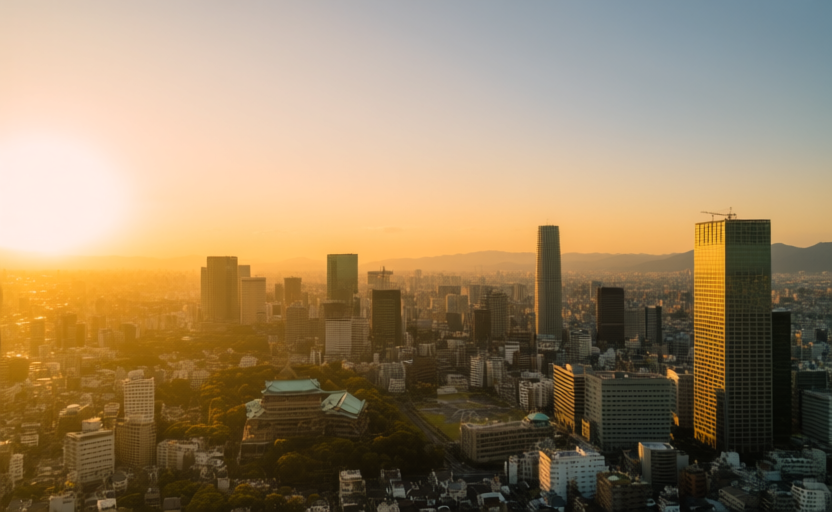
Japan · East Asia
Moving to Osaka
Osaka quick facts
Japan at a glance
East Asia & Pacific
Economy
World Bank · 2025Religion
% of populationCIA World Factbook / national censuses
Cost of living in Osaka
Can you move to Japan?
Pick your passport to see whether you can enter Japan — and what it takes to stay.
Entry rules come from github.com/imorte/passport-index-data, updated 17 February 2026. They change without notice — confirm with the official immigration service before booking.
Getting set up in Japan
The residence card, ward registration, and the fourteen-day rule
Japan issues your residence card at the airport on arrival, which is unusually efficient — but the card alone is not enough. You must register your address at your ward office within fourteen days, and that registration is what produces the jūminhyō certificate, triggers your My Number, and unlocks health insurance, banking and phone contracts. The card must be carried at all times and updated whenever you move.
Read the full step-by-step guideConverting a licence, and a city where a car is a liability
Converting a foreign licence — gaimen kirikae — requires a knowledge check and, for most countries, a practical test on a closed course that is notoriously exacting. A defined list of countries is exempt from the practical test. An International Driving Permit is valid for one year only and cannot simply be renewed by leaving and returning. Osaka has one of the world's densest rail networks and parking requires proof of a space before you can even register a car.
Read the full step-by-step guideOpening a Japanese account, and the six-month problem
Japanese banks vary enormously in how they treat new foreign residents, and several major banks effectively require six months of residence before opening a full account. Japan Post Bank and the online banks are the usual first stop because they do not. You need ward registration first. Japan remains more cash-oriented than most comparable countries, though contactless IC cards and QR payments have moved quickly.
Read the full step-by-step guideHealth insurance, the 30% rule, and the pension you can claim back
Enrolment in health insurance is a legal obligation, not a choice. Once enrolled you pay 30% of the cost of most treatment at the point of care and the scheme pays the rest, with a monthly ceiling that caps catastrophic costs. Pension enrolment is equally compulsory — and if you leave Japan you can claim a lump-sum withdrawal of part of what you paid, which a great many departing residents never do.
Read the full step-by-step guideGetting a Japanese SIM, and why the MVNOs are the answer
Japanese mobile has historically been expensive, dominated by three carriers with two-year contracts and heavy handset subsidies. Government pressure changed that, and the low-cost sub-brands and MVNOs now offer genuinely cheap plans on the same networks. You need a residence card and usually a Japanese bank account or credit card. Home fibre is fast and cheap but installation in an apartment can depend on the building.
Read the full step-by-step guideIncome tax, residence tax billed in arrears, and the exit trap
Most employees never file a return — the employer's year-end adjustment handles it. The two things that catch foreign residents are residence tax, which is calculated on last year's income and billed from the following June, and the distinction between non-permanent and permanent tax residence, which determines whether Japan taxes your foreign income at all. Both matter most at the beginning and the end of a stay.
Read the full step-by-step guideEach guide has verified costs, timelines, required documents, and the non-obvious gotchas — sourced from official government pages. Last verified August 2026.
Essential Japanese phrases
Reading a list isn’t learning it. Globe Quest turns these into a trainer — hear each phrase spoken, drill them with spaced repetition, and get scored as you say them out loud.
What to know before you go
Register at your ward office within fourteen days — everything else waits on it
CriticalJapanese law requires you to register your address at the local ward office within fourteen days of moving in. That registration produces the jūminhyō residence certificate and triggers your My Number, and without it you cannot enrol in health insurance, open most bank accounts, or complete a phone contract. It is a short in-person appointment with your residence card and passport. Newcomers treat it as an errand and then find four separate things blocked behind it.
Renting in Japan costs four to six months' rent up front, and much of it is not refundable
CriticalThe standard package is a deposit (shikikin), key money (reikin — a non-refundable gift to the landlord), an agency fee, a guarantor company fee, fire insurance and the first month's rent. Together these routinely reach four to six months. Key money in particular is money you never see again and is not a deposit despite being paid like one. Osaka is somewhat gentler than Tokyo on this and zero-reikin properties are increasingly common — but budget for the full package and treat anything less as a bonus.
Residence tax is billed a year in arrears and it ambushes people leaving Japan
CriticalJūminzei is calculated on your previous calendar year's income and billed from the following June. So your first year feels cheap and your second year is expensive, and if you leave Japan you can still owe a full year's residence tax on income you have already spent. Anyone planning a departure should either appoint a tax agent or settle it before going — this is the single most common financial shock among people finishing a stint in Japan.
Health insurance and pension enrolment are mandatory, not optional
CriticalIf your employer enrols you in shakai hoken, this is handled for you. If not — freelancers, some contract workers, and anyone between jobs — you must enrol in National Health Insurance and the National Pension at your ward office yourself. Both are legal obligations and back-payments can be demanded. The pension has a lump-sum withdrawal available on leaving Japan, which is worth claiming and is frequently forgotten.
Osaka is materially cheaper than Tokyo for a comparable life
ImportantRents run well below Tokyo's for equivalent space and location, and the city is compact enough that a central flat is genuinely attainable. Salaries are somewhat lower but not proportionally, so disposable income is usually better. What you give up is the depth of Tokyo's international job market and the direct international flight network — Kansai is a good airport but it is not Haneda.
Stand on the right on the escalator, and other things Tokyo does backwards
Good to knowOsaka stands on the right and walks on the left, the reverse of Tokyo and most of Japan. 'Aho' is affectionate here and offensive there. Conversation with strangers is more common, shopkeepers are blunter, and the formality gradient is noticeably shallower. None of this is trivia — people arriving from Tokyo reliably misread Osaka's directness as rudeness, and it is the opposite.
Top industries & employers
Pharmaceuticals & life sciences
Takeda, Shionogi, Ono Pharmaceutical, Sumitomo Pharma
Doshomachi in central Osaka is the historic birthplace of Japan's pharmaceutical industry, and Takeda — Japan's largest drug company — was founded there in 1781.
Electronics & manufacturing
Panasonic, Sharp, Daikin, Keyence, Omron
Panasonic and Sharp were both founded in the Osaka region, and Daikin is the world's largest air conditioning manufacturer. Keyence, in nearby Amagasaki, is one of Japan's most profitable companies.
Trading & commerce
Itochu, Sumitomo Corporation, Marubeni, Iwatani
Osaka is Japan's merchant city and several of the great sōgō shōsha trading houses were founded here, retaining substantial operations alongside their Tokyo headquarters.
Heavy industry & machinery
Kubota, Sumitomo Heavy Industries, Hitachi Zosen, Kawasaki Heavy Industries
The Osaka Bay industrial belt remains one of Japan's most concentrated manufacturing regions, spanning shipbuilding, agricultural machinery and industrial plant.
Retail, food & hospitality
Nissin Foods, House Foods, Ezaki Glico, Takashimaya
Instant noodles were invented in Ikeda just outside the city, and Glico's running man sign in Dotonbori is one of Japan's most recognised images. Food is genuinely central to the local economy.
Higher education & research
Osaka University, Osaka Metropolitan University, RIKEN Osaka, Kansai University
Osaka University is one of Japan's former imperial universities and a leading research institution, with particular strengths in immunology and materials science.
Where to go in Osaka
Dotonbori & Namba
Nightlife · Minami, southern central Osaka
The canal-side neon strip with the Glico running man, and the dense grid of eating and drinking streets behind it.
Local tip: Dotonbori itself is where you photograph the signs. The actual eating is one street back in Hozenji Yokocho, a stone-paved lane of tiny old restaurants that survived the war, and in the arcades running south toward Namba.
Osaka Castle & the park
Landmark · Central, east of Umeda
A reconstructed keep on the original stone base, in a large park that is the city's best cherry blossom and running ground.
Local tip: The keep interior is a museum and lift, which disappoints people expecting an original castle. The stonework and the moats are the genuinely astonishing part — some single blocks weigh over a hundred tonnes — and walking the perimeter is free.
Shinsekai & Tsutenkaku
Neighborhood · South, near Tennoji
A 1912 vision of the future frozen in place — a tower modelled on the Eiffel, and streets of kushikatsu restaurants beneath it.
Local tip: The rule at a kushikatsu counter is absolute: never double-dip the shared sauce. Every restaurant has a sign about it. The area is rougher than most of Osaka and entirely fine in the evening.
Nakazakichō
Neighborhood · Just south of Umeda
A pocket of pre-war wooden houses that escaped the bombing, now full of small cafés, vintage shops and galleries.
Local tip: Ten minutes' walk from Umeda's towers and almost nobody makes the trip. The streets are too narrow for cars, which is why it feels like a different city. Best on a weekday afternoon.
Kuromon Ichiba market
Food · Nipponbashi
A 600-metre covered market that has fed central Osaka since the nineteenth century, now half local grocers and half street food.
Local tip: The eastern end is still where restaurants buy their fish and where prices are normal. The western end is priced for visitors. Go before nine in the morning to see it working rather than performing.
Minoo Falls
Hidden gemNature · 40 minutes north by train
A 33-metre waterfall at the end of a wooded gorge walk, on the edge of the metropolitan area.
Local tip: A short train from Umeda puts you at the trailhead, and the walk up the valley takes under an hour on a paved path. In November the maples are as good as anything in Kyoto and with a fraction of the crowd — and the tempura-fried maple leaves sold along the path are a genuine local speciality rather than a gimmick.
Emergency numbers in Osaka
Compare Osaka with…
Side-by-side cost of living, language, climate and careers — to help you choose.