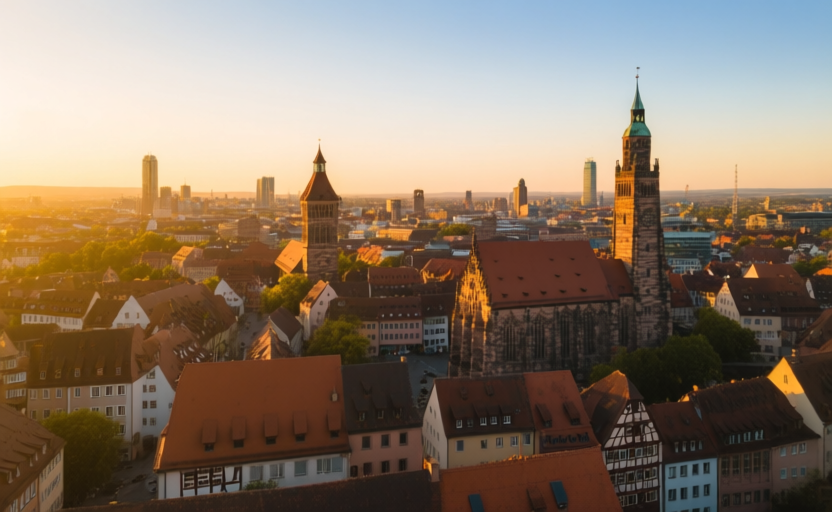
Germany · Europe
Moving to Nuremberg
Nuremberg quick facts
Germany at a glance
Europe & Central Asia
Economy
World Bank · 2025Religion
% of populationCIA World Factbook / national censuses
Cost of living in Nuremberg
Can you move to Germany?
Pick your passport to see whether you can enter Germany — and what it takes to stay.
Entry rules come from github.com/imorte/passport-index-data, updated 17 February 2026. They change without notice — confirm with the official immigration service before booking.
Getting set up in Germany
Anmeldung, residence permits, and why BAMF being down the road does not help
Register your address within two weeks of moving in and you receive the Meldebescheinigung that everything else depends on. Nuremberg's genuine administrative advantage over Munich is availability: registration slots are usually obtainable within days. Two Bavarian points then matter — church tax is 8% rather than the usual 9%, and it is elected on the registration form — and one local myth is worth dispelling: BAMF's headquarters being here does not make your personal permit faster.
Read the full step-by-step guideExchanging a licence, and a metropolitan region that runs on one ticket
An EU or EEA licence needs no action. A non-EU licence is valid for six months from taking up residence, and whether the exchange is a form or a full German driving course depends on the issuing country — and for the United States, Canada and Australia, the state or province. Practically, Nuremberg is easy to live in without a car: the VGN network covers the whole metropolitan region including Fürth, Erlangen and Herzogenaurach, and the Deutschlandticket covers all of it.
Read the full step-by-step guideOpening a Girokonto, the Schufa file, and a deposit you can pay in thirds
A German IBAN is the precondition for salary, rent and the direct debits that run everything here. Traditional banks want the registration certificate and tax ID first, which is circular on arrival; digital banks generally do not. The rental market is far less brutal than Munich's, so a thin Schufa file is survivable — but only if you turn up with the documents that stand in for it, and only if you know that the deposit is capped and splittable.
Read the full step-by-step guideCompulsory cover, the near-irreversible private choice, and finding a GP
Employees below an annually reset income threshold join the statutory system, where contributions are income-based, split with the employer and cover non-earning dependants free. Above it, and for the self-employed, private cover opens up — cheaper at thirty, dearer at sixty, priced per person and effectively closed to exit after 55. Nuremberg's practical advantages are that GP lists are less uniformly full than Munich's, and that Klinikum Nürnberg and the Erlangen university hospital give the region unusually strong hospital coverage.
Read the full step-by-step guideGetting a German SIM, and coverage once you leave for the beer cellars
There is no anonymous SIM in Germany — every card is tied to an identified person, verified in store, by video call or at a post office. Prepaid needs no registration certificate, bank account or credit history and is the sensible first move. Fixed-line provisioning takes weeks, so order at lease signing. And if your weekends look like most people's here — regional trains out into Franconian Switzerland and the brewery villages — check coverage for those routes, not for the city.
Read the full step-by-step guideIncome tax, Bavaria's 8% church tax, and the cheapest purchase tax in Germany
For an employee the machinery runs itself — Lohnsteuer comes off monthly by tax class and many people never file. Three things repay attention. Church tax is 8% here rather than the usual 9%, elected on your registration form. The commuting allowance is unusually valuable in a region where people routinely live in one of three cities and work in another. And Bavaria still charges the lowest property transfer tax in Germany, which matters the moment you consider buying.
Read the full step-by-step guideEach guide has verified costs, timelines, required documents, and the non-obvious gotchas — sourced from official government pages. Last verified August 2026.
Essential German phrases
Reading a list isn’t learning it. Globe Quest turns these into a trainer — hear each phrase spoken, drill them with spaced repetition, and get scored as you say them out loud.
What to know before you go
Register within two weeks — and it is far easier here than in Munich
CriticalThe Anmeldung at a Bürgeramt is legally due within two weeks of moving in and unlocks the tax ID, the bank account, health insurance and the residence permit. Nuremberg's appointment availability is one of the quiet advantages of choosing it over Munich: slots are usually obtainable within days rather than weeks. Book online as soon as you have a move date, take any district office, and ask for several certified copies of the Meldebescheinigung at the counter, because four separate institutions will each want one.
Bavaria charges 8% church tax, and the question is asked at registration
CriticalDeclaring membership of a recognised church on your registration form starts automatic deduction of Kirchensteuer at 8% of your income tax liability — the reduced rate that only Bavaria and Baden-Württemberg apply, against 9% everywhere else. Declaring no affiliation is lawful and free. Leaving the church afterwards requires a formal appointment at the registry, a fee, and takes effect only from the following month rather than retrospectively, so an answer given in January costs a full year if you change your mind in November.
Nuremberg has been on the rent-cap list since 2015, but the cap has not been continuously enforceable
CriticalBavaria's Mieterschutzverordnung limits a new rent to at most 10% above the local reference rent and caps increases to a sitting tenancy at 15% over three years. Nuremberg has been named in it since the first ordinance in August 2015. The complication is history: that 2015 ordinance was held ineffective by the Landgericht München I in December 2017 because the state had not properly justified, municipality by municipality, why each area qualified — so for a period landlords here simply could not be held to the cap. Bavaria re-issued it in 2019 and the current version took effect on 1 January 2026, covering 285 Bavarian municipalities and running to 31 December 2029. Check which version applies to your contract's start date before assuming you are protected.
Health insurance is compulsory and the private choice is close to permanent
CriticalEveryone must be insured. Employees below the annually reset threshold — around EUR 77,400 gross for 2026 — join the statutory system, where contributions are income-based, split with the employer, and cover a non-earning spouse and children at no extra charge. Above it, private cover opens up: cheaper at thirty, considerably dearer at sixty, priced per person and effectively impossible to leave after 55. Nuremberg salaries mean many people sit near the threshold rather than clearly above it, which is exactly where brokers work hardest.
This is Bavaria at roughly half the Munich rent, with an honest trade-off
ImportantA central one-bedroom flat here costs materially less than the equivalent in Munich, the schools and public services are the same Bavarian standard, and the Alps are still reachable for a weekend. What you give up is the depth of the international job market and, usually, some salary — Nuremberg pays well by German standards and less than Munich for the same role. The city is also a hinge in the rail network, which makes Munich, Frankfurt and Berlin all straightforward day trips.
The history here is on display rather than tucked away, and the city is deliberate about it
Good to knowThe Nazi party rally grounds still stand on the city's southeast edge with a documentation centre built into the unfinished Congress Hall, and Courtroom 600 in the Justizpalast — where the Nuremberg Trials were held — is a working courtroom with a museum attached. The city responded by rebuilding its identity around human rights: there is a Street of Human Rights running beside the national museum and an international human rights prize awarded here. Expect the subject to come up, and expect locals to be direct rather than uncomfortable about it.
Top industries & employers
Federal agencies
Bundesagentur für Arbeit, Bundesamt für Migration und Flüchtlinge (BAMF)
Both the Federal Employment Agency and the federal migration office are headquartered in Nuremberg, making the public sector one of the city's largest and most stable employers — and giving it an unusual concentration of policy and administrative work for a city this size.
Electrical engineering & rail
Siemens, Siemens Mobility, Diehl, Alstom (Nuremberg works)
Siemens has manufactured in Nuremberg for over a century and the city builds trains, drives and industrial automation. The engineering labour market here is deep, and less exposed to a single sector than Stuttgart's.
Medical technology & research (Erlangen)
Siemens Healthineers, Friedrich-Alexander-Universität Erlangen-Nürnberg, Universitätsklinikum Erlangen
Erlangen, twenty minutes north on the S-Bahn, is one of Europe's densest medical technology clusters, anchored by Siemens Healthineers and one of Germany's largest universities.
IT, financial services & market research
DATEV, Consorsbank, TeamBank, Nürnberger Versicherung, GfK
DATEV is one of Germany's largest IT service providers, a cooperative built to run the software of the country's tax advisers — an unglamorous, very large and very stable local employer.
Consumer brands, writing instruments & toys
Playmobil (Zirndorf), Faber-Castell (Stein), Staedtler, Schwan-Stabilo, NürnbergMesse
The region makes an improbable share of the world's pencils and toys, and NürnbergMesse runs the world's largest toy fair as well as BIOFACH and embedded world.
Sporting goods & precision components (Herzogenaurach)
adidas, Puma, Schaeffler
Two of the world's three largest sportswear companies were founded by feuding brothers in the same small town twenty kilometres west, and both still have their global headquarters there alongside Schaeffler's bearings business.
Where to go in Nuremberg
Kaiserburg and the city walls
Landmark · Altstadt
The imperial castle on the sandstone ridge above the old town, with five kilometres of surviving medieval wall running round it.
Local tip: The Sinwellturm view is the classic one, but the free part is better: walk the wall and the dry moat, which is a continuous green ditch circling the old town that locals use as a park and almost no visitor walks all the way round.
Reichsparteitagsgelände and the Dokumentationszentrum
Culture · Southeast, by the Dutzendteich
The Nazi party rally grounds, including the unfinished Congress Hall which now houses a documentation centre about them.
Local tip: The site is enormous and deliberately not tidied up — the Zeppelinfeld grandstand is crumbling and the debate about whether to conserve it is very much live. Take the S-Bahn to Dutzendteich and allow three hours. The documentation centre is excellent and unflinching.
Memorium Nuremberg Trials, Courtroom 600
Landmark · Justizpalast, west of the centre
The courtroom where the leadership of Nazi Germany was tried in 1945 and 1946 — still an operating Bavarian courtroom, with a museum on the floor above.
Local tip: Because it is a working court, access to the room itself depends on the day's sittings — check before travelling. Walk from there to the Street of Human Rights beside the Germanisches Nationalmuseum, where thirty elements — twenty-seven concrete pillars, two floor plates and an oak tree — each carry one article of the Universal Declaration in German and in a different second language.
Tiergarten Nürnberg
Nature · Schmausenbuck, east of the city
A zoo laid out in a disused sandstone quarry and the surrounding forest, and one of the most beautiful in Europe for that reason.
Local tip: The quarry walls and pine woods do most of the design work, and the site is large enough that a visit is a walk in a forest that happens to contain animals. A season ticket costs little more than two visits and locals treat it as a park.
Gostenhof
Neighborhood · Immediately west of the old town
'GoHo' — the multicultural district just outside the walls that has become the city's centre of gravity for bars, studios and independent shops.
Local tip: The stretch around Austraße and the Jamnitzerplatz is where most of the good small restaurants are, and it is where the city's nightlife has migrated from the tourist-facing Altstadt. Still genuinely mixed rather than finished, which is the point.
The Felsengänge and the Kellerbier gardens
Hidden gemFood · Under the old town, and out into Franconia
Four storeys of rock-cut cellars beneath the castle hill, dug for brewing, later used as a bomb-proof art store — and the beer gardens above them.
Local tip: The cellars are cold, cut by hand into sandstone, and in the war they held the imperial regalia and Dürer's work while the city above burned. Then get on a train to Upper Franconia and drink Kellerbier at a brewery tap — the region has the highest brewery density on earth, and almost nobody who moves to Nuremberg is told this in the first year.
Emergency numbers in Nuremberg
Compare Nuremberg with…
Side-by-side cost of living, language, climate and careers — to help you choose.