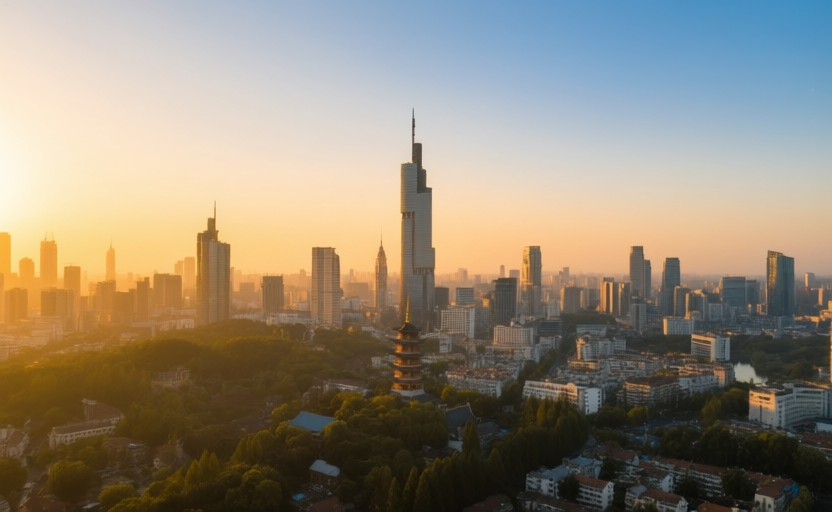
China · East Asia
Moving to Nanjing
Nanjing quick facts
China at a glance
East Asia & Pacific

Economy
World BankReligion
% of populationCIA World Factbook / national censuses
Cost of living in Nanjing
Can you move to China?
Pick your passport to see whether you can enter China — and what it takes to stay.
Entry rules come from github.com/imorte/passport-index-data, updated 17 February 2026. They change without notice — confirm with the official immigration service before booking.
Getting set up in China
Work permit, study residence permit, and the 24-hour registration
The national sequence is fixed: Notification Letter of Foreigner's Work Permit obtained by your employer, Z visa at a Chinese mission abroad, entry, work permit card, then a residence permit within 30 days of entry — plus police registration within 24 hours of moving into a private flat. Because Nanjing's foreign population is heavily academic, a large share of arrivals come on X1 study visas instead, which follow the same 30-day residence permit rule and carry a specific restriction: working without the endorsement noted on your permit is illegal employment, and it is enforced.
Read the full step-by-step guideConverting a licence in a city you can mostly walk
A foreign licence is not valid in mainland China and the International Driving Permit is not recognised. Conversion means a translation, a medical and the hundred-question written theory test, with practical tests waived for ordinary car categories. Unlike its wealthier neighbours, Nanjing has not rationed number plates, so you can buy a car and register it. Whether you need one is a different question in a city with a good metro, a compact walled old core and hills you cannot drive up anyway.
Read the full step-by-step guideOpening an account, and the student account trap
Alipay and WeChat Pay accept foreign Visa and Mastercard up to USD 5,000 per transaction and USD 50,000 a year after verification, which covers a visit. Living here needs a local account, and the account needs a Chinese mobile number registered against your passport. The Nanjing-specific point is that a large share of foreign residents arrive as students, and student accounts are frequently opened as restricted-tier accounts that will not do what a working adult needs them to do.
Read the full step-by-step guideSocial insurance, university hospitals, and student insurance that is not enough
Nanjing has strong teaching hospitals attached to its universities — the Drum Tower Hospital and Jiangsu Province Hospital among them — with the standard Chinese structure of cheap Mandarin-language ordinary outpatient departments and international wings at several times the price. The distinction that matters here is between employees, who are enrolled in social insurance and usually given private cover, and the very large student and researcher population, whose compulsory insurance is basic and whose exposure is correspondingly higher.
Read the full step-by-step guideReal-name SIM, campus broadband, and the internet you should plan for
A SIM takes twenty minutes and a passport and should be your first errand, because the number gates the bank account and the payment apps. The blocked-services position is the same as everywhere in mainland China, but there is a Nanjing-specific wrinkle: university networks operate their own authentication and their own filtering, and what works on a campus connection is not necessarily what works in a private flat, or the reverse. Sort out your arrangement before you fly.
Read the full step-by-step guideIIT, the six-year rule, and the teacher and researcher treaty articles
The national rules apply: monthly withholding, an annual reconciliation between March and June, a 183-day residence test, and a six-year rule on worldwide income that resets with a single absence of more than thirty consecutive days. Foreign nationals elect annually between the expatriate fringe-benefit exemptions and the standard itemised deductions. What is worth particular attention in a university city is that many of China's double tax treaties contain specific articles for teachers, researchers and students that can exempt qualifying income for a defined period — and almost nobody claims them.
Read the full step-by-step guideEach guide has verified costs, timelines, required documents, and the non-obvious gotchas — sourced from official government pages. Last verified August 2026.
Essential Mandarin Chinese phrases
Reading a list isn’t learning it. Globe Quest turns these into a trainer — hear each phrase spoken, drill them with spaced repetition, and get scored as you say them out loud.
What to know before you go
Register with the police within 24 hours of moving into a flat
CriticalArticle 39 of the Exit and Entry Administration Law requires anyone staying outside a hotel to register with the local public security organ within 24 hours of arrival. Hotels file it invisibly; private landlords do not. Take passport, visa, lease and landlord to the neighbourhood pàichūsuǒ and keep the slip, because it is requested again at your residence permit application and every renewal. If you are living in university accommodation the international office usually handles it, which is exactly why people who later move into a private flat do not know the rule exists.
The residence permit is due within 30 days of entry, and student status is not an exemption
CriticalA Z visa or an X1 study visa gets you across the border and expires. Within 30 days of entry you must apply to the Nanjing Public Security Bureau's Exit–Entry Administration for a residence permit. Universities here are well drilled and usually run the process for their international students in a batch, but a researcher or a language student arriving off-cycle can fall through it. The deadline attaches to you, not to the institution.
This is an academic city, and the foreign community reflects that
ImportantNanjing has one of the densest concentrations of universities and research institutes in China — Nanjing University, Southeast University, Hohai, the aeronautics and astronautics university, the normal university and dozens more — plus the Jiangsu provincial government. The consequence is that the foreign population here is weighted toward students, researchers, language teachers and academics rather than corporate expatriates. That makes the community younger, poorer, more transient and considerably more welcoming than Shanghai's, and it means the services built around foreign residents are university-adjacent rather than commercial.
An hour from Shanghai on the same line, at a fraction of the cost
ImportantNanjing South to Shanghai Hongqiao runs in a little over an hour on the high-speed line, with departures every few minutes. Rents here are roughly a third of central Shanghai's, the city is calmer and greener, and the Yangtze delta's economic gravity still reaches it. For anyone whose work is delta-wide, or who is comparing a Nanjing offer with a Shanghai one, the arithmetic is genuinely favourable. What you give up is the depth of Shanghai's international job market and its direct long-haul flights.
The summer is among the hardest in China, and there is no central heating in winter
Good to knowNanjing is traditionally counted among China's 'furnace' cities. July and August combine high thirties with humidity that removes any evening relief, and the city sits in a river basin ringed by hills that trap the heat. Winter is short but damp and hovers around freezing, and like everywhere south of the Huai river there is no municipal central heating — you will heat one room with a reverse-cycle air conditioner. Spring and autumn, when the plane trees turn, are genuinely lovely and genuinely brief.
The history here is heavy, and it is worth understanding before you arrive
ImportantNanjing has been the capital of Chinese states repeatedly, most recently as the Republic of China's capital, and it was the site of the mass killing of Chinese civilians and disarmed soldiers by Japanese forces in the winter of 1937–38. The Memorial Hall is a major civic institution and the anniversary each December is marked with a national commemoration. This is not background: it shapes how the city sees itself, it is taught intensively in local schools, and it can surface in conversation in ways a newcomer may not expect. Reading about it properly before you arrive is a basic courtesy to the place you have moved to.
Top industries & employers
Higher education & research
Nanjing University, Southeast University, Hohai University, Nanjing University of Aeronautics and Astronautics
One of the densest university clusters in China, with a very large student population and a correspondingly deep research base. It is the single largest reason foreign professionals end up here.
Software & information services
Huawei and ZTE R&D centres, Suning, Nanjing Software Valley tenants
Nanjing Software Valley in Yuhuatai district is one of China's designated software industry bases, and the major telecoms companies run substantial research operations here rather than only in Shenzhen.
Petrochemicals & materials
Sinopec Jinling Petrochemical, BASF joint ventures, Nanjing Chemical Industry Park
The Yangtze riverfront north-east of the city holds one of China's largest petrochemical complexes, a substantial employer of process and safety engineers.
Automotive & new energy
Nanjing Iveco, LG Chem battery operations, BYD and Xpeng supply chain
Jiangning district in the south is a significant automotive and battery manufacturing base, and the electric vehicle supply chain here has expanded considerably.
Pharmaceuticals & biotech
Simcere Pharmaceutical, Nanjing Biomedical Valley tenants
A growing life sciences cluster anchored by the medical faculties of the local universities and by domestic pharmaceutical companies headquartered in the city.
Provincial government & professional services
Jiangsu provincial administration, the major Chinese law and accountancy firms
Nanjing is the capital of Jiangsu, China's second-largest provincial economy, which supports a substantial administrative and professional services sector.
Where to go in Nanjing
The Ming city wall & Zhonghua Gate
Landmark · Encircling the old city
The longest surviving city wall in the world, built in the fourteenth century, with long stretches walkable along the top.
Local tip: Zhonghua Gate in the south is the extraordinary bit — a fortified gatehouse with four successive gates and internal courtyards designed to trap an attacking army, plus tunnels for three thousand soldiers. Walk the wall section from Jiming Temple toward Xuanwu Lake at sunset; it is one of the great urban walks in China and it costs almost nothing.
Purple Mountain (Zijinshan)
Nature · Eastern edge of the city
A forested massif on the city's edge holding the Ming Xiaoling tomb, the Sun Yat-sen Mausoleum and an observatory.
Local tip: The Sacred Way at Ming Xiaoling — a curving avenue lined with stone elephants, camels and officials, laid out in the 1380s — is best in late November when the maples and ginkgos turn. It is a UNESCO-listed site as part of the Imperial Tombs of the Ming and Qing dynasties, and on a weekday morning it is nearly empty.
The Nanjing Massacre Memorial Hall
Culture · Jiangdongmen, western Nanjing
The national memorial to the Chinese civilians and disarmed soldiers killed by Japanese forces in the winter of 1937–38, built on a mass grave site.
Local tip: It is free, it is heavily visited by school groups, and it is a demanding two hours. Going is a normal thing for a resident to do rather than a tourist act — this event is central to how the city understands itself, and the anniversary each December is marked citywide.
Xuanwu Lake
Nature · Immediately north-east of the old city, inside the wall
A large lake with islands and causeways, wrapped by the Ming wall on one side and Purple Mountain on the other.
Local tip: The circuit is about ten kilometres and the northern shore is the quiet half. This is where Nanjing exercises — the early morning around the lake, with the wall above and the mountain behind, is the best free thing the city offers.
Fuzimiao & the Qinhuai river
Food · Qinhuai district, southern old city
The Confucius Temple and the historic imperial examination quarter, on a canal lit with lanterns at night.
Local tip: Fuzimiao itself is the busiest tourist strip in the city. Go one street back into the lanes off Zhanyuan Road for the actual Nanjing snacks — salt-water duck, duck blood and vermicelli soup, and the small dumplings — at half the price and without the crowds.
Pingshi Street & the Republican quarter
Hidden gemNeighborhood · Gulou and Xuanwu, around the former government buildings
Streets of 1920s and 1930s Republican-era villas and ministries under plane trees, largely unvisited and still in use.
Local tip: Between 1927 and 1937 this was the capital of China and the state built accordingly — legations, ministries and villas in a distinctive Republican style, most of them still standing and many still occupied. Walk Yihe Road and the streets around it on an autumn afternoon. Almost no visitor knows this exists, and it is the most atmospheric part of the city.
Emergency numbers in Nanjing
Compare Nanjing with…
Side-by-side cost of living, language, climate and careers — to help you choose.