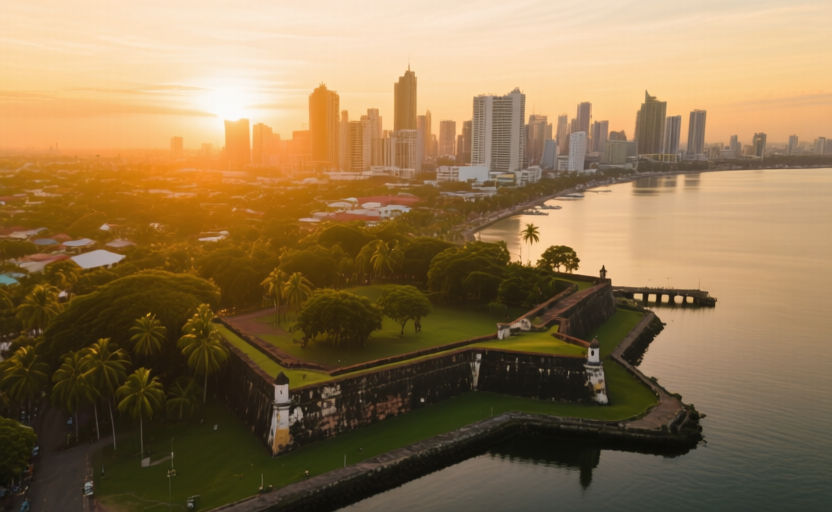
Philippines · Southeast Asia
Moving to Manila
Manila quick facts
Philippines at a glance
East Asia & Pacific

Economy
World Bank · 2025Religion
% of populationCIA World Factbook / national censuses
Cost of living in Manila
Can you move to Philippines?
Pick your passport to see whether you can enter Philippines — and what it takes to stay.
Entry rules come from github.com/imorte/passport-index-data, updated 17 February 2026. They change without notice — confirm with the official immigration service before booking.
Getting set up in Philippines
AEP, 9(g) working visa and the ACR I-Card
Three documents, in a fixed order. The Department of Labor and Employment issues an Alien Employment Permit; only then will the Bureau of Immigration convert your status to a 9(g) pre-arranged employment visa; and within thirty days of that approval you must obtain an ACR I-Card. Expect six to ten weeks end to end, and note that everything renews annually.
Read the full step-by-step guideConverting your licence and the LTO process
You may drive on a valid foreign licence for a limited window after arrival — commonly cited as 90 days — provided it's in English or accompanied by a translation. Beyond that, conversion through the LTO requires a medical examination, a drug test and, depending on your licence, a theory exam. Most residents in Manila conclude they'd rather not drive at all.
Read the full step-by-step guideOpening a Philippine bank account
Philippine banks want your ACR I-Card, and most will not open a standard peso account for a foreigner without it. Once you have it, the process is straightforward. Digital wallets — GCash and Maya — are used far more than cards for everyday payments and are worth setting up alongside the bank account.
Read the full step-by-step guidePhilHealth, HMOs and private hospitals
PhilHealth is the national health insurance scheme and enrolment is compulsory for employees. Its coverage is partial, functioning as a subsidy against hospital bills rather than comprehensive insurance. Nearly all professional employers therefore provide an HMO plan, and Manila's private hospitals are genuinely excellent.
Read the full step-by-step guideGetting a Philippine mobile number
Two main networks, Globe and Smart, with DITO as a newer third. The SIM Registration Act requires every SIM to be registered against identification, with foreigners registering using passport details. Prepaid dominates, and mobile data is how most people get online.
Read the full step-by-step guideTIN, income tax and residency status
A Tax Identification Number from the Bureau of Internal Revenue is required for employment. The important subtlety is classification: resident aliens are taxed on Philippine-sourced income at graduated rates, while non-resident aliens not engaged in trade or business face a flat rate on gross income with no deductions. Which bucket you fall into materially changes your take-home.
Read the full step-by-step guideEach guide has verified costs, timelines, required documents, and the non-obvious gotchas — sourced from official government pages. Last verified July 2026.
Essential Filipino phrases
Reading a list isn’t learning it. Globe Quest turns these into a trainer — hear each phrase spoken, drill them with spaced repetition, and get scored as you say them out loud.
What to know before you go
Your appliances will die: 220V through US-style sockets
CriticalThe Philippines uses American flat-pin plugs at 220 volts. A US or Japanese appliance will physically fit the socket and then be destroyed by double the voltage it expects. Check every device's rating before plugging anything in — this catches Americans in particular, constantly.
Learn po and opo in your first week
CriticalFilipino encodes respect grammatically. Adding 'po' when addressing anyone older or in a service role is not optional politeness — leaving it out marks you as rude in a way that's hard to recover from socially. It costs nothing to adopt.
Plan your life around traffic, not distance
CriticalMetro Manila's congestion is among the worst on earth. Eight kilometres across EDSA at rush hour can take two hours. Where you live relative to your office is the single biggest determinant of your quality of life here — more than the flat itself.
Typhoon season runs roughly June to November
ImportantExpect several significant storms a year, with flooding in low-lying areas and work-from-home or suspension announcements. Check the flood history of any neighbourhood before signing a lease — it varies enormously street by street.
English will take you further than you expect
Good to knowEnglish is an official language and the medium of business, government and higher education. You can live and work here without Tagalog. Learning courtesy phrases still transforms how you're received, but you won't be locked out.
Christmas genuinely starts in September
Good to knowThe 'ber months' bring decorations and carols from 1 September. It's the longest Christmas season in the world and it is not a joke — plan around a very long festive period and heavy December traffic.
Top industries & employers
Business process outsourcing
Concentrix, Accenture, TaskUs, Teleperformance, Alorica
The defining industry — the Philippines is the world's leading destination for voice BPO, employing well over a million people, concentrated in Makati, BGC and Ortigas.
Banking & financial services
BDO, Metrobank, BPI, Security Bank, UnionBank
Makati is the traditional financial district, with a growing fintech scene alongside the incumbents.
Real estate & conglomerates
Ayala Land, SM Prime, Megaworld, JG Summit
A handful of family conglomerates dominate the economy, and property development is how much of the country's wealth is expressed.
Information technology & software
Accenture, Cognizant, local startups, global captives
Increasingly moving up the value chain from voice support into software engineering and shared services.
Maritime & seafaring
Global shipping lines, crewing agencies
The Philippines supplies a very large share of the world's merchant seafarers, and Manila is the industry's administrative centre.
Healthcare & medical services
St. Luke's, Makati Medical Center, The Medical City
A major exporter of nursing and medical talent, with strong private hospitals serving both locals and medical tourists.
Where to go in Manila
Intramuros
Landmark · Old Manila
The Spanish colonial walled city — Fort Santiago, San Agustin Church and cobbled streets inside sixteenth-century walls.
Local tip: Do it by bamboo bike with a guide rather than on foot in the heat. San Agustin survived the 1945 battle that levelled almost everything else, and knowing that changes how you see it.
Binondo
Food · Old Manila
The oldest Chinatown in the world, established 1594, and the best eating in the city.
Local tip: Go hungry on a food walk. The Filipino-Chinese cooking here — kiam pung, hopia, lumpia — exists nowhere else in quite this form.
Bonifacio Global City (BGC)
Neighborhood · Taguig
A planned modern district of towers, walkable streets and public art — the Manila that surprises visitors.
Local tip: It's genuinely walkable, which is rare here. High Street on a weekend evening is where young professional Manila actually spends its time.
Manila Bay sunset
Nature · Roxas Boulevard
The bay produces some of the most spectacular sunsets anywhere, watched from the baywalk.
Local tip: Go around 5:30pm and walk the baywalk. The water quality is poor, but the sunset is genuinely world-class and completely free.
Poblacion, Makati
Nightlife · Makati
A former red-light district turned into the city's most interesting bar, speakeasy and restaurant quarter.
Local tip: Start on Felipe Street and wander. It's the one part of Manila where you can move between good bars on foot rather than by car.
Escolta
Hidden gemCulture · Old Manila
Manila's pre-war main street, lined with faded art deco buildings now filling with artists and small studios.
Local tip: The First United Building and the Saturday market inside it are the way in. Almost no visitors come here and it's the most atmospheric corner of the old city.
Emergency numbers in Manila
Compare Manila with…
Side-by-side cost of living, language, climate and careers — to help you choose.