Luxembourg · Europe
Moving to Luxembourg City
Luxembourg City quick facts
Luxembourg at a glance
Europe & Central Asia
Economy
World Bank · 2025Religion
% of populationCIA World Factbook / national censuses
Cost of living in Luxembourg City
Can you move to Luxembourg?
Pick your passport to see whether you can enter Luxembourg — and what it takes to stay.
Entry rules come from github.com/imorte/passport-index-data, updated 17 February 2026. They change without notice — confirm with the official immigration service before booking.
Getting set up in Luxembourg
The authorisation to stay you need before arriving, and the three-day rule after
Luxembourg reverses the order most people expect. You apply to the Immigration Directorate of the Ministry of Foreign and European Affairs for a temporary authorisation to stay BEFORE entering the country, and you must hold it when you arrive. It is valid for 90 days. Within three days of arriving you declare your arrival at your commune; within three months you apply for the residence permit itself, for €80. The first salaried-worker permit lasts a maximum of one year and is restricted to one profession in one sector.
Read the full step-by-step guideRegistering or exchanging your driving licence with the SNCA
The Société Nationale de Circulation Automobile (SNCA) handles licences. Non-EU holders must have their licence transcribed within one year of taking up residence in Luxembourg, and must have been resident for 185 days before applying. Transcription costs €30. Failing to comply can attract a fine of €74 if you are stopped. Applications go through the SNCA, and can be handed in at the Guichet.lu reception desk in the city.
Read the full step-by-step guideOpening a Luxembourg bank account
BGL BNP Paribas, Spuerkeess (the state savings bank), Banque Internationale à Luxembourg and ING Luxembourg cover the retail market. Everything runs in French, German, English and often Luxembourgish. What slows things down is the anti-money-laundering process in a jurisdiction that has spent a decade rebuilding its reputation after the end of banking secrecy in 2015 — expect a thorough source-of-funds review even for an ordinary salaried account.
Read the full step-by-step guideCNS health cover, and why you pay the doctor first
Health insurance is compulsory and runs through the Caisse nationale de santé (CNS), with affiliation handled by the Centre commun de la sécurité sociale (CCSS). Your employer declares you to the CCSS within eight days of starting and affiliation is automatic from there. The distinctive feature is the reimbursement model: for many providers you pay the full bill and reclaim from the CNS afterwards, though direct-settlement arrangements are spreading.
Read the full step-by-step guideGetting a Luxembourg mobile number
Three networks — POST Luxembourg (the incumbent), Orange and Tango — with comprehensive coverage of a country you can cross in an hour. Identification is required at purchase. EU roaming applies, and because Luxembourg is surrounded by EU states your phone will hop networks constantly without any cost consequence. Postpaid contracts need a Luxembourg address and usually a local bank account.
Read the full step-by-step guideTax classes, the solidarity surcharge, and the 2025 impatriate regime
Luxembourg taxes individuals on a progressive scale from 8% to 42%, with the top rate applying above roughly €234,870, plus a solidarity surcharge of 7% of the tax due — 9% for higher earners. That puts the effective top marginal rate around 45.8%. Taxpayers fall into class 1 (single), 1a (single parents and over-65s) or class 2 (married and civil partners). The impatriate regime, rewritten with effect from 2025, exempts 50% of gross annual remuneration up to €400,000 for qualifying arrivals.
Read the full step-by-step guideEach guide has verified costs, timelines, required documents, and the non-obvious gotchas — sourced from official government pages. Last verified August 2026.
Essential Luxembourgish phrases
Reading a list isn’t learning it. Globe Quest turns these into a trainer — hear each phrase spoken, drill them with spaced repetition, and get scored as you say them out loud.
What to know before you go
You must have the authorisation to stay BEFORE you enter the country
CriticalThird-country nationals apply to the Immigration Directorate of the Ministry of Foreign and European Affairs from abroad, and must hold the temporary authorisation to stay when they arrive. It is valid for 90 days once granted. Turning up as a visitor and applying from inside Luxembourg is not the process, and it has cost people job offers. This ordering is unusual in the EU and it is the number one mistake here.
Declare your arrival at the commune within three days
CriticalThree days, not three weeks. Take your passport, your authorisation to stay and proof of address to the commune where you are living. The copy of that declaration together with the authorisation is what constitutes your lawful right of residence until the permit card is issued. Then you have three months from entry to lodge the residence permit application itself, which costs €80.
Public transport has been free nationwide since 2020 — genuinely, not conditionally
CriticalSince 1 March 2020 all second-class bus, tram and train travel within Luxembourg is free for everyone: residents, commuters and visitors alike. No ticket, no pass, no registration. The only exceptions are first-class rail and the sections of cross-border journeys outside Luxembourg. It is the first nationwide scheme of its kind in the world and it is not a trial.
The impatriate tax regime was rewritten for 2025 — and the 150 km rule disqualifies most people who assume they qualify
ImportantFrom the 2025 tax year the regime exempts 50% of gross annual remuneration, capped at €400,000, for the year of arrival plus eight years. You need a fixed annual salary of at least €75,000 and you must not have lived within 150 km of the Luxembourg border, or been taxed here, in the five preceding tax years. Luxembourg is small: Metz, Trier and Arlon are all inside that radius.
Salaries are the highest in the EU and so is the rent — run the ratio, not the number
ImportantA one-bedroom apartment in Luxembourg City runs roughly €1,900–2,800 a month, and Kirchberg and Limpertsberg sit at the top of that. The salary offer that looks transformative from Lisbon or Warsaw is competing with a housing market that absorbs a great deal of it. Roughly half the workforce concludes the maths does not work and commutes in from across a border.
Three official languages, plus English at work — and they are not interchangeable
Good to knowLuxembourgish is the national language, French is the language of legislation and most administration, and German dominates schooling and the press. English runs the finance and technology sectors. In practice: French gets you through daily life, German through the newspapers, English through the office, and Luxembourgish opens social doors nothing else does. Nationality requires a Luxembourgish language test.
Top industries & employers
Investment funds & asset servicing
State Street, BNY, Northern Trust, Amundi, Schroders, and the whole UCITS industry
Luxembourg is the largest investment fund domicile in Europe and second in the world after the United States. Fund administration, depositary and transfer agency work is the single largest source of professional employment in the country.
Banking & private banking
BGL BNP Paribas, Banque Internationale à Luxembourg, Spuerkeess, Deutsche Bank Luxembourg
A long-established private banking and corporate banking centre, restructured heavily since the end of banking secrecy in 2015 toward wealth management and fund servicing.
EU institutions
Court of Justice of the European Union, European Investment Bank, European Court of Auditors, Eurostat
Luxembourg is one of the three seats of the EU and hosts the Court of Justice, the EIB and the Court of Auditors on Kirchberg. Institutional employment is a substantial and stable part of the city's professional class.
Space & satellites
SES, Luxembourg Space Agency, LuxSpace, Kleos
SES is one of the world's largest satellite operators and headquartered here. Luxembourg legislated for space resources in 2017 and built a deliberate national cluster around it.
ICT, data centres & payments
Amazon EU headquarters, PayPal Europe, Skype alumni, LuxConnect
Amazon's European headquarters and PayPal's European banking entity are both in Luxembourg. Tier IV data centres and low-latency connectivity underpin a serious digital infrastructure sector.
Logistics & steel
Cargolux, ArcelorMittal, Luxair
Cargolux is one of Europe's largest all-cargo airlines and Findel a significant freight hub. ArcelorMittal, the world's largest steel producer outside China, is headquartered here — a direct descendant of the country's industrial past.
Where to go in Luxembourg City
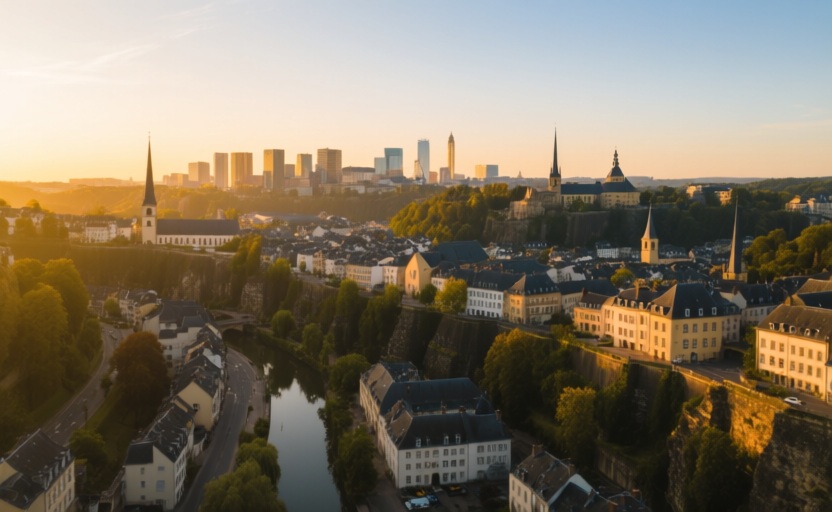
Chemin de la Corniche
Landmark · Ville Haute, above the Grund
A rampart walkway along the old fortifications, looking down into the Alzette valley — often called the most beautiful balcony in Europe.
Local tip: Walk it at dusk and then take the stairs or the Grund lift down into the valley. The city reads completely differently from the bottom of it.
The Bock casemates
Landmark · Bock promontory
Seventeen kilometres of tunnels cut into the rock beneath the old fortress, UNESCO-listed along with the old quarters.
Local tip: Go for the tunnels, stay for the view from the Bock. In winter the casemates close — check before making the trip.
Kirchberg plateau
Neighborhood · North-east across the Red Bridge
The modern quarter of EU institutions, banks, the Philharmonie and the Mudam contemporary art museum, connected by tram.
Local tip: Mudam sits inside a Pei-designed building on the old fort's foundations, and its café is one of the better quiet lunch spots in the city.
Grund and Clausen
Neighborhood · In the Alzette valley below the old town
The riverside lower town of stone houses, breweries and bars, reachable by a free public lift from the Pfaffenthal.
Local tip: The Pfaffenthal panoramic lift is free and takes seventy-one metres of the climb out of your evening. Locals use it constantly and visitors almost never find it.
Mullerthal
Nature · 35 minutes east
Sandstone gorges, moss and beech woodland along a well-marked long trail — 'Little Switzerland', and the country's best walking.
Local tip: The Schiessentümpel waterfall is the postcard, but the narrow rock passages on the Mullerthal Trail's second stage are the reason to go. Free trains get you to Echternach.
Pétrusse valley park
Hidden gemNature · Directly below the city centre
A recently reworked park in the gorge beneath the viaducts, following the Pétrusse stream through the middle of the capital.
Local tip: You can walk from the station district to the Grund entirely below street level, under the bridges, and barely see another person. In a city this dense it is a genuinely surprising piece of quiet.
Emergency numbers in Luxembourg City
Compare Luxembourg City with…
Side-by-side cost of living, language, climate and careers — to help you choose.