Hong Kong SAR · East Asia
Moving to Hong Kong
Hong Kong quick facts
Cost of living in Hong Kong
Getting set up in Hong Kong SAR
Visas & Residency
Hong Kong runs a deliberately employer-light talent funnel: the Top Talent Pass Scheme (TTPS) lets high earners (HK$2.5M+ income last year) and graduates of ~185 top global universities move WITHOUT a job offer — the single biggest draw. Most others arrive via the employer-sponsored General Employment Policy (GEP), the points-based QMAS, or IANG if they studied in Hong Kong. Everyone staying over 180 days must register for a Hong Kong Identity Card (HKID) within 30 days of arrival — it gates banking, leases, and daily life. Visas are now fully electronic (e-Visa, no passport sticker) and applications go through the online system only. After 7 continuous years of ordinary residence you can claim permanent residency and right of abode — Hong Kong's defining milestone.
Read the full step-by-step guideGetting Around & Driving
You almost certainly won't drive in Hong Kong: the MTR, trams, buses and ferries are among the best transit on earth, and one tap-and-go Octopus card pays for all of them. Get the Octopus first. If you do need to drive, you can use a valid overseas licence plus an International Driving Permit as a visitor for up to 12 months. Once you're a resident, holders of licences from ~40+ approved countries/places (UK, Singapore, Japan, much of Australia/Canada, many US states) get a full HK licence by DIRECT ISSUE — no test. Everyone else must pass the HK driving test. Owning a car is brutally expensive (first-registration tax plus HK$3,000-6,000/month parking), so most residents never bother.
Read the full step-by-step guideOpening a Bank Account
Hong Kong is a global banking hub, so an account is very doable — but KYC has tightened since 2023. With an HKID card the process is fast; without one (newcomers in their first weeks) you'll lean on passport + proof of HK address. Two routes: traditional banks (HSBC, Hang Seng, Bank of China (HK), Standard Chartered) via an in-person branch appointment, or virtual banks (ZA Bank, Mox, WeLab, livi, Fusion) opened entirely in-app in minutes. Everyone then links to FPS for instant free transfers. The HKMA's basic-banking guidance bars banks from refusing simple accounts solely on minimum-balance grounds, but premium tiers still carry HK$10,000+ balance requirements.
Read the full step-by-step guideHealthcare & Insurance
Hong Kong runs a two-tier system. HKID holders ('Eligible Persons') get among the cheapest excellent public care in the world via the Hospital Authority (HA): after a major fee reform on 1 Jan 2026, A&E is HK$400, a GP clinic visit HK$150, a specialist HK$250 and an acute hospital bed HK$300/day — all capped at HK$10,000 per person per year. The catch is long waits for non-urgent specialist and elective care. Non-eligible persons (no HKID) pay 5-25x more (A&E ~HK$2,100, inpatient ~HK$7,400/day), so securing your HKID matters. Private hospitals (Hong Kong Sanatorium, Matilda, Gleneagles, Adventist, St Paul's) are world-class but costly, so most professional expats carry private insurance — often employer-provided, or a personal VHIS-certified plan that earns a salaries-tax deduction of up to HK$8,000/insured person. Emergency number is 999.
Read the full step-by-step guideMobile & Internet (SIM)
Hong Kong has some of the cheapest, fastest mobile data and broadband on earth: ubiquitous 5G from four carriers (csl/1010, 3 Hong Kong, China Mobile HK, SmarTone) and 1000Mbps home fibre for ~HK$130-230/month. The one rule that surprises everyone: since the SIM Card Real-name Registration Scheme came into force (prepaid from 1 Mar 2022), every SIM — prepaid included — must be registered to an identity document before it activates. The old 'grab an anonymous prepaid from 7-Eleven' era is over. A prepaid local data SIM costs HK$50-100; a generous postpaid 5G plan runs HK$100-300/month.
Read the full step-by-step guideTaxes
Hong Kong's territorial system taxes only HK-source income, and salaries tax is the lower of progressive rates (2/6/10/14/17% after a ~HK$132,000 basic allowance) or the two-tier standard rate (15% on the first HK$5M of net income, 16% above). There's no capital-gains, dividend, interest, estate, or sales tax. There's no PAYE withholding — you get a bill from the IRD and pay it yourself, usually in two instalments, and the first year stings because of provisional tax.
Read the full step-by-step guideEach guide has verified costs, timelines, required documents, and the non-obvious gotchas — sourced from official government pages. Last verified 2026-06-29.
Essential Cantonese phrases
What to know before you go
Register for your HKID within 30 days — it's the master key
CriticalAnyone staying over 180 days must register for a Hong Kong Identity Card within 30 days of arrival — it's a legal duty, not optional. The HKID gates almost everything: subsidised public healthcare, opening a local bank account, signing a tenancy, employer onboarding. Book the Immigration Department appointment early (slots fill weeks out). Without it you're treated like a non-resident — for hospital care that's the difference between HK$400 and HK$2,100 at A&E.
Tax is famously low and territorial — but there's no PAYE and a year-one 'provisional tax' shock
ImportantHong Kong taxes only HK-source income; there's no capital-gains, dividend, sales or estate tax. Salaries tax is the lower of progressive 2-17% (after a ~HK$132,000 allowance) or the 15% standard rate. The catch: nothing is withheld from your pay — you get a lump-sum bill months later, and your FIRST bill bundles last year's tax PLUS a provisional prepayment of next year's, so it can feel like ~1.75x. Park 15-20% of gross from day one.
Public healthcare is world-class and nearly free with an HKID — but waits are long
ImportantHospital Authority care for HKID holders is among the best-value on earth (post-Jan-2026 reform: A&E HK$400, a GP visit HK$150, an acute bed HK$300/day, all capped at HK$10,000/person/year). The trade-off is long waits for non-urgent specialist and elective care, so most professional expats also carry private insurance (often employer-provided, or a VHIS-certified plan that earns a tax deduction). Emergency number is 999.
Get an Octopus, skip the car — transit is world-class and driving is on the LEFT
ImportantOne Octopus card taps you onto the spotless MTR, the double-decker trams ('ding ding', HK$3 flat), the Star Ferry, buses and minibuses, and pays at every 7-Eleven. The MTR reaches almost everywhere. Car ownership is brutally expensive (first-registration tax + HK$3,000-6,000/mo parking), so most residents never drive. Note Hong Kong drives on the left, and Uber sits in a legal grey area — licensed taxis are the norm.
Rent is the world's most brutal — flats are tiny and pricey
Good to knowHousing is Hong Kong's defining cost: a small central flat runs HK$18,000-32,000/month, and 'cosy' often means 300-450 sq ft. Most newcomers trade space for location, or move to Kowloon and the New Territories for more room per dollar. Two-year leases with two months' deposit are standard, and agency fees (typically half a month) apply. Budget hard, and lean on the superb transit to live further out.
Subtropical and storm-prone — learn the typhoon signals
Good to knowSummers (May-Sep) are hot, intensely humid and wet; typhoon season runs roughly May-November. When the Observatory hoists a Typhoon Signal No. 8 (or a black rainstorm warning), the whole city shuts — offices close, transport stops, and you stay in. It's a real rhythm of HK life. Winters are mild and dry. Flats run aircon hard; humidity and mould are worth checking when renting.
Top industries & employers
Finance & Banking
HSBC, Standard Chartered, Bank of China (HK), HKEX, global asset managers & hedge funds
Hong Kong is one of the world's top financial centres — banking, capital markets (the HKEX is a global IPO venue), asset and wealth management, and private equity. The deepest, most international finance job market in Asia outside the mainland.
Trade & Logistics
Major shipping lines, the container port, air cargo at HKIA, global sourcing offices
A historic entrepôt and one of the busiest air-cargo hubs on earth. Trade, sourcing, supply-chain and logistics remain core, leveraging Hong Kong's free port and gateway role to mainland China.
Professional Services
The Big Four, Magic/Silver Circle law firms, global consultancies
A dense cluster of law, accounting, tax, consulting and corporate services supporting the finance and trade sectors — a major employer of internationally qualified professionals.
Tech, Fintech & Web3
Cyberport & HKSTP startups, virtual banks (ZA, Mox, WeLab), fintech and crypto firms
Government is pushing hard on fintech, virtual banking, Web3 and innovation via Cyberport and the Science Park. A fast-growing startup scene, helped by the Top Talent Pass pulling in founders and engineers.
Tourism, Retail & Hospitality
Luxury retail groups, international hotels, F&B and entertainment
A global shopping and dining destination with a dense hospitality sector. Retail, hotels and F&B rebounded post-pandemic and remain a common entry point for foreign residents.
Real Estate & Property
Sun Hung Kai, Henderson, CK Asset, Swire, Hongkong Land
Among the world's most valuable property markets, dominated by a handful of giant developers. Real estate, surveying, construction and property management are large, deeply embedded sectors.
Where to go in Hong Kong
Victoria Peak (The Peak)
Landmark · Hong Kong Island
The mountain-top lookout over the skyscraper forest, Victoria Harbour and Kowloon beyond — the definitive Hong Kong panorama, reached by the historic Peak Tram.
Local tip: Skip the paid Sky Terrace and walk the free, flat Lugard Road loop for the same jaw-dropping view minus the crowds. Go at dusk to catch the city flip from gold to neon; take a bus or taxi up if the Peak Tram queue is brutal.
Victoria Harbour & the Star Ferry
Landmark · Tsim Sha Tsui / Central
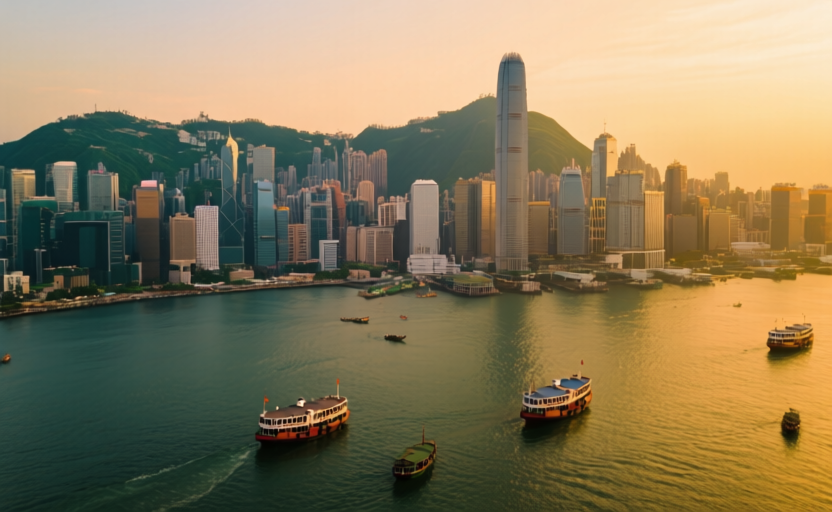
The dramatic harbour at the city's heart, crossed by the century-old green-and-white Star Ferry, with the nightly Symphony of Lights laser show over the skyline.
Local tip: Ride the Star Ferry from Tsim Sha Tsui to Central (around HK$5) — the best-value harbour cruise in the world. Watch the 8pm Symphony of Lights from the TST waterfront promenade, then walk to the Avenue of Stars.
Temple Street Night Market & Mong Kok
Food · Yau Ma Tei / Mong Kok (Kowloon)
Neon-lit street markets, fortune tellers, claypot rice and seafood dai pai dongs — the chaotic, sensory heart of old Kowloon, plus Mong Kok's themed market streets.
Local tip: Eat claypot rice and clams at the Temple Street stalls, then browse the Ladies' Market, Flower Market and Goldfish Market nearby. Mong Kok is reputedly the most densely populated place on earth — embrace the crush.
Sham Shui Po
Hidden gemCulture · Kowloon
The gritty, authentic working-class district reborn as a foodie and maker haven — Michelin street eats, fabric and electronics bazaars (Apliu Street), and indie cafés.
Local tip: Queue for the Michelin-listed cheung fun and a bowl at Lau Sum Kee, raid Apliu Street for cheap electronics and gadgets, and explore the design shops around the new-wave cafés. The most real, least touristy eating in town.
Dragon's Back & the Hong Kong Trail
Hidden gemNature · Shek O / HK Island south
The famous ridge hike with sweeping views over Shek O, Big Wave Bay and the South China Sea — proof that ~70% of Hong Kong is green country park, not city.
Local tip: Take the bus to To Tei Wan and walk the Dragon's Back to Big Wave Bay for a post-hike swim and a beachside beer. Most newcomers are stunned that world-class hiking and beaches are 40 minutes from Central.
Central, SoHo & the Mid-Levels Escalator
Neighborhood · Hong Kong Island
The dense, vertical core — banking towers, the world's longest outdoor covered escalator, and the bar-and-restaurant warrens of SoHo, PMQ and Lan Kwai Fong.
Local tip: Ride the Mid-Levels Escalator up through SoHo's restaurants and galleries, browse local design at PMQ, and end in Lan Kwai Fong or the quieter bars of Sheung Wan. Great for a first taste of expat-and-local nightlife.
Emergency numbers in Hong Kong
Compare Hong Kong with…
Side-by-side cost of living, language, climate and careers — to help you choose.