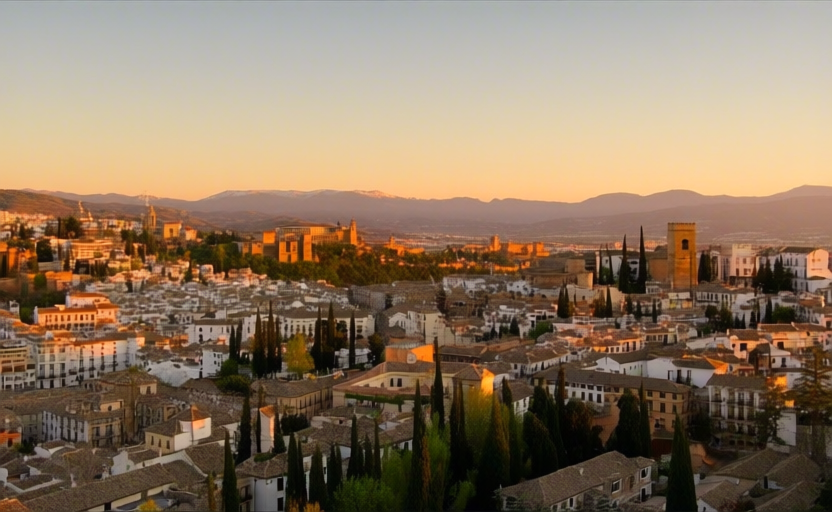
Spain · Europe
Moving to Granada
Granada quick facts
Spain at a glance
Europe & Central Asia
Economy
World Bank · 2025Religion
% of populationCIA World Factbook / national censuses
Cost of living in Granada
Can you move to Spain?
Pick your passport to see whether you can enter Spain — and what it takes to stay.
Entry rules come from github.com/imorte/passport-index-data, updated 17 February 2026. They change without notice — confirm with the official immigration service before booking.
Getting set up in Spain
NIE, TIE and the padrón that unlocks everything
Spanish residency runs in a fixed order: a NIE number, then registration on the padrón, then the TIE card, then social security, then the Andalusian health card. Each is a prerequisite for the next and each needs a cita previa. Granada's provincial office is smaller and less overwhelmed than Málaga's, which is a real advantage — but the city's academic calendar means demand for student and researcher procedures spikes hard in September.
Read the full step-by-step guideExchanging a licence, and a city where the hill decides everything
EU and EEA licences exchange straightforwardly, and the UK has been covered by a bilateral agreement since March 2023. For everyone else it depends on whether Spain has an agreement with the issuing country — if it does you exchange without a test, if not you sit the full Spanish exams in Spanish. The six-month clock runs from residency. In Granada the practical questions are different from the coast's: the Albaicín is effectively closed to cars, the centre is a low-emission zone, and the mountain road becomes a winter-equipment problem for five months a year.
Read the full step-by-step guideOpening a Spanish account without a Spanish payslip
Spanish banks distinguish between resident and non-resident accounts, and the non-resident version costs more and depends on a certificate that must be renewed. With a NIE and a padrón certificate you qualify as resident. The bigger practical issue in Granada is that most bank fee waivers assume a domiciled monthly salary — and a large share of the city's incoming population is on a research grant, a nine-month contract or remote income from abroad, which meets none of the conditions.
Read the full step-by-step guideThe Andalusian health card, two university hospitals, and a basin that traps its own air
The sequence is padrón, then social security registration, then the Andalusian tarjeta sanitaria. Public care is good and free at the point of use once you are in it. Granada is served by two large university hospitals — Virgen de las Nieves and the Clínico San Cecilio, relocated to the health science park on the southern edge — and by a research and teaching infrastructure disproportionate to the city's size. The local health issue nobody warns you about is the air.
Read the full step-by-step guideGetting a Spanish SIM, and why the Albaicín is the exception to Spain's fibre story
There is no anonymous pay-as-you-go in Spain. A prepaid SIM activates on a passport, which is what to do on arrival; contract tariffs — better value and usually bundled with fibre — need a NIE and a Spanish IBAN. Spain has some of the best and cheapest full-fibre coverage in Europe and Granada's modern districts are well served. The exception is the protected old city, where what an operator may attach to a facade is not entirely the operator's decision.
Read the full step-by-step guideIRPF, the Andalusian half, and the wealth tax this region gives back
You become a Spanish tax resident by spending more than 183 days in Spain in a calendar year or by having your main economic interests here, and Spanish tax residency is worldwide. Andalusia sets its own half of IRPF and has cut it, rebates wealth tax in full, and applies reduced property transfer rates — the same position as Málaga and Seville. Tax residents must also declare foreign assets on the Modelo 720. What differs in Granada is the arithmetic: on this cost base, ordinary deductions matter far more than the wealth tax rebate does.
Read the full step-by-step guideEach guide has verified costs, timelines, required documents, and the non-obvious gotchas — sourced from official government pages. Last verified August 2026.
Essential Spanish phrases
Reading a list isn’t learning it. Globe Quest turns these into a trainer — hear each phrase spoken, drill them with spaced repetition, and get scored as you say them out loud.
What to know before you go
Granada gets genuinely cold, and the housing is not built for it
CriticalThe city sits at around 680 metres in a basin ringed by mountains, and this is not the coastal Andalusia of the brochures. Winter nights go below freezing, frost is normal, and January in an old flat with tiled floors, single glazing and no central heating is the thing that most surprises people who moved here for the sun. Ask specifically what heating a property has — gas central heating, a heat pump, or the usual answer, which is a butane bottle and an electric radiator. The summer half of the problem is the reverse: July and August routinely pass 38 °C in a basin with no sea breeze.
Empadronamiento first — almost nothing else works without it
CriticalThe padrón is the municipal register of residents and its certificate unlocks the Andalusian health card, school places, your TIE appointment, the driving-licence exchange and residency renewals. Register at the Ayuntamiento de Granada with your passport and a rental contract, utility bill or signed owner's authorisation, in your first fortnight. It costs nothing and it is a prerequisite for three or four separate things that will otherwise sit blocked behind it.
You are competing with a university, not with a city
CriticalThe Universidad de Granada is one of Spain's largest and is consistently the leading European institution for both sending and receiving Erasmus students. The practical effect on housing is that the market runs on the academic year: the best flats and rooms in the centre, Realejo and Zaidín are let from September, they are advertised in July and August, and a great many are offered for nine or ten months rather than as ordinary leases. If you arrive in October you are picking over what fifty thousand students left. Time your search to the university calendar, not to the weather.
This is Spain's most seismically active basin, and it is worth one question
ImportantThe Vega de Granada sits on a system of active normal faults and has among the highest seismic hazard values in the Spanish building code's zoning map. Damaging earthquakes are historically documented and swarms of small events are routine — a sequence in the villages just west of the city in 2021 was felt across Granada for weeks. Spain's current seismic construction standard is NCSE-02, and buildings put up before the earlier 1994 code were not designed to it. Nothing about this makes Granada unsafe to live in, but 'when was this building built and has it been reinforced' is a reasonable question here in a way it is not in Seville.
Andalusia rebates wealth tax, and Granada is where that matters least and costs least
ImportantAndalusia rebates wealth tax in full and has cut its regional half of income tax, which is the same position Málaga and Seville enjoy. What Granada adds is the cheapest cost base of any major Andalusian city — rents here run at roughly half Palma's per square metre and comfortably below Málaga's. The regional tax advantage is real, but for most people arriving on an ordinary income it is the rent, not the wealth tax, that changes their life. The state solidarity levy on very large fortunes still applies above its own threshold regardless of the regional rebate.
The Alhambra runs on named tickets and a thirty-minute slot, and there is no talking your way in
Good to knowTickets are nominative: the name and identity document you buy under must match what you present at the gate, and they are not transferable. The Nasrid Palaces carry a separate half-hour entry window printed on the ticket, enforced strictly — miss it and you do not get in that day. This matters to residents because visiting friends arrive assuming they can buy at the door. Book weeks ahead, buy in each visitor's own name with their passport number, and put the palace slot in their calendar rather than yours.
Top industries & employers
Higher education & research
Universidad de Granada, Instituto de Astrofísica de Andalucía (CSIC), Instituto Andaluz de Geofísica, Escuela de Estudios Árabes
The UGR is one of Spain's largest universities and consistently the leading European institution for both sending and receiving Erasmus students — which shapes the city's demography, rental market and nightlife more than any employer does.
Health sciences & biotech
Parque Tecnológico de la Salud, GENYO genomics centre, Hospital Universitario Clínico San Cecilio, Vircell, Bioibérica
The PTS on the city's southern edge combines the relocated Clínico San Cecilio hospital, university faculties and a biotech cluster — the most concentrated life-sciences site in Andalusia.
Big science & engineering
IFMIF-DONES consortium (Escúzar), Ferrovial, FCC, Añil Construcciones
The IFMIF-DONES fusion-materials particle accelerator is being built at Escúzar, 20 km from the city, with construction contracts running and a project cost in the hundreds of millions — the largest scientific infrastructure ever sited in Andalusia.
Tourism & heritage
Patronato de la Alhambra y Generalife, hotel groups, Sacromonte and Albaicín operators
The Alhambra is among the most-visited monuments in Spain and the constraint on the whole sector is the daily visitor cap rather than demand — which is why the pressure has expressed itself as a housing problem instead.
Agri-food
Puleva (Lactalis), Covirán, Vega de Granada cooperatives, Costa Tropical growers
Puleva's dairy operation and Covirán — a supermarket cooperative headquartered in Granada and operating across Spain and Portugal — are the two largest private employers, alongside the Vega's horticulture and the subtropical fruit growers on the coast.
Winter sports & mountain economy
Cetursa Sierra Nevada, mountain hospitality operators, Parque Nacional de Sierra Nevada
Sierra Nevada is Europe's southernmost ski resort and Spain's highest, publicly owned through Cetursa, and it supports a seasonal economy 45 minutes from the city centre.
Where to go in Granada
La Alhambra & the Generalife
Landmark · On the Sabika hill above the city
The Nasrid palace-city, its fortress and its summer gardens — the most complete surviving medieval Islamic palace complex anywhere.
Local tip: Residents' trick: the Alcazaba and the Generalife gardens are on a general ticket that is far easier to get than the Nasrid Palaces slot, and the gardens at opening time in April are the best hour the monument has. There is also a free-access route through the Bosque de la Alhambra and up past the Puerta de la Justicia, which is how locals walk up.
The Albaicín, the miradores & Sacromonte
Neighborhood · The hill facing the Alhambra
A UNESCO-listed medieval Moorish quarter of walled carmen houses and cobbled cuestas, running up into the cave dwellings of Sacromonte.
Local tip: San Nicolás is the famous viewpoint and is crowded from mid-afternoon. San Miguel Alto is twenty minutes further up, higher, and has a fraction of the people. Sacromonte's zambra is the local flamenco form and the caves that still run family shows are worth choosing over the polished venues below.
The Capilla Real & the Cathedral
Culture · Central, off Gran Vía
The mausoleum of Ferdinand and Isabella beside Granada's Renaissance cathedral, in the streets of the old silk market.
Local tip: The Capilla Real is the one people skip on their way to the Alhambra and it is the more historically loaded building of the two — the Catholic Monarchs chose to be buried in the city whose conquest completed the Reconquista. The Alcaicería lanes beside it are the surviving fragment of the Nasrid silk bazaar.
Realejo & Campo del Príncipe
Food · South of the Alhambra hill
The old Jewish quarter turned into the city's best eating and drinking district, built up the lower slope with street art on half the walls.
Local tip: This is where the free-tapa rule is at its best. Order a drink and the kitchen decides — and if you want the good tapa, sit at the bar rather than a table, and go to the same place twice. Campo del Príncipe fills with students on warm evenings and the terraces run late.
Sierra Nevada
Nature · 32 km south-east, about 45 minutes by road
Europe's southernmost and Spain's highest ski resort, on a national park massif topped by the 3,479-metre Mulhacén — mainland Spain's highest peak.
Local tip: The season is genuinely long because of the altitude, and the resort is close enough that half-day skiing after a morning of work is an ordinary thing to do here. The A-395 is a fast road but chains or winter tyres become obligatory when the signs say so, and the ski-bus from Granada's Palacio de Congresos saves the parking problem entirely.
Los Cahorros de Monachil
Hidden gemNature · Monachil, 10 km from the city
A river gorge with hanging bridges, sheer overhangs and a chain-assisted scramble, twenty minutes from the centre.
Local tip: Almost every visitor drives past it on the way to Sierra Nevada and never stops. The lower route is an easy family walk; the upper one involves a suspension bridge and a squeeze through a rock passage. Park in Monachil village rather than at the trailhead, which fills by nine on any weekend.
Emergency numbers in Granada
Compare Granada with…
Side-by-side cost of living, language, climate and careers — to help you choose.