Germany · Europe
Moving to Dusseldorf
Dusseldorf quick facts
Germany at a glance
Europe & Central Asia
Economy
World Bank · 2025Religion
% of populationCIA World Factbook / national censuses
Cost of living in Dusseldorf
Can you move to Germany?
Pick your passport to see whether you can enter Germany — and what it takes to stay.
Entry rules come from github.com/imorte/passport-index-data, updated 17 February 2026. They change without notice — confirm with the official immigration service before booking.
Getting set up in Germany
Anmeldung, the residence permit, and NRW's 9% church tax question
Germany's sequence is fixed and unforgiving: register your address within two weeks of moving in, which produces the Meldebescheinigung that a tax ID, a bank account, health insurance and a residence permit all hang off. Düsseldorf's registration appointments are far easier to get than Munich's — the slow step here is the Ausländerbehörde, so start the permit stage early rather than waiting for your entry visa to run down.
Read the full step-by-step guideExchanging a licence, the Umweltzone, and a city built for the Rheinbahn
An EU or EEA licence needs no action at all. A non-EU licence is valid for six months from the day you take up residence, and whether the exchange after that is a form or a full driving course depends entirely on which country — and for the United States, Canada and Australia, which state or province — issued it. Düsseldorf's low emission zone covers the inner city rather than the whole municipality, and requires a green badge on the windscreen.
Read the full step-by-step guideOpening a Girokonto, building a Schufa file, and paying a deposit correctly
You need a German IBAN for salary, rent and the direct debits that run German life. Traditional banks want your Meldebescheinigung and Steuer-ID first, which is circular for a new arrival; digital banks generally do not, which is why almost everyone starts there. The deeper problem is Schufa: you arrive with an empty file, and in a market covered by the Mietpreisbremse but still short of flats, that is the thing standing between you and a lease.
Read the full step-by-step guideCompulsory cover, the one-way door into private insurance, and finding a Hausarzt
Employees earning below an annually reset threshold must join the statutory system, where contributions are a percentage of gross income shared with the employer and non-earning dependants are covered at no extra cost. Above that threshold, and for the self-employed, private cover becomes available — usually cheaper at thirty, usually not at sixty, and very hard to leave. Düsseldorf's practical problem is finding a GP with an open list, particularly one who consults in English or Japanese.
Read the full step-by-step guideGetting a German SIM, and the broadband order you should place at signing
There is no anonymous SIM in Germany — every card is tied to an identified person, verified in a shop, by video call or at a post office. Prepaid needs no Anmeldung, no bank account and no credit history, which makes it the only sensible first move. Postpaid contracts run a Schufa check you will not yet pass comfortably. Home broadband is the real trap: order it the day you sign the lease, not the day you move in.
Read the full step-by-step guideIncome tax, NRW's 9% church tax, and the return that pays for the move
For an employee the system largely runs itself: Lohnsteuer is withheld each month according to your tax class, and many people are never obliged to file at all. The three things worth understanding are that your tax class sets monthly cash flow rather than the final bill, that NRW church tax is 9% of your income tax if you declared a religion at registration, and that the return for your relocation year is very likely to refund.
Read the full step-by-step guideEach guide has verified costs, timelines, required documents, and the non-obvious gotchas — sourced from official government pages. Last verified August 2026.
Essential German phrases
Reading a list isn’t learning it. Globe Quest turns these into a trainer — hear each phrase spoken, drill them with spaced repetition, and get scored as you say them out loud.
What to know before you go
The Anmeldung is the keystone, and here the residence permit is the slower half
CriticalRegister your address at a Bürgerbüro within two weeks of moving in. Düsseldorf's registration appointments are released online and are far easier to obtain than Munich's, so the registration itself is rarely the bottleneck. The Ausländerbehörde is: non-EU nationals routinely wait considerably longer for the residence-permit stage than for anything else in the chain. Start the permit process the week your Meldebescheinigung is issued rather than when your entry visa gets close to expiring.
Church tax in North Rhine-Westphalia is 9% of your income tax
CriticalThe religion question on the Anmeldung form is a tax declaration. Declaring membership of a recognised church means Kirchensteuer is deducted from every payslip at 9% of your income tax liability in NRW, against 8% in Bavaria and Baden-Württemberg. On a professional salary that is a serious annual sum. Declaring no affiliation is legitimate and costs nothing; leaving the church afterwards requires a formal appointment, a fee, and only takes effect from the following month.
The Mietpreisbremse covers Düsseldorf and its ring — but not the Ruhr
CriticalNRW's Mieterschutzverordnung designates tight housing markets where a new rent may exceed the local reference rent by no more than 10%, and where existing rents may rise only 15% in three years rather than 20%. The current version took effect on 1 March 2025, grew the list from 18 municipalities to 57, and runs to 28 February 2030. Düsseldorf is on it, and so are Neuss, Ratingen, Meerbusch, Erkrath, Hilden and Langenfeld. Essen, Duisburg and Bochum are not — twenty minutes on the S-Bahn genuinely changes your legal position.
The statutory-versus-private insurance choice is close to permanent
CriticalHealth cover is compulsory. Employees under an annually reset income threshold — around EUR 77,400 gross for 2026 — must join the statutory system; above it, and for the self-employed, private cover opens up. Private is often cheaper for a young high earner, prices every family member separately rather than covering dependants free, rises with age, and is very difficult to leave. Model thirty years, not the first premium, and take advice before signing anything a broker puts in front of you in your first month.
Plan your arrival around the trade fair calendar
ImportantMesse Düsseldorf hosts drupa, K, MEDICA, boot and ProWein, several of which are the largest events in their industries anywhere. During a big fair, hotel rates in the city triple, serviced apartments are booked out months ahead, and short-term rentals disappear. If you are arriving without a permanent flat, check the fair calendar first — landing in MEDICA week can cost you a four-figure premium on temporary accommodation for no reason at all.
Never order a Kölsch here, and never shout Alaaf
Good to knowDüsseldorf drinks Altbier and Cologne drinks Kölsch, and the forty-kilometre rivalry between them is the most reliable small-talk topic in the city. In an Altbier house the waiter keeps replacing your glass until you rest your beer mat on top of it, which is the signal to stop rather than a decoration. At carnival the cry is Helau. None of this is trivia — getting it right buys you goodwill instantly, and getting it wrong is a running joke you will not be allowed to forget.
Top industries & employers
Japanese corporate Europe
Mitsubishi Corporation, Marubeni, Mitsui, ITOCHU, and around 410 Japanese firms in total
Düsseldorf is the largest Japanese business location in continental Europe — trading houses, machine tool makers, electronics and logistics firms, plus the banks, law firms and schools built around them.
Telecoms & digital
Vodafone Deutschland, Trivago, sipgate, Uniper's digital arm
Vodafone runs its German headquarters from a purpose-built campus in Heerdt, and the MedienHafen holds a cluster of digital businesses including Trivago.
Consumer goods & chemicals
Henkel, L'Oréal Deutschland, Teekanne, Wilkinson Sword
Henkel has been headquartered in Holthausen since the nineteenth century and is one of the city's largest employers, with Persil, Schwarzkopf and Loctite all run from here.
Industry, energy & defence
Rheinmetall, Uniper, GEA Group, Vallourec, Metro AG
A concentration of listed industrial headquarters that is unusual for a city this size, and a legacy of Düsseldorf's role as the administrative capital of Ruhr heavy industry.
Consulting, advertising & professional services
McKinsey Deutschland, BBDO, Grey, the Big Four audit firms
Historically Germany's advertising capital and still one of its main consulting centres — Düsseldorf sells services to the industry that Essen and Duisburg carry out.
Fashion, retail & trade fairs
Messe Düsseldorf, Peek & Cloppenburg, C&A, Esprit (Ratingen)
The wholesale fashion showrooms and the Fashion Days keep Düsseldorf as Germany's fashion trading centre, while Messe Düsseldorf runs several of the world's biggest industrial fairs.
Where to go in Dusseldorf
Königsallee
Landmark · Stadtmitte
A canal lined with chestnut trees, luxury flagships on one bank and offices on the other — the city's shorthand for itself.
Local tip: Known universally as the Kö. The shopping is not the point unless it is; walk the eastern bank for the shade and the water, and carry on north into the Hofgarten, laid out in 1769 as one of the first parks in Germany opened to the general public and immediately free of everything the Kö is about.
MedienHafen
Neighborhood · South of the old town
A working harbour converted into an architecture park, with Frank Gehry's three leaning buildings at its centre.
Local tip: The Gehry buildings photograph best in late afternoon from the far quay. Come for a weekday lunch rather than a weekend evening — the restaurants price for expense accounts and the district is oddly empty at weekends.
Immermannstraße and Little Tokyo
Food · Behind the Hauptbahnhof
Two blocks of Japanese restaurants, bookshops, bakeries and supermarkets serving the largest Japanese community in continental Europe.
Local tip: This is a genuine community district rather than a themed one, and the ramen and tonkatsu are held to a standard that regular Tokyo commuters enforce. Queue at lunchtime with everyone else, and go to the Japanese supermarket for ingredients you will not find in any Rewe.
The Altstadt — 'the longest bar in the world'
Nightlife · Old town, by the Rhine
Around 260 bars and breweries packed into half a square kilometre, including the four surviving Altbier brewhouses.
Local tip: Uerige, Füchschen, Schumacher and Schlüssel brew on the premises and are where locals actually drink; the streets between them are for stag parties. Order 'ein Alt' and say nothing else. The waiter is called a Köbes, and being brusque is part of the job description.
The Rheinuferpromenade and the Rheinturm
Nature · Riverfront
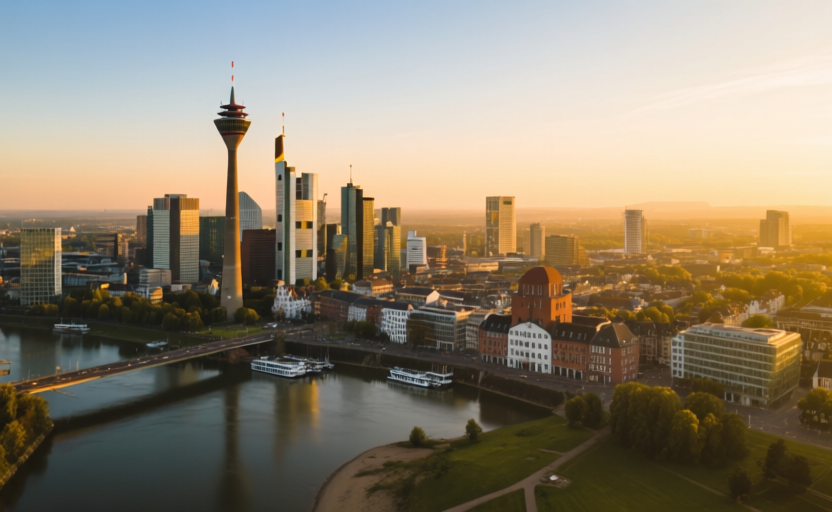
A riverside promenade built over a buried motorway, running from the old town past the parliament to the 240-metre telecommunications tower.
Local tip: Burying the road in a tunnel in 1993 is the single decision that made this city pleasant, and locals will tell you so. The Rheinturm's light column is the world's largest decimal clock — once you know how to read it you cannot stop.
EKO-Haus and the Japanese garden in Nordpark
Hidden gemCulture · Niederkassel and Golzheim
A complete Japanese Buddhist temple with a garden and a tea house on the left bank, and a formal Japanese garden across the river in Nordpark.
Local tip: EKO-Haus is the only Japanese Buddhist temple complex of its kind in Europe, built for the Japanese community rather than as an attraction, and almost no visitor to Düsseldorf ever crosses the river to find it. Both are free or nearly so, and both are at their best in the first week of cherry blossom.
Emergency numbers in Dusseldorf
Compare Dusseldorf with…
Side-by-side cost of living, language, climate and careers — to help you choose.