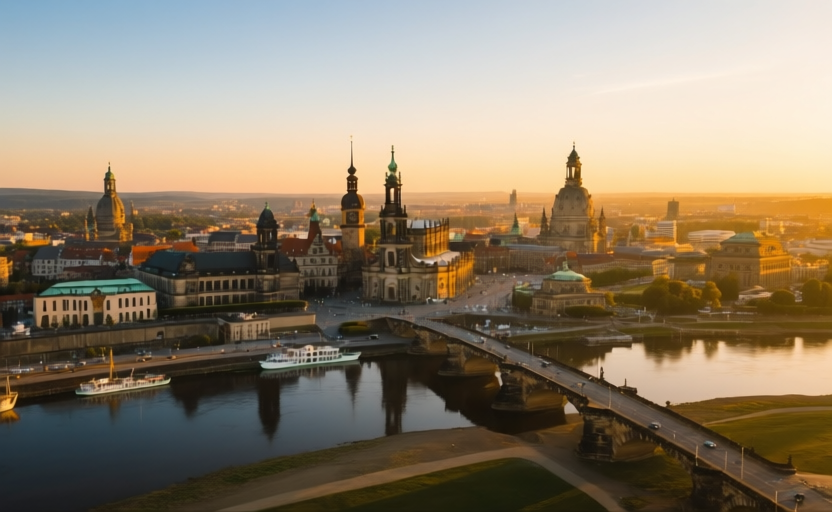
Germany · Europe
Moving to Dresden
Dresden quick facts
Germany at a glance
Europe & Central Asia
Economy
World Bank · 2025Religion
% of populationCIA World Factbook / national censuses
Cost of living in Dresden
Can you move to Germany?
Pick your passport to see whether you can enter Germany — and what it takes to stay.
Entry rules come from github.com/imorte/passport-index-data, updated 17 February 2026. They change without notice — confirm with the official immigration service before booking.
Getting set up in Germany
Anmeldung, residence permits, and getting a foreign qualification recognised
Register your address within two weeks of moving in and you receive the Meldebescheinigung that everything else depends on. Dresden's own pressure point is volume: the semiconductor build-out is bringing international staff at a pace the city's offices have not previously handled. The other Dresden-relevant step is qualification recognition — Germany cares about formal vocational credentials far more than most countries, and for technician and skilled-trade roles the Anerkennung process is the thing that unlocks the job, not the visa.
Read the full step-by-step guideExchanging a licence, and a river with one bridge fewer than it had
An EU or EEA licence needs no action. A non-EU licence is valid for six months from taking up residence, after which whether you exchange on paper or sit a full German driving course depends on the issuing country — and for the United States, Canada and Australia, the state or province. The Dresden-specific issue is not the licence but the river: since the Carolabrücke collapsed in 2024, the remaining Elbe crossings carry traffic that was never designed for them.
Read the full step-by-step guideOpening a Girokonto, and passing a corporate landlord's automatic screening
A German IBAN is the precondition for salary, rent and the direct debits that run everything. Traditional banks want the registration certificate and tax ID first; digital banks generally do not. The Dresden twist is on the other side of the transaction: after the city sold its entire municipal stock in 2006, a very large share of flats are let by corporate landlords whose application process is a portal, a document upload and an automated credit check — which rewards a complete file and punishes a charming explanation.
Read the full step-by-step guideCompulsory cover, the private one-way door, and sick notes on a shift rota
Employees below an annually reset threshold join the statutory system, where contributions are income-based, split with the employer and cover non-earning dependants free. Above it, and for the self-employed, private cover opens up — cheaper young, dearer old, priced per person and effectively impossible to leave after 55. Two practical Dresden points: GP lists in the northern districts have tightened as the fabs have grown, and if you work rotating shifts you need to know exactly how the sick note works.
Read the full step-by-step guideGetting a German SIM, and coverage once you leave the Elbe valley
There is no anonymous SIM in Germany — every card is tied to an identified person, verified in store, by video call or at a post office. Prepaid needs no registration certificate, bank account or credit history and is the sensible first move. Fixed-line provisioning takes weeks, so order at lease signing. The Dresden-specific note is geographic: coverage is fine in the valley and genuinely patchy in the sandstone gorges everyone spends their weekends in.
Read the full step-by-step guideIncome tax, 9% church tax, and the shift premiums that arrive tax-free
For an employee the machinery runs itself: Lohnsteuer comes off monthly by tax class and many people never file. Three things repay attention here. Church tax is 9% and was elected on your registration form. Night, Sunday and public holiday premiums are tax-free within statutory limits, which matters enormously to anyone on a fab rota. And the relocation year is the return most likely to refund and the one most often skipped.
Read the full step-by-step guideEach guide has verified costs, timelines, required documents, and the non-obvious gotchas — sourced from official government pages. Last verified August 2026.
Essential German phrases
Reading a list isn’t learning it. Globe Quest turns these into a trainer — hear each phrase spoken, drill them with spaced repetition, and get scored as you say them out loud.
What to know before you go
Register within two weeks, and book before the semiconductor intake does
CriticalThe Anmeldung at a Bürgerbüro is legally due within two weeks of moving in and gates the tax ID, the bank account, health insurance and the residence permit. Dresden's chip fabs and their suppliers are hiring internationally at a scale the city has not seen before, and both the registration desks and the Ausländerbehörde feel it. Book the moment you know your move date, take any district office, and start the residence permit application the week your certificate is issued rather than when your visa runs short.
Dresden sold every one of its municipal flats, and the protections from that sale are expiring
CriticalIn 2006 the city sold WOBA — all 48,000 municipal flats — to the American investor Fortress for around EUR 1.7 billion, cleared debts of some EUR 741 million in one transaction and became Germany's first debt-free major city. The stock passed through Gagfah into Vonovia. The practical consequence for you is that unlike Leipzig, Dresden has essentially no city landlord to apply to; a new municipal company founded in 2017 is building only a small number of flats. The Sozialcharta attached to the sale bound the buyer for ten years, and the city's occupancy rights over 8,000 of the flats ran to 2026 — so the protections written into that deal have now largely run out. Plan for a market of corporate landlords with automated screening.
Saxony's rent cap covers this city and Leipzig and nowhere else in the state
CriticalThe Sächsische Mietpreisbegrenzungsverordnung limits a new rent to at most 10% above the local reference rent, and caps increases to a sitting tenancy at 15% over three years rather than 20%. It applies in Dresden and Leipzig only — not in Chemnitz, not in Radebeul, not in Freital. The current version took effect on 1 January 2026 and runs to 30 June 2027, continuing a cap first introduced in 2022. Crossing a municipal boundary for a cheaper flat also crosses out of the protection.
Church tax in Saxony is 9%, and it is decided by one line on a form
CriticalDeclaring membership of a recognised church at your Anmeldung triggers automatic deduction of Kirchensteuer at 9% of your income tax liability — the standard rate in every state except Bavaria and Baden-Württemberg, which charge 8%. The clerk asks it as a routine demographic question and most newcomers answer it that way. Declaring no affiliation is lawful and free. Leaving afterwards means a formal registry appointment, a fee, and effect only from the following month.
Check which Elbe bridge your commute needs before you sign a lease
ImportantA hundred-metre section of the Carolabrücke carrying the tram tracks fell into the river on 11 September 2024, minutes after the last tram had crossed — hydrogen-induced stress corrosion in GDR-era prestressing steel from the 1971 construction. Demolition was completed in September 2025, reconstruction is planned to begin in 2027 and the city is targeting completion in 2031. The road traffic and several tram routes it carried have been redistributed onto the remaining crossings. A flat that looks fifteen minutes from your office on a map can be a very different journey depending on which bridge it depends on.
Know the political context before you arrive, not after
Good to knowPEGIDA began with Monday marches in Dresden in 2014, and Saxony's state-level politics differ sharply from the western states. Within the city, the Neustadt and the university districts vote very differently from the outer ones, and newcomers who are visibly foreign consistently report that the inner city and the regional trains out of it feel like different places. Every 13 February the city marks the anniversary of the 1945 bombing with a human chain, alongside marches and counter-demonstrations. None of this makes Dresden unliveable; not knowing it makes the first year harder.
Top industries & employers
Semiconductors & microelectronics
Infineon, GlobalFoundries, Bosch, ESMC (the TSMC joint venture)
Silicon Saxony is the largest microelectronics cluster in Europe by employment, and the new fabs north of the city — including the European TSMC joint venture with Bosch, Infineon and NXP — represent one of the largest industrial investments in German history.
Research institutes & universities
TU Dresden, Fraunhofer institutes, Max Planck Institute of Molecular Cell Biology and Genetics, Helmholtz-Zentrum Dresden-Rossendorf
TU Dresden holds excellence university status and the city has one of Germany's densest concentrations of non-university research institutes, weighted toward materials, microelectronics and cell biology.
Software & IT services
T-Systems Multimedia Solutions, ZEISS Digital Innovation, Communardo
A substantial IT services sector grew up alongside the university and the chip industry, and pays less than Munich while costing far less to live in — which is the whole local argument.
Life sciences & pharmaceuticals
BioInnovationsZentrum Dresden, pharmaceutical manufacturing in Radebeul, university hospital spin-outs
The biotech cluster sits alongside the Max Planck cell biology institute and the university hospital, with regenerative medicine and diagnostics the strongest strands.
Automotive & precision engineering
Volkswagen Gläserne Manufaktur, regional suppliers, machine building across the Elbe valley
The Transparent Factory in the centre of the city was built as a showroom-cum-assembly hall and has repeatedly changed role; the surrounding Saxon engineering base is older and quieter than the headline plants.
Culture & tourism
Semperoper, Staatliche Kunstsammlungen Dresden, Striezelmarkt, Sächsische Dampfschiffahrt
Dresden is one of Germany's leading cultural destinations and employs heavily in it — the state art collections alone run a dozen museums, and the Christmas market dates from 1434.
Where to go in Dresden
Frauenkirche & the Neumarkt
Landmark · Altstadt
A baroque church that stood as a rubble mound for fifty years and was rebuilt between 1994 and 2005 using thousands of the original stones.
Local tip: The dark blocks scattered through the pale façade are the salvaged originals, catalogued where they fell and returned to their exact positions. The golden orb and cross on top were made in London by a goldsmith whose father flew in the raid that destroyed it. Climb to the dome viewing platform late in the afternoon.
Äußere Neustadt & the Kunsthofpassage
Neighborhood · North of the river
The nineteenth-century quarter that largely survived the firestorm, now the densest concentration of bars, small shops and courtyards in eastern Germany.
Local tip: The Kunsthofpassage is a chain of five themed courtyards you walk through rather than into; one façade is covered in funnels and gutters that play like an instrument when it rains. Go on a wet day, which is the only time it works and the only time it is empty.
Zwinger & the Grünes Gewölbe
Culture · Altstadt
A baroque pleasure palace and the treasure chamber of the Saxon electors, holding one of Europe's great collections of jewels and goldsmithery.
Local tip: The Historisches Grünes Gewölbe admits a limited number of visitors per slot and sells out — book online well ahead. The Zwinger courtyard itself is free and open, and the Old Masters gallery inside holds Raphael's Sistine Madonna, whose two bored cherubs at the bottom are on half the postcards in Germany.
The Elbwiesen and the Elbe cycle path
Nature · Both banks, through the whole city
Wide open meadows along both banks, deliberately left unbuilt so the river has somewhere to go, and a cycle path running the length of the valley.
Local tip: The meadows are the city's living room in summer — barbecues, swimming, the paddle steamers going past. The cycle path runs to the Saxon Switzerland sandstone hills in one direction and Meissen in the other, both easy day rides, and the S-Bahn takes bicycles if you only want to pedal one way.
Alaunstraße and the Neustadt bars
Nightlife · Äußere Neustadt
The spine of Dresden's nightlife — a kilometre of bars, courtyards and late-night kitchens in surviving nineteenth-century blocks.
Local tip: Alaunpark fills on summer evenings with people who brought their own bottles, which is legal and normal. A lot of the smaller bars are cash-only. The Bunte Republik Neustadt street festival in June turns the whole district into one event and residents either love it or leave town for it.
Loschwitz — the Schwebebahn, the funicular and the Blaues Wunder
Hidden gemLandmark · Upstream on the right bank
A suspended monorail from 1901, a funicular from 1895, and an 1893 steel bridge that survived the war unblown.
Local tip: The Schwebebahn is the oldest suspension railway of its kind still running anywhere, and both it and the funicular are scheduled public transport on an ordinary ticket rather than attractions. Ride up, walk the ridge path between the two stations for the whole Elbe bend, and come down the other one.
Emergency numbers in Dresden
Compare Dresden with…
Side-by-side cost of living, language, climate and careers — to help you choose.