Peru · Latin America
Moving to Cusco
Cusco quick facts
Peru at a glance
Latin America & Caribbean

Economy
World BankReligion
% of populationPeru National Census 2017
Cost of living in Cusco
Can you move to Peru?
Pick your passport to see whether you can enter Peru — and what it takes to stay.
Entry rules come from github.com/imorte/passport-index-data, updated 17 February 2026. They change without notice — confirm with the official immigration service before booking.
Getting set up in Peru
Residence from a regional office, and the tourist-stamp trap
The rules are the same as everywhere in Peru: a calidad migratoria granted for 365 days, evidenced by a carné de extranjería, renewed annually, with permanent residence available after three years. Two things are different in Cusco. The regional MIGRACIONES office is smaller than Lima's and appointment availability is a real constraint. And a large part of Cusco's foreign population is not resident at all — it is living on tourist stamps, which have a hard annual limit that many people do not know about.
Read the full step-by-step guideMountain driving, thin air, and a city better walked
The licensing route is the same as in Lima — a medical certificate from an authorised centre, a theory examination in Spanish, and either an exchange where reciprocity exists or a practical assessment. What differs is the driving itself. At 3,400 metres engines lose a substantial fraction of their power, the roads out of the city are steep and often single-lane with sheer drops, the rains between November and March bring landslides, and regional paros close roads with little notice. Inside the city, most residents walk.
Read the full step-by-step guideBanking in a cash-and-dollars tourist economy
The rules are national: a carné de extranjería opens a full account at the major banks, and you get parallel soles and dollar accounts as standard. What is specific to Cusco is that the tourist economy runs heavily on cash and US dollars, exchange houses are everywhere and their rates vary meaningfully, and the seasonal swing in income makes a dollar buffer more useful here than in Lima.
Read the full step-by-step guideAltitude medicine, EsSalud, and knowing when to go down
The insurance mechanics are the same as anywhere in Peru: employers must enrol you in EsSalud and pay 9% of salary, there is a qualifying period before entitlement begins, and an EPS top-up buys private access. The clinical reality is different. Cusco's doctors are experienced in altitude medicine in a way sea-level doctors are not, oxygen is routinely available, and the definitive treatment for serious altitude illness is descent — which makes the Sacred Valley and the Lima flight part of your medical plan rather than travel options.
Read the full step-by-step guideCoverage in the mountains, and fibre inside a monument
The four national operators — Claro, Movistar, Entel and Bitel — differ far more here than they do in Lima, because what matters is coverage in the valleys and on the trails rather than in a dense city. Prepaid works on a passport and is genuinely usable. The other local constraint is the historic centre: it is a protected monument, works require Ministerio de Cultura consent, and getting fibre into a colonial building on Inca foundations is sometimes simply not possible.
Read the full step-by-step guideThe same flat 30%, a RUC for tourism income, and municipal charges
The Peruvian rules apply unchanged: you are non-domiciled until you have spent more than 183 days in Peru within a twelve-month period, and even then the status only takes effect from 1 January of the following year — with Peruvian-source income withheld at a flat 30% in the meantime. What is local is that so much Cusco income is independent rather than salaried. Guiding, running a hostel, letting a flat and freelancing all mean a RUC, electronic invoicing and periodic filing.
Read the full step-by-step guideEach guide has verified costs, timelines, required documents, and the non-obvious gotchas — sourced from official government pages. Last verified August 2026.
Essential Spanish phrases
Reading a list isn’t learning it. Globe Quest turns these into a trainer — hear each phrase spoken, drill them with spaced repetition, and get scored as you say them out loud.
What to know before you go
Altitude at 3,400 metres is the single biggest planning fact about living here
CriticalCusco sits roughly 550 metres higher than Quito and more than a kilometre above Bogotá. Arriving directly from sea level, expect two to four days of headaches, breathlessness, disturbed sleep, loss of appetite and very low alcohol tolerance. Do not schedule anything important on day one, do not carry heavy bags up stairs, and hydrate far more than feels necessary. Anyone with cardiac, pulmonary or sickle-cell conditions, and anyone pregnant, should take medical advice before coming. The definitive treatment for severe altitude illness is descent — which here means the Sacred Valley at 2,800 metres or a flight to Lima at sea level, and that is worth knowing before you need it.
Boiling water for three minutes, not one, is the rule above 2,000 metres
CriticalCusco's tap water is not potable and water here boils at roughly 88 °C rather than 100 °C because of the reduced air pressure. Public-health guidance is that above 2,000 metres water should be held at a rolling boil for three minutes rather than the one minute sufficient at sea level. A great many long-stay residents boil for thirty seconds out of habit and assume they are safe. Either boil properly for three minutes, use a filter rated for the job, or buy bidón water — but do not carry a sea-level habit up here unexamined.
Cusco's rental market is set by tourism, which is both the problem and the opportunity
ImportantA large share of the housing stock in and around the historic centre is oriented to short stays, so long-term supply in the most attractive streets is thinner and more expensive than the city's income levels would suggest. Prices also move with the season. The practical consequences: arrive in low season if you can, look outside the centre where the market is genuinely local, and expect a landlord to prefer a twelve-month commitment over a six-month one precisely because it removes them from the tourist cycle.
The historic centre is a protected monument, and that limits what you can do inside it
ImportantCusco's centre is a UNESCO World Heritage site and works there fall under the Ministerio de Cultura as well as the municipality. Renovations, external alterations, signage and even routing new cabling can require approval, and refusal is a real outcome rather than a formality. If your work depends on a fast fixed connection, ask specifically whether the building already has fibre installed — retro-fitting into a colonial building on an Inca foundation is sometimes simply not permitted, and no amount of paying more solves it.
Your tax status is Peruvian, not Cusqueño, and the flat 30% applies here too
CriticalNothing about the tax rules changes because you live in the Andes. Until you have been in Peru more than 183 days within a twelve-month period — and then only from the following 1 January — you are non-domiciled and Peruvian-source income is withheld at a flat 30% of gross with no deductions and no 7 UIT allowance. Anyone taking a guiding, hospitality or NGO salary in Cusco should model their take-home on that rate for the whole first stretch, because it is what will land.
Paros and blockades are a normal part of the calendar, not an emergency
ImportantRegional strikes over transport, mining or agricultural policy periodically close roads in and out of Cusco and can suspend the rail service to Machu Picchu, sometimes with a day's notice. They usually end within days. Build slack into travel plans around them, keep some food and cash at home, and follow local news rather than international coverage, which reports them as crises when the city treats them as weather.
Top industries & employers
Tourism & tour operations
Inca Rail, PeruRail, Belmond, Explorandes, Llama Path, Alpaca Expeditions
Cusco is the gateway to Machu Picchu and the entire Andean circuit, and tourism is not one sector among several here — it is effectively the economy. Employment, rents and the mood of the city all follow the high and low seasons.
Hospitality & food
Belmond Monasterio, JW Marriott El Convento, Cicciolina, Chicha, MAP Café
A dense and unusually sophisticated restaurant and hotel scene for a city this size, built on international visitor volume and increasingly on Andean produce — native potatoes, quinoa varieties, alpaca and river trout.
Textiles & artisan production
Centro de Textiles Tradicionales del Cusco, Kuna, Sol Alpaca, community weaving cooperatives
Alpaca and vicuña textile production is a genuine export industry with a real craft base in the surrounding communities, and the Centro de Textiles has done serious work documenting and reviving pre-Hispanic techniques.
Archaeology, heritage & conservation
Ministerio de Cultura Cusco, Dirección Desconcentrada de Cultura, university research programmes
The density of Inca and colonial sites supports a permanent professional community of archaeologists, conservators and heritage administrators, and Cusco's Dirección Desconcentrada de Cultura is one of the largest outside Lima.
Education & language schools
Universidad Nacional de San Antonio Abad del Cusco, Amauta, Fair Play, Wiracocha
One of the oldest universities in the Americas, plus a substantial Spanish and Quechua language-school sector serving the long-stay visitor population and employing a rotating international teaching staff.
Agriculture & the Sacred Valley
Sacred Valley producers, Wayra, community cooperatives, craft brewers and cheesemakers
The valley floor around Urubamba and Calca is intensively farmed and has developed a serious small-producer economy — dairy, brewing, organic vegetables — supplying Cusco's restaurants and increasingly Lima's.
Where to go in Cusco
Plaza de Armas & Qorikancha
Landmark · The historic centre
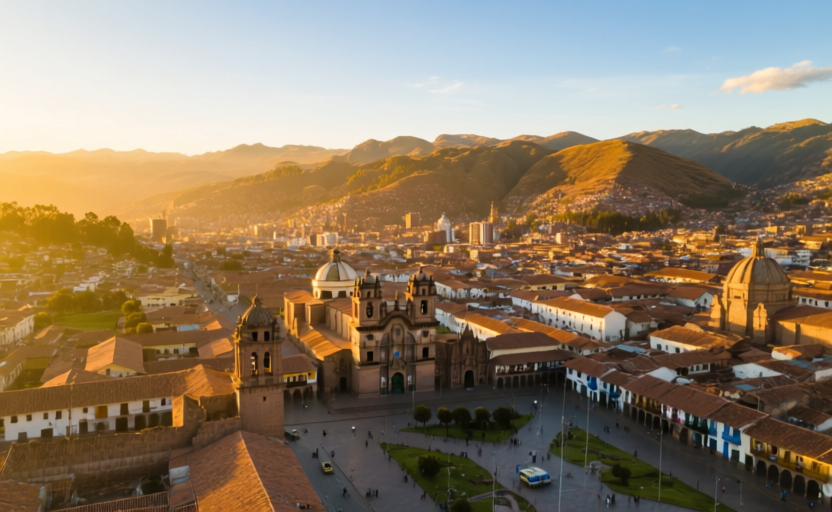
The colonial square built directly on the Inca ceremonial centre, and the temple whose stonework the Spanish cathedral was raised on top of.
Local tip: Qorikancha is the one to spend time in: a Dominican convent sitting on the Inca Temple of the Sun, with the original curved wall intact because the Spanish could not improve on it and later earthquakes proved the point. Go late in the afternoon when the tour groups have moved on.
San Blas
Neighborhood · The steep artisan quarter above the Plaza de Armas
Narrow cobbled streets, workshops, small bars and the best views over the city's tiled roofs.
Local tip: Beautiful and severely steep — living here at 3,400 metres means climbing a serious hill every time you come home, which is a genuine daily consideration and not a romantic one. The little plaza is the place to sit; the streets above it are quieter and cheaper.
Mercado Central de San Pedro
Food · A few blocks west of the Plaza de Armas
The city's working market, in a building attributed to the Eiffel workshop, selling everything from a hundred potato varieties to frog juice.
Local tip: The juice counters at the front are the tourist face; the real market is behind them, where restaurants buy and where the almuerzo counters serve a full lunch for a few soles. Go before nine, bring small notes, and ask before photographing anyone.
Sacsayhuamán
Culture · On the ridge immediately above the city
Enormous Inca ceremonial walls of interlocking stones, some weighing over a hundred tonnes, fitted without mortar.
Local tip: You can walk up from San Blas in about forty minutes, which is a real effort at this altitude and worth doing once. Beyond the main site the ridge continues past Q'enqo and Puka Pukara with far fewer people. Inti Raymi is staged here on 24 June and the city fills completely.
The Sacred Valley — Pisac & Urubamba
Nature · 45–90 minutes north of the city
The Urubamba valley floor at around 2,800 metres — terraced hillsides, market towns, and noticeably easier breathing.
Local tip: Six hundred metres lower than Cusco makes a real physical difference, which is why so many long-stay residents end up living down here and coming up for business. Pisac's market is Sunday; Urubamba is where people actually live. The valley is warmer, greener and has better produce than the city.
Templo de la Luna & the ridge sites
Hidden gemNature · The hillside above San Blas, beyond Sacsayhuamán
Carved rock shrines, caves and unrestored Inca sites scattered across the ridge, mostly unsigned and mostly empty.
Local tip: A short walk beyond the ticketed sites is a whole landscape of carved outcrops — the Templo de la Luna, the so-called Zona X, Inkilltambo — that most visitors never hear about and many are free to enter. Go with someone who knows the paths the first time, in the morning, and treat the sites with the care the ticketed ones get.
Emergency numbers in Cusco
Compare Cusco with…
Side-by-side cost of living, language, climate and careers — to help you choose.