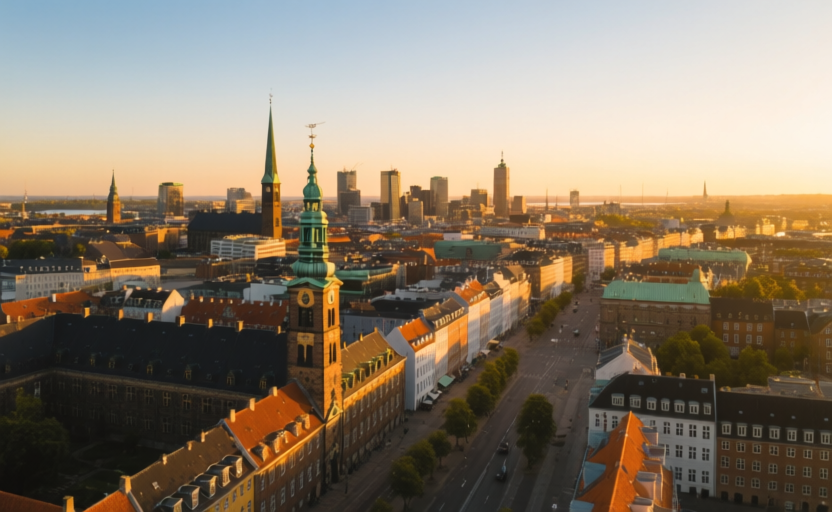
Denmark · Europe
Moving to Copenhagen
Copenhagen quick facts
Denmark at a glance
Europe & Central Asia
Economy
World BankReligion
% of populationCIA World Factbook / national censuses
Cost of living in Copenhagen
Can you move to Denmark?
Pick your passport to see whether you can enter Denmark — and what it takes to stay.
Entry rules come from github.com/imorte/passport-index-data, updated 17 February 2026. They change without notice — confirm with the official immigration service before booking.
Getting set up in Denmark
The work permit schemes, and the five-day CPR deadline
Denmark's main work routes are salary-based rather than points-based: the Pay Limit Scheme at DKK 552,000 a year for 2026, the two Positive Lists of shortage occupations, and the Fast-track Scheme that lets employees of certified companies start work almost immediately. Because of Denmark's EU justice and home affairs opt-out there is no Danish EU Blue Card at all. Once here, the decisive step is CPR registration, which the law requires within five days of arrival.
Read the full step-by-step guideExchanging a licence, and a city where the bicycle wins
EU/EEA licences remain valid in Denmark and can be exchanged on request. Licences from a defined group of other countries can be exchanged after a control driving test; the rest require the full Danish theory and practical tests. The more consequential fact is economic: Denmark's registration tax makes a car dramatically more expensive to put on the road than the same car elsewhere in Europe, and Copenhagen is built so that a bicycle is genuinely faster for most journeys.
Read the full step-by-step guideNemKonto, MitID and the account every payment goes to
Denmark runs a system with no real equivalent elsewhere: every resident designates one account as their NemKonto, and all payments from the public sector — tax refunds, benefits, pensions, holiday pay — go there automatically. You need a CPR number to open an account, and MitID to operate it. MobilePay is the near-universal instant payment app, and Denmark is close to cashless in practice.
Read the full step-by-step guideThe yellow card, your assigned GP, and why you must call 1813 first
CPR registration produces the yellow sundhedskort, which names the general practitioner you have been assigned. That GP is your gatekeeper: almost all specialist care requires their referral, and you cannot simply walk into a hospital. In the Capital Region, out-of-hours and emergency care runs through the 1813 medical helpline — calling before you go is not advice, it is the way the system is designed, and turning up unannounced at an emergency department will get you sent away.
Read the full step-by-step guideA cheap SIM in minutes, and the fibre question to ask your landlord
Danish mobile is cheap and the market is competitive: prepaid SIMs are sold in supermarkets and kiosks and work immediately, and postpaid plans with generous data cost little once you have a CPR number and a Danish payment method. Home broadband is fast, but which provider you can use often depends on what is physically installed in the building. The specifically Copenhagen issue is roaming across the Øresund — Sweden is EU roaming, so a Danish SIM works in Malmö at domestic rates.
Read the full step-by-step guideAM-bidrag, church tax, and the researcher scheme whose floor just fell
Denmark deducts an 8% labour market contribution (AM-bidrag) before income tax and before any personal allowance, then applies municipal tax and a state bottom and top bracket, with an overall marginal ceiling. Church tax applies only to members of the national church — a box on the registration form that foreigners tick by mistake. The researcher and key-employee scheme, taxing gross salary at a flat 32.84% for up to 84 months, is the single most valuable thing to establish before signing, and its salary floor dropped in 2026.
Read the full step-by-step guideEach guide has verified costs, timelines, required documents, and the non-obvious gotchas — sourced from official government pages. Last verified August 2026.
Essential Danish phrases
Reading a list isn’t learning it. Globe Quest turns these into a trainer — hear each phrase spoken, drill them with spaced repetition, and get scored as you say them out loud.
What to know before you go
Register for a CPR number within five days of arriving
CriticalIf you plan to stay in Denmark more than three consecutive months you must register with the Civil Registration System, and the law gives you five days from arrival. In Copenhagen this is done at International House Copenhagen, which combines the municipality's citizen service with SIRI and the tax agency in one building. You need documentation of your address and your residence basis. The CPR number produces the yellow health card, assigns your GP, is required for a bank account, and is the identifier every Danish system keys off. Nothing else in your first month proceeds without it.
The CPR form asks about church membership, and answering yes costs you money every month
CriticalDanish church tax (kirkeskat) is levied only on members of the Evangelical Lutheran Church of Denmark, at roughly 0.8% of taxable income in Copenhagen. The registration form asks whether you are a member. Foreign nationals baptised Lutheran abroad frequently tick yes assuming it is a demographic question, and are then taxed for it. Membership of the Danish national church is a separate legal act; being baptised in Germany, Sweden or Finland does not make you one. If you do not intend to join, say no.
Ask about the researcher tax scheme before you sign, and know the number changed this year
CriticalThe Danish tax scheme for researchers and highly-paid employees (forskerskatteordningen) taxes gross salary at a flat 27% plus the 8% labour market contribution — an effective 32.84% — for up to 84 months. The minimum monthly salary for the key-employee route fell to DKK 65,400 for 2026, down from DKK 78,000, which brought a much wider group into scope. Approved researchers qualify on credentials rather than salary. You must not have been liable to Danish tax in the previous ten years, and the employer applies. Half the guides online still quote the old threshold.
Renting costs up to six months' rent before you have the keys
CriticalDanish law allows a landlord to take a deposit of up to three months' rent plus up to three months' prepaid rent, and both are routinely charged in full. That is a five- to seven-month cash requirement including the first month, and the prepaid portion covers your final months rather than being returned in cash. Deposit disputes at move-out are the most common Danish tenancy conflict; the Rent Tribunal (Huslejenævnet) hears them, and photographing the flat in detail at move-in is what wins them.
Commuting across the Øresund to Malmö changes which country taxes you
ImportantMalmö is about thirty-five minutes from Copenhagen Central. Living on one side and working on the other is common and entirely normal, but it puts you inside a cross-border tax and social security framework rather than a domestic one — where your salary is taxed depends on where you physically perform the work, and how much of it you do from home can change the answer. Öresunddirekt, run jointly by Danish and Swedish authorities, exists precisely because this is too complicated for ordinary advisers. Use it before you accept a job on the other side.
The bicycle is transport, not recreation, and the etiquette is enforced socially
ImportantRoughly half of all journeys to work or education in Copenhagen are made by bike, on a network of kerb-separated tracks with their own signals. It is the fastest way across the city and it is used in rain, snow and darkness. The rules are taken seriously: lights front and rear after dark are a legal requirement with an on-the-spot fine, hand signals are expected, you keep right and overtake left, and stopping in a cycle track to check your phone will get you shouted at. Buying a decent second-hand bike in week one is the single best money you will spend.
Top industries & employers
Pharmaceuticals & biotech
Novo Nordisk, Lundbeck, LEO Pharma, Genmab, Zealand Pharma
Novo Nordisk became Europe's most valuable company on the back of its diabetes and obesity drugs, and its foundation's ownership structure means much of the profit is recycled into Danish research.
Shipping & logistics
A.P. Moller-Maersk, DFDS, DSV
Maersk is headquartered on the Copenhagen waterfront and remains one of the largest container shipping companies in the world — the city's commercial identity was built on the sea long before it was built on medicine.
Renewable energy
Ørsted, Vestas, European Energy, Copenhagen Infrastructure Partners
Ørsted converted itself from a state oil and gas company into the world's largest offshore wind developer within about a decade, and the supply chain and finance around it is concentrated here.
Industrial biotech & enzymes
Novonesis, Chr. Hansen legacy operations, Coloplast
Denmark's enzyme and microbial culture industry is world-leading and quietly enormous, sitting alongside medical devices in the same research corridor.
Software & fintech
Unity, Pleo, Zendesk, Lunar, Templafy
Copenhagen's software scene is smaller than Stockholm's but hires internationally and works in English almost universally, with a strong cluster in payments and developer tooling.
Design, architecture & food
BIG, Bang & Olufsen, Fritz Hansen, Noma alumni restaurants
Danish architecture practices export worldwide, and the New Nordic movement that came out of Noma reshaped restaurant cooking globally — both are real employers, not just cultural exports.
Where to go in Copenhagen
Nyhavn & the inner harbour
Landmark · City centre
The painted eighteenth-century canal houses and the harbour front behind them, now with a swimming-clean waterway running through the city.
Local tip: Nyhavn itself is a photograph. The interesting part is the harbour bus — a regular public boat on the Rejsekort, not a tour — which runs the length of the harbour for the price of a bus fare and is the best view in the city.
Christiania
Neighborhood · Christianshavn
A self-declared free town on a former military site since 1971, with self-built houses, workshops and a complicated relationship with the state.
Local tip: Photography is prohibited on Pusher Street and that rule is enforced by residents, not by signs. Walk past it to the lakeside paths and the self-built houses on the ramparts, which are the genuinely remarkable part and almost never visited.
Refshaleøen
Food · Across the harbour from the centre
A decommissioned shipyard turned into food halls, breweries, a sauna, a climbing wall and Copenhagen's most interesting restaurants.
Local tip: Reachable by harbour bus, which turns the journey into part of the outing. La Banchina's tiny harbour sauna and swim spot is a local institution — book, because turning up does not work.
Amager Strandpark
Nature · Eastern Amager
An artificial island beach five kilometres from the city centre, with a lagoon, dunes and clean swimming water.
Local tip: Fifteen minutes on the metro from the middle of the city puts you on open sand. Copenhageners swim here through the winter as well; there is a formal winter bathing club culture, and the sauna beside the water is the point of it.
Frederiksberg Have & Søndermarken
Nature · Frederiksberg
A romantic royal garden with canals and a palace, joined to a second wooded park across the road, in the middle of the densest part of the city.
Local tip: Frederiksberg is a separate municipality entirely surrounded by Copenhagen, with its own tax rate and its own citizen service — a fact that matters when you rent. The Cisternerne, a former underground reservoir beneath Søndermarken, now hosts art installations in near-total darkness.
Vestre Kirkegård
Hidden gemCulture · South-west Copenhagen
Denmark's largest cemetery, and in practice one of the city's biggest parks — 54 hectares of avenues, lakes and mature woodland.
Local tip: Danes treat cemeteries as public parks without embarrassment, and this one is used for running, cycling and picnicking. It is a fifteen-minute ride from the centre, almost empty on weekdays, and one of the quietest green spaces in a city that is short of them.
Emergency numbers in Copenhagen
Compare Copenhagen with…
Side-by-side cost of living, language, climate and careers — to help you choose.