Sri Lanka · South Asia
Moving to Colombo
Colombo quick facts
Sri Lanka at a glance
South Asia
Economy
World Bank · 2025Religion
% of populationCIA World Factbook / national censuses
Cost of living in Colombo
Can you move to Sri Lanka?
Pick your passport to see whether you can enter Sri Lanka — and what it takes to stay.
Entry rules come from github.com/imorte/passport-index-data, updated 17 February 2026. They change without notice — confirm with the official immigration service before booking.
Getting set up in Sri Lanka
Residence Visa and the new Digital Nomad Visa
Sri Lanka launched a Digital Nomad Visa in February 2026: USD 500 a year for the main applicant and the same for a spouse and each dependant, valid 12 months and renewable annually. For employment, the route is a Residence Visa applied for after arrival on an entry visa, sponsored by your employer and tied to that specific job. Both are annual and both are single-purpose.
Read the full step-by-step guideConverting your licence at the Department of Motor Traffic
Foreign nationals holding a visa valid for more than six months can apply for a full Sri Lankan licence; under six months you get a temporary one. Conversions are handled at the Department of Motor Traffic, and a medical fitness certificate from the National Transport Medical Institute is compulsory. A knowledge test, and sometimes a practical test, may be required depending on your nationality and licence category.
Read the full step-by-step guideOpening a Sri Lankan bank account
With a residence visa you can open an account, but the standard expat product is a Personal Foreign Currency Account — which holds USD, EUR or GBP and cannot accept rupee deposits. You convert out of it to spend locally. Understanding which account you are being offered, and asking for a rupee account alongside it, is the whole game here.
Read the full step-by-step guideHealthcare, private insurance and dengue
Public healthcare is free at the point of use and Sri Lanka's health outcomes are strong for its income level. In practice foreign residents use Colombo's private hospitals, which are inexpensive by Western standards and quick. Health insurance is a stated requirement of the Digital Nomad Visa. Dengue is the year-round risk that actually matters here.
Read the full step-by-step guideGetting a Sri Lankan mobile number
Dialog and Mobitel dominate, with Hutch and Airtel competing on price. Biometric registration against your passport is required by regulation, so you cannot buy an anonymous SIM. Both major operators have 24-hour counters in the arrivals hall at Bandaranaike airport, and data is very cheap by international standards.
Read the full step-by-step guideIncome tax, APIT and the 2025 relief increase
Sri Lanka taxes personal income progressively from 6% to 36%, with a personal relief that rose substantially on 1 April 2025 — from LKR 1.2 million to LKR 1.8 million a year, or LKR 150,000 a month. Employment income is withheld at source through APIT. The tax year runs April to March, not January to December.
Read the full step-by-step guideEach guide has verified costs, timelines, required documents, and the non-obvious gotchas — sourced from official government pages. Last verified July 2026.
Essential Sinhala phrases
Reading a list isn’t learning it. Globe Quest turns these into a trainer — hear each phrase spoken, drill them with spaced repetition, and get scored as you say them out loud.
What to know before you go
The Digital Nomad Visa is brand new — verify the numbers yourself
CriticalSri Lanka launched it in February 2026. The Department of Immigration confirms a fee of USD 500 a year for the main applicant and the same for a spouse and each dependant, valid 12 months and renewable annually. The minimum income figure has moved since launch and secondary sources disagree, so check immigration.gov.lk directly before you plan around a number. This is a genuinely new programme and its parameters are still settling.
A residence visa is granted for one purpose only
CriticalSri Lankan residence visas are tied strictly to the activity they were issued for. You may not take any other employment, paid or unpaid, or run any other trade or business during your stay. Changing jobs means a new visa, not an amendment — this is stricter than most of Asia and it is written into the Immigrants and Emigrants Act.
Every full moon is a public holiday, and the country closes
ImportantPoya days fall monthly. Government offices shut, alcohol sales stop, meat shops close and many restaurants go vegetarian. Nobody warns new arrivals, so a visa appointment or a planned night out lands on one about once a quarter. Check the Poya calendar when scheduling anything official.
You need a resident visa to open a proper bank account
ImportantA tourist visa will not do. With a residence visa — including the Digital Nomad Visa — you can open accounts, but note the common expat account is a foreign currency one you cannot pay rupees into. Understand which account type you're being offered before you sign, because the wrong one makes daily spending awkward.
Use PickMe rather than negotiating with three-wheelers
Good to knowThe local ride-hailing app meters properly and removes the daily haggle, which for a foreigner otherwise starts at several times the real fare. It covers tuk-tuks and cars, and it is the single most useful app to install on arrival.
Colombo is a Ramsar Wetland City, which explains the mosquitoes
Good to knowThe city sits on an interconnected wetland system that is internationally recognised and genuinely beautiful in places. It also means dengue is a real, year-round consideration rather than an exotic worry. Repellent, screens and emptying standing water are ordinary local habits, not paranoia.
Top industries & employers
IT services & software
WSO2, IFS, Virtusa, 99X, Sysco LABS
Sri Lanka's strongest export sector after apparel. WSO2 and IFS both run substantial global engineering out of Colombo, and English-language technical work is the norm.
Apparel & textiles
MAS Holdings, Brandix, Hirdaramani
The country's largest export industry, supplying most major Western brands, with a genuine reputation for ethical manufacturing that the companies market hard.
Business process outsourcing
WNS, HSBC, Standard Chartered, Amba
Financial and knowledge-process outsourcing for banks and insurers, and a reliable source of English-language white-collar work.
Tea & agriculture
Dilmah, John Keells, Hayleys
Ceylon tea remains a major export and a national identity marker, with the plantation and export businesses headquartered in Colombo.
Ports & logistics
Colombo Port, SLPA, Port City Colombo
One of the busiest transshipment hubs in South Asia, sitting on the main Europe-Asia shipping lane, with a large Chinese-financed port city development alongside it.
Tourism & hospitality
John Keells Hotels, Aitken Spence, Jetwing
Recovering strongly after a difficult period, and the sector most directly targeted by the new nomad and long-stay visa categories.
Where to go in Colombo
Galle Face Green
Landmark · Colpetty seafront
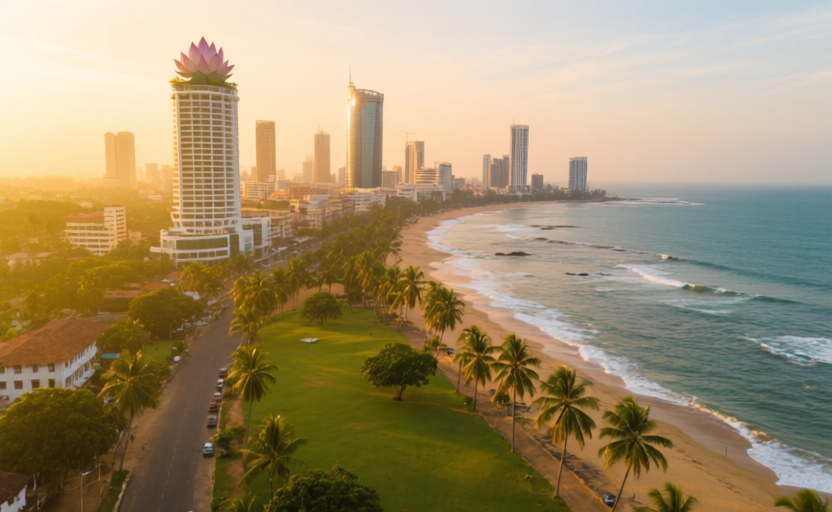
A half-kilometre strip of lawn along the Indian Ocean where the whole city comes at sunset.
Local tip: Go on a Sunday evening for the kite sellers and isso wade (prawn fritters) carts. It is the most democratic space in Colombo and the best free thing to do in the city.
Pettah
Neighborhood · North of Fort
The dense wholesale bazaar district — street after street each dedicated to a single trade.
Local tip: Go early morning before the heat and crowds. The Red Mosque on Second Cross Street is extraordinary, and Pettah is where you actually buy things rather than shop.
Gangaramaya Temple and Seema Malaka
Culture · Beira Lake
A working Buddhist temple crammed with donated objects, plus a serene Geoffrey Bawa-designed pavilion floating on the lake.
Local tip: Seema Malaka next door is the quieter and more beautiful half, and most visitors miss it. Bawa is Sri Lanka's great architect and this is his most accessible work.
Old Dutch Hospital & Fort
Food · Colombo Fort
A 17th-century colonial building turned into the city's best-known restaurant and bar courtyard.
Local tip: Convenient rather than authentic, but genuinely pleasant. Walk the surrounding Fort streets for the colonial banking architecture, which few visitors bother with.
Galle Fort
Culture · 2 hours south by expressway
A Portuguese and Dutch walled town on a promontory, and the best-preserved colonial fortification in South Asia.
Local tip: The Southern Expressway makes this a genuine day trip. Stay for sunset on the ramparts after the coach parties leave — that is when it becomes remarkable.
Diyasaru Park and the Colombo wetlands
Hidden gemNature · Thalawathugoda
Boardwalks through a restored urban marsh with monitor lizards, kingfishers and the occasional crocodile, inside the city.
Local tip: Almost no foreigners know Colombo is an internationally designated Wetland City. Go at dawn, take binoculars, and you will have a genuine wilderness twenty minutes from the centre to yourself.
Emergency numbers in Colombo
Compare Colombo with…
Side-by-side cost of living, language, climate and careers — to help you choose.