Germany · Europe
Moving to Cologne
Cologne quick facts
Germany at a glance
Europe & Central Asia
Economy
World Bank · 2025Religion
% of populationCIA World Factbook / national censuses
Cost of living in Cologne
Can you move to Germany?
Pick your passport to see whether you can enter Germany — and what it takes to stay.
Entry rules come from github.com/imorte/passport-index-data, updated 17 February 2026. They change without notice — confirm with the official immigration service before booking.
Getting set up in Germany
Residence permits, Anmeldung, and a manageable German city
Germany's sequence is rigid: register your address within two weeks of moving in, producing the confirmation needed for a tax ID, bank account, health insurance and residence permit. Cologne's appointment availability is considerably better than Munich's, and its rental market is far less brutal, which makes the whole first-month sequence more tractable here than in most large German cities.
Read the full step-by-step guideExchanging a licence, and the Rhine rail corridor
EU and EEA licences remain valid without action. Non-EU licences are valid for six months from taking up residence, after which you need a German licence — and whether tests are required depends on the issuing country and, for federal countries, the specific state or province. Cologne is flat, compact and sits on one of Europe's densest regional rail networks, so a car is genuinely optional.
Read the full step-by-step guideOpening a German account, and the Schufa problem
You need a German account for salary, rent and the direct debits German life runs on. Traditional banks require an Anmeldung first, creating a sequencing problem; digital banks generally do not. The Schufa problem is identical to every German city — but it costs you less here, because Cologne's rental market is far less competitive than Munich's or Frankfurt's.
Read the full step-by-step guideCompulsory insurance, and the statutory-versus-private decision
Germany requires everyone to hold health insurance. Employees below an annually-set income threshold must join the statutory system, where contributions are a percentage of income shared with the employer and dependants are covered free. Above the threshold, and for the self-employed, private cover becomes available — cheaper when young and healthy, considerably more expensive later, and very difficult to leave.
Read the full step-by-step guideGetting a German SIM, and why registration matters
Germany requires identity verification for every SIM including prepaid — passport or ID, verified in a shop, by video call or at a post office. Prepaid needs no Anmeldung or Schufa. Postpaid contracts run a Schufa check a newcomer will fail or pass marginally, so start prepaid and switch once you have a record.
Read the full step-by-step guideGerman income tax, tax classes, and 9% church tax in NRW
German income tax is progressive and deducted at source, with your tax class determining monthly withholding. Church tax adds 9% of your income tax liability in NRW if you declared a religious affiliation at Anmeldung. A solidarity surcharge applies to higher incomes. Filing is optional for many employees but frequently produces a refund, particularly in the relocation year.
Read the full step-by-step guideEach guide has verified costs, timelines, required documents, and the non-obvious gotchas — sourced from official government pages. Last verified August 2026.
Essential German phrases
Reading a list isn’t learning it. Globe Quest turns these into a trainer — hear each phrase spoken, drill them with spaced repetition, and get scored as you say them out loud.
What to know before you go
Carnival is not optional background — plan your February around it
CriticalKarneval peaks in the week before Lent, and Weiberfastnacht and Rosenmontag effectively close the city: offices shut or empty, public transport reroutes, and the streets fill from morning. It is genuinely joyful and genuinely inescapable. Do not schedule anything important, do not expect shops or offices to behave normally, and if you have no interest in it, plan to be elsewhere — half the city does exactly that.
Register within two weeks, and Cologne's appointments are easier than Munich's
CriticalThe Anmeldung must be done at a Bürgeramt within two weeks of moving in, gating your tax ID, bank account, health insurance and residence permit. Cologne's availability is considerably better than Munich's, but the deadline is real and everything downstream waits on it. Book online as soon as you know your move date.
Church tax in North Rhine-Westphalia is 9%
CriticalDeclaring membership of a recognised church at your Anmeldung triggers automatic deduction of church tax at 9% of your income tax liability in NRW — as in most German states, against 8% in Bavaria and Baden-Württemberg. Declaring no affiliation means no church tax. The question is asked in a short appointment most newcomers do not realise carries an annual cost.
Health insurance is compulsory and the choice is near-irreversible
CriticalEveryone in Germany must hold health insurance. Employees below an income threshold join the statutory system; above it, private becomes available. Private is often cheaper when young and healthy, considerably more expensive later, prices each family member separately, and is very difficult to leave. Statutory covers dependants free. Decide on the thirty-year view.
This is the cheapest and most relaxed of Germany's big cities
ImportantCologne's rents sit well below Munich's and Frankfurt's, and the city has a reputation — earned — for being socially open, informal and easy to make friends in. It has one of Germany's largest queer communities and a genuinely welcoming temperament that the Kölsches Grundgesetz half-jokingly codifies. For a newcomer worried about German reserve, this is the softest landing of the big five.
You are in the middle of a dense rail corridor
ImportantCologne sits on the Rheinschiene: Bonn is 20 minutes away, Düsseldorf 25, and the Ruhr cities beyond that, all on regional rail covered by the Deutschlandticket. Living in one and working in another is entirely normal. It also means Brussels, Amsterdam and Paris are all direct high-speed trains, which materially changes what a weekend can be.
Top industries & employers
Media & broadcasting
RTL, WDR, Deutschlandfunk, Brainpool, Warner Music Germany
Cologne is Germany's television capital — RTL and WDR are both headquartered here and the production ecosystem around them is the largest in the country.
Insurance
AXA Germany, Gothaer, DEVK, Generali Deutschland, Zurich Germany
One of Europe's oldest insurance centres, with several major German insurers headquartered in the city and a deep actuarial and technology labour market.
Logistics & aviation
DHL, UPS, Ford, Cologne Bonn Airport, Kühne+Nagel
Cologne Bonn Airport is a major European air cargo hub — DHL and UPS both run large operations — and the Rhine port adds inland shipping.
Automotive & manufacturing
Ford, Toyota Deutschland, Igus, Deutz
Ford has manufactured in Cologne since 1930 and the plant has been converted for electric vehicle production, though the sector's future here is a live local question.
Chemicals & energy
Shell Rheinland, LANXESS, Evonik, RWE
The Rhine chemical corridor runs through the region, and RWE's energy operations make the surrounding area central to Germany's energy transition debate.
Games & digital
Ubisoft Blue Byte, Gamigo, Deutsche Telekom digital units
Cologne hosts Gamescom, the world's largest games trade fair by attendance, and has a genuine games development cluster around it.
Where to go in Cologne
Kölner Dom
Landmark · Altstadt
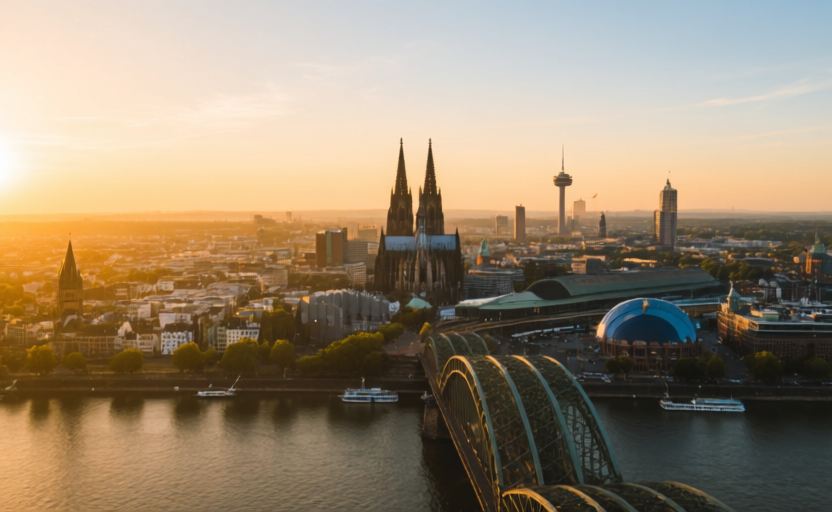
A Gothic cathedral begun in 1248 and finished in 1880, which survived the war largely intact while the city around it did not.
Local tip: Free to enter. Climb the 533 steps of the south tower for the view — it is a genuine effort and the staircase is narrow. Go early; it is Germany's most visited landmark.
The Rhine promenade & Rheinauhafen
Nature · Riverside
The riverbank walk from the old town south to the converted harbour, with the three Kranhaus buildings shaped like cranes.
Local tip: The east bank has the better view — of the cathedral and the old town — and is where locals go to sit with a beer in summer. Cross the Hohenzollern bridge on foot.
Belgisches Viertel
Neighborhood · West of the ring
The Belgian Quarter — independent shops, bars and restaurants on streets named after Belgian cities.
Local tip: The best eating and drinking in Cologne, and where you will end up most evenings. Brüsseler Platz on a summer evening fills with people sitting on the church steps, which the neighbours periodically object to.
Museum Ludwig
Culture · Beside the cathedral
One of Europe's most important collections of modern art, with the largest Pop Art holding outside the United States and a major Picasso collection.
Local tip: Directly beside the cathedral and consistently overshadowed by it. The Picasso rooms and the Russian avant-garde collection are world class, and it is rarely crowded.
The Kölsch breweries
Food · Altstadt and beyond
Früh, Päffgen, Sion and others — traditional halls where Kölsch arrives in 200ml glasses until you stop it.
Local tip: Päffgen on Friesenstraße is the one locals defend most fiercely. Put your beer mat on top of the glass when you have had enough, or the Köbes will keep going. The gruffness is performance and you are meant to give it back.
Decksteiner Weiher & the Äußere Grüngürtel
Hidden gemNature · West of the city
A lake in the outer green belt — a ring of parkland laid out in the 1920s on the former fortifications encircling the city.
Local tip: Cologne has two concentric green belts most visitors never see, built on demolished Prussian fortifications. The outer ring is where the city actually runs, cycles and barbecues, and Decksteiner Weiher is its best stretch.
Emergency numbers in Cologne
Compare Cologne with…
Side-by-side cost of living, language, climate and careers — to help you choose.