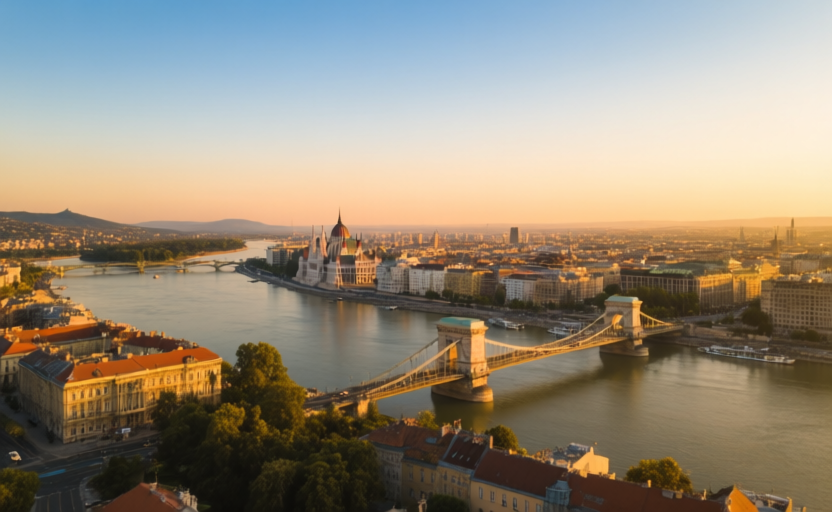
Hungary · Europe
Moving to Budapest
Budapest quick facts
Hungary at a glance
Europe & Central Asia

Economy
World BankReligion
% of populationHungary Census 2022 (the religion question was optional)
Cost of living in Budapest
Can you move to Hungary?
Pick your passport to see whether you can enter Hungary — and what it takes to stay.
Entry rules come from github.com/imorte/passport-index-data, updated 17 February 2026. They change without notice — confirm with the official immigration service before booking.
Getting set up in Hungary
Residence permits after the 2024 rewrite, and the address card that gates everything
Hungary rewrote its immigration law with Act XC of 2023, in force from 1 January 2024 with most provisions applying from 1 March 2024. The old single permit was abolished and replaced by separate categories — employment, Guest Worker, Hungarian Card, EU Blue Card, White Card, Guest Investor — that carry deliberately different rights to family reunification and to permanence. Separately, and regardless of category, you must register a Hungarian address and obtain the lakcímkártya, which requires the property owner's cooperation.
Read the full step-by-step guideExchanging a licence, the motorway e-vignette, and a city that does not need a car
EU and EEA licences are valid and exchangeable without a test. Licences from countries covered by Hungary's international convention obligations or bilateral arrangements can generally be exchanged, in some cases after a theory examination; the rest means a full Hungarian test. Hungary applies zero tolerance for alcohol — the limit is 0.00, not a low number — and motorway use requires an electronic vignette bought against the plate. Budapest's transport network is dense enough that most residents in the inner districts do not own a car.
Read the full step-by-step guideOpening a Hungarian account, and the forint you get paid in
Hungarian retail banking is modern and instant domestic transfers have been standard since 2020 — a payment between any two Hungarian accounts clears in seconds, around the clock. Getting in is the friction: most banks want the address card and tax number, which in turn need the landlord's cooperation. Because the forint moves, multi-currency accounts and euro sub-accounts are close to universal among internationally-paid residents.
Read the full step-by-step guideThe TAJ card, what public healthcare actually covers, and the private layer
Employment in Hungary brings social security contributions and a TAJ card, which entitles you to public healthcare including a registered GP (háziorvos), specialist referrals and hospital treatment. Emergency care is provided regardless of status. The public system is genuinely capable at the serious end and strained at the routine end, so most Budapest professionals use private clinics for anything non-urgent — a layer that is inexpensive by Western European standards and often employer-provided.
Read the full step-by-step guideSIM cards, home internet, and the documents each one wants
Hungary has three mobile networks — Magyar Telekom, Yettel and One — and prices sit around the European middle rather than at the Romanian or Polish low end. Prepaid SIMs are registered against identity documents and available immediately. Postpaid contracts and home internet want the address card, which puts them behind the same landlord conversation as everything else. Fixed broadband in Budapest is good and widely available, with cable and fibre in most inner-district buildings.
Read the full step-by-step guideThe flat 15%, the family exemptions that go under it, and the local business tax
Hungary levies a flat 15% personal income tax and a set of exemptions and allowances that can reduce it to nothing for particular households. Employees rarely file: NAV prepares a draft return each spring which you accept or amend online, and for most people accepting it is the entire process. The complications are the family exemptions — which are being expanded on a published schedule — and, for anyone self-employed, the local business tax that Hungarian municipalities levy on turnover rather than profit.
Read the full step-by-step guideEach guide has verified costs, timelines, required documents, and the non-obvious gotchas — sourced from official government pages. Last verified August 2026.
Essential Hungarian phrases
Reading a list isn’t learning it. Globe Quest turns these into a trainer — hear each phrase spoken, drill them with spaced repetition, and get scored as you say them out loud.
What to know before you go
No address card, no life — and the landlord holds the pen
CriticalThe lakcímkártya proves your registered Hungarian address, and without it you cannot obtain a tax identification number, a TAJ health card, most bank accounts, a company directorship or a school place. To register you need the property owner's signed declaration of accommodation — the befogadó nyilatkozat — or a properly attested lease, and where a flat has multiple owners all of them may need to sign. Some landlords refuse outright, usually to keep the rental income undeclared. Ask about address registration at the viewing, not after you have paid a deposit. It is the single most consequential question in a Budapest flat hunt.
Hungary abolished the single permit — find out which category your employer is filing
CriticalAct XC of 2023 came into force in 2024 and replaced the old single permit with separate categories carrying deliberately different rights. A residence permit for employment or a Hungarian Card allows family reunification and can lead onward to permanent status. A Guest Worker permit does neither: no family, and a hard three-year ceiling counted from first issuance. A White Card holder may not be granted a national residence card at all. These look interchangeable in a job offer and are not. Ask the category by name before you accept.
The flat 15% is real, and the family exemptions can take it to zero
ImportantHungarian personal income tax is a flat 15%, one of the simplest systems in Europe. Layered on it is the most aggressive family tax policy in the EU: under-25s are exempt up to a cap, mothers under 30 with a child are exempt, mothers of three became exempt for life from 1 October 2025, and mothers of two are being phased in from 1 January 2026 starting with those under 40. The family tax allowance is separately substantial and was increased again for 2026. Two households on identical gross salaries can pay wildly different effective rates.
You are paid in forint and the forint moves
ImportantHungary is in the EU and Schengen but keeps the forint, and it has been one of Europe's more volatile currencies. Rents in the international end of the market are frequently quoted in euro while salaries are paid in forint, which puts the exchange risk squarely on the tenant. Anyone with euro-denominated obligations — a foreign mortgage, school fees abroad, savings targets in another currency — should treat a forint salary as a variable number rather than a fixed one and negotiate accordingly.
District VI banned short-term letting from January 2026, and it moved the market
ImportantTerézváros held a referendum in September 2024 in which a narrow majority voted to ban Airbnb-style letting in condominium flats. The Kúria cleared the ordinance in November 2025 and it took effect on 1 January 2026, making District VI the first place in Hungary to prohibit it outright. Around 2,700 listings had to convert to long-term letting or sell. For a long-term tenant this is straightforwardly good news — more supply, in one of the best-located districts in the city — and it is worth checking whether neighbouring districts follow.
The baths are infrastructure, and you should buy a pass rather than a ticket
Good to knowBudapest sits on more than a hundred thermal springs and has done since the Romans. Széchenyi, Gellért, Rudas, Lukács and Király are not attractions locals visit once — Lukács in particular runs on annual passholders who swim before work. Single tickets are priced for visitors and passes are priced for residents, and the difference is large. Every bath is a slightly different institution with its own conventions about swimwear, caps and single-sex days; ask before your first visit rather than at the turnstile.
Top industries & employers
Automotive & engineering
Audi, Mercedes-Benz, BMW, Bosch, Continental, Knorr-Bremse, ThyssenKrupp
Hungary is one of Europe's most automotive-dependent economies per head; the plants are outside Budapest but the engineering, R&D and shared-service headcount is concentrated here.
Shared services & business process
BP, Morgan Stanley, Citi, BlackRock, ExxonMobil, Vodafone, Diageo
Budapest hosts one of the largest concentrations of multinational shared service centres in Europe, hiring heavily for German, French, Nordic and Dutch language skills alongside English.
Software & IT
LogMeIn/GoTo, Prezi, Ustream, EPAM, NNG, Cisco, IBM
Prezi and Ustream both came out of Budapest, and NNG's navigation software ships in a large share of the world's car dashboards — a small but genuinely product-led scene.
Pharmaceuticals & life sciences
Richter Gedeon, Egis, Sanofi-Chinoin, Teva
Richter Gedeon has operated from Budapest since 1901 and is one of central Europe's largest independent pharmaceutical companies, with a substantial research operation in the city.
Banking & finance
OTP Bank, MBH Bank, K&H, Erste, Raiffeisen, UniCredit
OTP has grown from the Hungarian savings bank into a regional group operating across a dozen countries, and its Budapest headquarters is the largest financial employer in the country.
Film production
Origo Studios, Korda Studios, National Film Institute
Hungary's production tax rebate has made Budapest one of Europe's busiest shooting locations, standing in for Berlin, Moscow, Paris and Buenos Aires in a steady stream of international productions.
Where to go in Budapest
Széchenyi & Lukács baths
Culture · City Park (XIV) and Buda side (II)
The two ends of Budapest bathing culture: Széchenyi's grand yellow neo-baroque courtyard, and Lukács, where the locals actually go.
Local tip: Széchenyi is genuinely magnificent and genuinely full of visitors. Lukács, across the river, is where you find the plaques left by regulars over a century and a pool culture of serious daily swimmers. Buy a pass, not a ticket.
Erzsébetváros & the ruin bars (VII)
Nightlife · District VII, the old Jewish quarter
The dense inner district where the ruin-bar movement started, wrapped around the Dohány Street Synagogue.
Local tip: Szimpla Kert is the original and worth seeing once. The district is also the historic Jewish quarter with a serious set of synagogues, kosher bakeries and memorial sites that most visitors walk past on the way to a bar. Living here means accepting genuine night noise.
Andrássy út & the Opera (VI)
Landmark · District VI, Terézváros
The great nineteenth-century boulevard from the centre to Heroes' Square, with the Opera House halfway along and the first metro on the continent running beneath it.
Local tip: The M1 line under Andrássy opened in 1896 and is the oldest electrified underground railway in continental Europe — it still runs with tiny yellow carriages and low ceilings. Take it once as a piece of history rather than as transport.
Gellért Hill & the Citadella
Nature · District XI, Buda side
A rocky hill above the Danube with the best view of the city, the Liberty Statue on top and the Gellért baths at its foot.
Local tip: The obvious approach is the stairs from Gellért tér. The better one is the path from the south-west, through the Jubilee Park, which is shaded, gentler, and empty. Go at sunset and walk down into District XI for dinner.
Hunyadi tér & Jókai tér markets (VI)
Food · District VI
Small neighbourhood market halls where Budapest actually shops, a few minutes from Andrássy.
Local tip: The Great Market Hall at Fővám tér is the famous one and is now largely paprika souvenirs upstairs. Hunyadi tér is what the Great Market Hall used to be — produce, cheese, pickles and a butcher's counter with a queue of pensioners.
Memento Park
Hidden gemCulture · District XXII, southern outskirts
Every communist statue removed from Budapest's streets after 1989, collected into a field on the edge of the city instead of being destroyed.
Local tip: Hungary did something unusual with its monuments: rather than smashing them, it moved them to a deliberately bleak open-air park and left them standing in rows. It is a forty-minute trip from the centre and almost nobody makes it, which is exactly why it is the most affecting historical site in the city.
Emergency numbers in Budapest
Compare Budapest with…
Side-by-side cost of living, language, climate and careers — to help you choose.