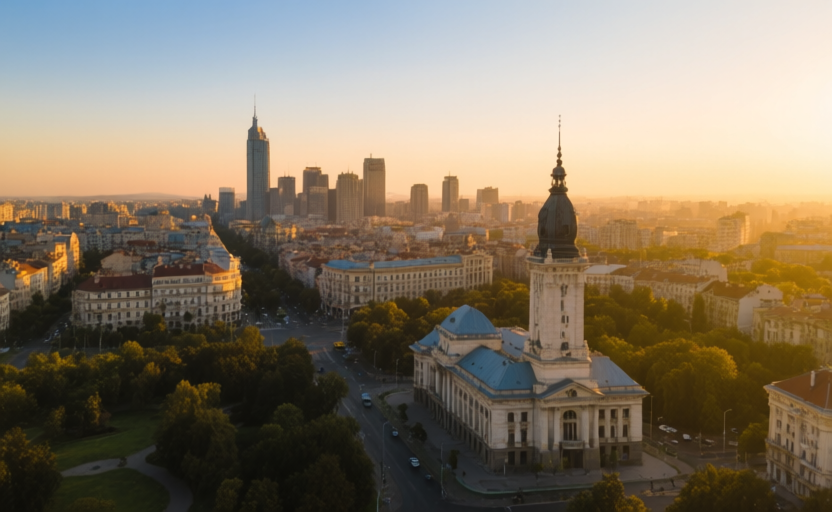
Romania · Europe
Moving to Bucharest
Bucharest quick facts
Romania at a glance
Europe & Central Asia

Economy
World BankReligion
% of populationRomania Census 2021 (shares of those who declared a religion)
Cost of living in Bucharest
Can you move to Romania?
Pick your passport to see whether you can enter Romania — and what it takes to stay.
Entry rules come from github.com/imorte/passport-index-data, updated 17 February 2026. They change without notice — confirm with the official immigration service before booking.
Getting set up in Romania
The residence permit, IGI Bucharest, and the order you cannot change
Romania runs a strictly ordered chain: your employer obtains an employment approval (aviz de angajare) from IGI against an annual national quota, you apply for a D-series long-stay visa at a Romanian mission abroad, you travel, and then you apply to IGI in Bucharest for the residence permit before the visa's 90 days expire. You cannot start this from inside Romania on a visa-free entry, and the quota is a real constraint — 90,000 places for 2026, down from 100,000.
Read the full step-by-step guideExchanging a licence, the rovinietă, and why a car is a poor idea here
EU and EEA licences are valid in Romania and can be exchanged without a test. Licences from countries with which Romania has a reciprocal arrangement can also be exchanged, sometimes with a theory examination; everything else means sitting the Romanian test in Romanian. Owning a car in Bucharest brings the rovinietă road tax, mandatory RCA insurance, an annual or biennial ITP roadworthiness inspection, and a local vehicle tax paid to your sector — plus the worst congestion in the European Union.
Read the full step-by-step guideOpening a Romanian account, and the CNP that gates it
Romanian retail banking is modern, app-first and cheap, and card acceptance is close to universal in Bucharest. The friction is at the door: most banks want your residence permit and CNP before opening a full resident account, and some will open a limited non-resident account beforehand on a passport alone. Multi-currency accounts are standard because so many salaries and rents are quoted in euro even though the leu is the legal currency.
Read the full step-by-step guideCNAS, the 10% health contribution, and why everyone also has private cover
If you are employed in Romania, 10% of your gross salary goes to health insurance (CASS) and you are in the state system automatically. That entitles you to a registered family doctor, referrals and hospital care at no charge at the point of use. In practice almost every professional in Bucharest also holds an employer-provided private subscription, because the state system's waiting times and hospital conditions vary enormously and the private networks are cheap by international standards.
Read the full step-by-step guideSIM cards, and the fibre that makes Bucharest a remote-work city
Romania has among the fastest and cheapest fixed broadband in the world, and Bucharest is thoroughly fibred — gigabit connections in ordinary apartment blocks at prices that Western Europeans disbelieve. Mobile is similarly cheap. The practical sequence is a prepaid SIM on day one, then a postpaid plan once the residence permit and bank account exist, and a fibre installation that in most blocks is a same-week job.
Read the full step-by-step guideThe flat 10%, the 35% that goes with it, and the IT exemption that ended
Romania levies a flat 10% personal income tax, one of the lowest headline rates in the EU. It sits on top of employee social contributions of 25% for pensions and 10% for health, which are deducted first — so the combined bite on gross salary is around 45%. Employees rarely file anything; the employer withholds and reports. The two things that catch people are the repeal of the IT salary exemption from January 2025 and the sector-level local taxes nobody tells you about.
Read the full step-by-step guideEach guide has verified costs, timelines, required documents, and the non-obvious gotchas — sourced from official government pages. Last verified August 2026.
Essential Romanian phrases
Reading a list isn’t learning it. Globe Quest turns these into a trainer — hear each phrase spoken, drill them with spaced repetition, and get scored as you say them out loud.
What to know before you go
Your sector is an administrative fact, not an address detail
CriticalBucharest is six sectors, each with an elected mayor, its own local council, its own local tax office (Direcția de Impozite și Taxe Locale) and its own set of counters. Local property and vehicle taxes are declared and paid to your sector, not to a single city authority, and a document issued by Sector 2 will not be processed by Sector 4. The city hall in the centre handles city-wide matters and almost nothing you personally need. Learn your sector number in week one and mention it whenever you ask anyone for directions to an office.
Check the seismic classification before you sign anything
CriticalBucharest sits on one of the most earthquake-exposed sites of any European capital; the 1977 Vrancea earthquake killed over 1,400 people here. Buildings assessed into seismic risk class I carry a painted red dot — bulină roșie — and there is a public register of them. Law 212/2022 and its subsequent amendments built a legal regime around this classification, including restrictions on letting class I buildings. Many of the most attractive interwar apartments in the centre are exactly the buildings at issue. Ask for the expertiză tehnică and check the register before you fall in love with a flat.
Romania's IT income tax exemption is gone — do not accept a salary offer based on it
CriticalFor roughly two decades software developers employed in Romania paid no income tax on salary, which is a large part of why the sector grew the way it did. That exemption was repealed with effect from 1 January 2025. Engineers now pay the ordinary flat 10%. Any salary calculator, recruiter spreadsheet or relocation guide that shows an IT net figure without income tax is describing the world before 2025. Model the offer on 10% income tax plus 35% employee social contributions on gross.
The flat 10% headline hides a 35% social contribution
CriticalRomania's personal income tax is a flat 10%, among the lowest in the EU, and that is the number that gets marketed. What is less advertised is that the employee pays 25% pension contribution and 10% health contribution on gross salary, and the 10% income tax is charged on what remains. The combined deduction from gross is around 45%, so a Romanian gross salary converts to net far less generously than the 10% headline suggests. Always negotiate and compare in net.
Bucharest is genuinely cheap for an EU capital, and the gap is in rent rather than in everything
ImportantRestaurant meals, transport, utilities and services are markedly below Western European levels, and salaries in tech and professional services have converged upwards faster than prices have. Rent is where the arithmetic is best: a central one-bedroom in a good northern district costs a fraction of Vienna or Milan. What is not cheap is imported goods, cars and anything involving a Western brand — those are priced at or above EU averages.
Traffic is the city's defining daily problem and the metro is the answer
ImportantBucharest routinely ranks among Europe's most congested cities, and the Pipera office corridor in the north is the worst of it — a journey that maps say is fifteen minutes reliably takes fifty at peak. The metro is fast, cheap and unaffected, and the practical decision most newcomers get wrong is renting somewhere pleasant but off the network. From 1 May 2026 the integrated STB and Metrorex monthly pass costs RON 196, which is still trivial against the cost of driving here.
Top industries & employers
Software & IT services
UiPath, Bitdefender, Endava, Luxoft, Softbinator, Adobe, Oracle, Microsoft
UiPath was founded in Bucharest in 2005 and became Romania's first technology company to list on the New York Stock Exchange; Bitdefender was also founded here and is one of the largest independent security vendors in Europe.
Business process & shared services
Genpact, Accenture, Deloitte, EY, WNS, Wipro
Bucharest hosts one of Europe's largest concentrations of multilingual shared service centres, hiring in French, German, Italian, Spanish and Nordic languages as much as in English.
Banking & financial services
Banca Transilvania, BCR, BRD Société Générale, ING, Raiffeisen, UniCredit
The National Bank of Romania and the Bucharest Stock Exchange are both here, and Romania's banking sector is concentrated in the capital to an unusual degree.
Energy & utilities
OMV Petrom, Romgaz, Hidroelectrica, Transelectrica, Nuclearelectrica
Romania is one of the EU's few significant domestic gas producers, and the Neptun Deep Black Sea project has made Bucharest an energy capital in a way it was not a decade ago.
Automotive & engineering services
Renault Technologie Roumanie, Continental, Bosch, Honeywell
Renault's Romanian engineering centre is one of the largest automotive R&D operations outside France, and much of the Dacia platform work is done from here.
Pharmaceuticals & medical
Zentiva, Antibiotice, Terapia, Regina Maria, MedLife
Private healthcare groups headquartered in Bucharest have consolidated aggressively and now run networks that many employers use in place of, or alongside, the state system.
Where to go in Bucharest
Centrul Vechi (Lipscani)
Nightlife · Central, Sector 3
The restored merchant quarter — cobbled lanes, Manuc's Inn, and the densest concentration of bars in the country.
Local tip: It is loud, touristed and genuinely fun, but locals eat one street out. Head for the streets around Str. Covaci and Str. Șelari after eleven and toward Piața Amzei or Dorobanți for dinner beforehand.
Palace of the Parliament
Landmark · Sector 5, west of the centre
Ceaușescu's megastructure — the heaviest building in the world, built by demolishing a fifth of historic Bucharest.
Local tip: The guided tour requires ID and booking, and it shows perhaps five percent of the interior. The more affecting visit is walking the Uranus district around it and seeing what was flattened to make room, then the surviving churches that were physically moved on rails to hide them behind blocks.
Herăstrău / King Michael I Park
Nature · Sector 1, north
A large lakeside park at the top of the city, with the Village Museum on its western edge.
Local tip: The Village Museum inside the park is an open-air collection of relocated peasant houses from every Romanian region — the fastest way to understand a country most newcomers only see through Bucharest. Go on a weekday morning.
Cotroceni
Neighborhood · Sector 5, west
Low-rise interwar villas on quiet tree-lined streets, around the presidential palace and the botanical garden.
Local tip: It is the one central district that survived systematisation largely intact, which is why it feels nothing like the rest of Bucharest. The Botanical Garden is underused and the streets between Str. Dr. Lister and the palace are the best architectural walk in the city.
Piața Obor
Food · Sector 2, north-east
The city's largest market — meat, produce, cheese, and the mici stand that has fed Bucharest for decades.
Local tip: Go to the covered hall for the food, then to the grill counter at the back where the queue is. Ordering is by number of mici, with mustard and bread as standard. Cash, and no English.
Văcărești Nature Park
Hidden gemNature · Sector 4, south-east
An abandoned communist reservoir project that flooded and rewilded itself into a 180-hectare wetland inside the city.
Local tip: The concrete dyke was built in the 1980s, never filled as planned, and left to nature for thirty years; it now holds otters, hundreds of bird species and is formally protected. Almost no visitors go, and there is a full circuit walk on top of the embankment with the city skyline on all sides.
Emergency numbers in Bucharest
Compare Bucharest with…
Side-by-side cost of living, language, climate and careers — to help you choose.