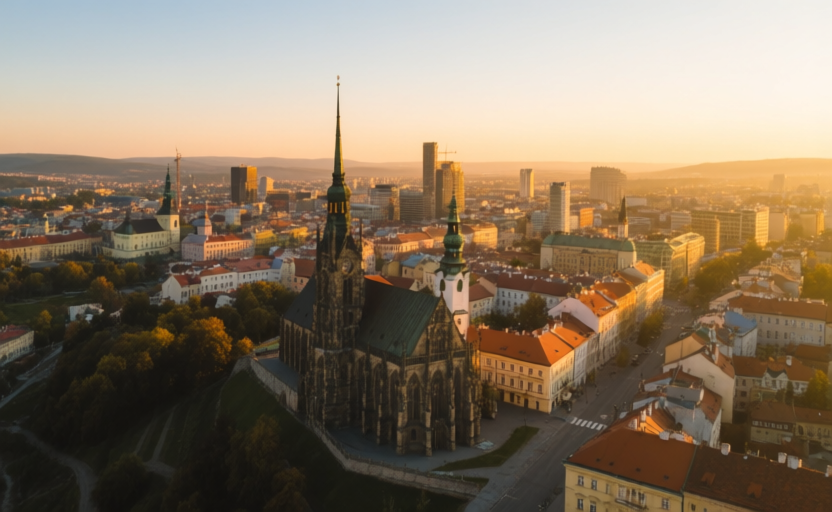
Czechia · Europe
Moving to Brno
Brno quick facts
Czechia at a glance
Europe & Central Asia
Economy
World Bank · 2025Religion
% of populationCIA World Factbook / national censuses
Cost of living in Brno
Can you move to Czechia?
Pick your passport to see whether you can enter Czechia — and what it takes to stay.
Entry rules come from github.com/imorte/passport-index-data, updated 17 February 2026. They change without notice — confirm with the official immigration service before booking.
Getting set up in Czechia
Employee Card, trade licence, and the Tuřanka office
Two non-EU routes dominate and they carry very different obligations. The Employee Card (zaměstnanecká karta) combines work authorisation and residence in one employer-tied document. The živnostenský list is a trade licence letting you contract freely, which is more flexible and makes you personally liable for insurance. Either way, non-EU arrivals must report their address to the Foreign Police within three working days. In Brno the Ministry of the Interior office handling all of this sits at Tuřanka 1554/115b and serves seven districts, not just the city.
Read the full step-by-step guideExchanging your licence, and a city that runs on trams without a metro
EU and EEA licences remain valid in Czechia without exchange. Non-EU licences must be exchanged at the municipal transport department within a set period after you take up residence, and licences from countries party to the Vienna or Geneva conventions generally exchange without a test. Locally, Brno has no metro but a dense tram, trolleybus and bus network under IDS JMK, with the city covered by zones 100 and 101 on a single tariff.
Read the full step-by-step guideOpening a Czech bank account, and the standing orders that protect you
Czech banks will generally open an account for a foreigner with a passport and proof of address, and a rodné číslo makes everything smoother. Czechia is not in the eurozone, so you will hold koruna and should watch conversion costs on any foreign-currency salary. If you are on a trade licence, the single most valuable thing you will do in the branch is set up standing orders for your monthly health and social insurance.
Read the full step-by-step guideHealth insurance, the freelancer trap, and finding a doctor who takes you
Employees are enrolled in the public system automatically through payroll, at which point Czech healthcare is comprehensive and cheap. The self-employed must register with a public insurer themselves and pay monthly minimums regardless of income. Non-EU nationals not yet in the public system need commercial insurance meeting statutory requirements, which costs more and covers less. Locally, Brno has two large teaching hospitals and a research base, and a shortage of GPs taking new patients.
Read the full step-by-step guideGetting a Czech mobile number, and why the resellers matter
Three networks — O2, T-Mobile and Vodafone — plus cheaper resellers running on the same infrastructure. Prepaid SIMs are widely available with light registration requirements. Czech mobile prices sit above regional norms, which is why the resellers are worth more here than in most countries. EU roaming means you can choose calmly after you have settled rather than at an airport kiosk.
Read the full step-by-step guideRodné číslo, the 15% and 23% bands, and the flat-rate regime
Czech income tax has two rates: 15%, and 23% on the slice of income above 36 times the average wage. That ceiling is recalculated every January, so treat any fixed figure as this year's only. The old super-gross wage base was abolished in 2021, which means pre-2021 calculators overstate the burden badly. Employees are taxed through payroll and often need not file. The self-employed can elect the paušální daň flat-rate regime, which bundles income tax and both insurances into one monthly payment and removes the annual return entirely.
Read the full step-by-step guideEach guide has verified costs, timelines, required documents, and the non-obvious gotchas — sourced from official government pages. Last verified August 2026.
Essential Czech phrases
Reading a list isn’t learning it. Globe Quest turns these into a trainer — hear each phrase spoken, drill them with spaced repetition, and get scored as you say them out loud.
What to know before you go
Register with the Foreign Police within three working days — and the Brno office serves seven districts
CriticalNon-EU nationals must report the address where they are actually staying within three working days of arrival. It is a hard deadline and a Friday arrival leaves you almost no margin. In Brno the Ministry of the Interior's Department for Asylum and Migration Policy office sits at Tuřanka 1554/115b, out towards Slatina rather than in the centre, and it serves not just the city but Brno-venkov, Vyškov, Blansko, Břeclav, Znojmo and Hodonín. That catchment is the reason appointment slots go quickly. Book through the ministry's ipc.gov.cz portal before you fly rather than after you land, and confirm in writing whether your accommodation provider is registering you or whether you must do it yourself — many will not, and will not tell you.
Brno runs a free city-backed service for foreigners, and Prague has no direct equivalent
CriticalThe Brno Expat Centre offers free, English-language help with residence paperwork, registration, health insurance and finding a doctor, and the South Moravian Region separately runs a Centre for Foreigners. Between them they will read your Employee Card file, tell you which office to go to and what to bring, and do it at no cost. This is genuinely unusual: in most European cities the equivalent service is a paid relocation consultant. Newcomers to Brno frequently pay for one anyway because nobody tells them the free version exists. Use it in week one, before you have made an expensive mistake with the trade licence or the insurance.
The freelance route makes you your own insurer, and that is where people lose money
CriticalThe živnostenský list is an accessible way to work here, and it is the route a lot of foreign contractors take. Unlike employment, it leaves you personally liable for monthly health and social insurance minimums, which are due whether or not you invoiced anything that month and accrue penalties quietly if missed. Set up standing orders the day your bank account opens. Then look at the paušální daň flat-rate regime, which bundles income tax and both insurances into a single monthly payment and removes the annual return entirely for eligible people below an income ceiling — but which you generally must elect by early January for that tax year.
Brno is the country's judicial capital, which shapes who lives here
ImportantThe Constitutional Court, the Supreme Court, the Supreme Administrative Court, the Supreme Public Prosecutor's Office and the Public Defender of Rights all sit in Brno rather than Prague — a deliberate counterweight to the capital's concentration of government and parliament. The practical consequence is a large, senior legal community, a strong law faculty at Masaryk University, and an unusual density of translation, notarial and legal-services capacity for a city of this size. If your work touches Czech administrative or constitutional law, the people who matter are here rather than in Prague.
This is wine country, not beer country, and it is the clearest cultural break from Prague
Good to knowSouth Moravia produces the overwhelming majority of Czech wine, and the vineyards around Mikulov, Valtice and Znojmo are under an hour away. The result is that a Brno evening as often means a wine bar or a cellar as a hospoda, that burčák — partly fermented young wine sold for a few weeks each autumn — is a genuine seasonal event, and that the local wine is decent and absurdly cheap by Western European standards. Arriving expecting the Prague beer-hall stereotype and finding a wine culture is one of the pleasant surprises of moving here.
Brno is materially cheaper than Prague, and the gap is largest in rent
Good to knowOverall costs run roughly a fifth below Prague, and the difference is concentrated in housing, where Prague's rent per square metre sits well above Brno's for equivalent stock. Combined with a genuine tech and research job market, that is the core case for Brno over the capital. The trade-offs are honest ones: a smaller English-speaking labour market outside tech and shared services, no metro — trams, trolleybuses and buses instead — and an international airport that handles a fraction of Prague's routes, so most long-haul travel starts with a bus or train to Vienna or Prague.
Top industries & employers
Software & IT services
Red Hat, Kentico, Y Soft, AVG/Gen Digital lineage, Kiwi.com engineering, NetSuite and Oracle operations
Brno is Czechia's second software centre and, for open-source and enterprise infrastructure work specifically, arguably its first — several global engineering organisations run substantial teams here rather than in Prague.
Law & the judiciary
Constitutional Court, Supreme Court, Supreme Administrative Court, Supreme Public Prosecutor's Office, Public Defender of Rights
The country's highest courts sit here by design, as a counterweight to Prague. That produces a deep legal labour market and a law faculty with national reach.
Higher education & research
Masaryk University, Brno University of Technology, Mendel University, CEITEC, the University of Veterinary Sciences
Masaryk is the second-largest university in the country and CEITEC is a major life-sciences and advanced-materials research institute — the student population visibly shapes the city's rhythm and rents.
Electron microscopy & precision instruments
Thermo Fisher Scientific (formerly FEI Czech Republic), TESCAN, Delong Instruments
An unusually specific local speciality: a very large share of the world's electron microscopes are designed and built in and around Brno, a cluster running back to Czechoslovak instrument-making.
Business services & shared operations
IBM, Honeywell, AT&T lineage operations, Kyndryl, SAP, Infosys
Multinationals running pan-European finance, IT and support functions — the largest single source of English-speaking entry-level employment in the city.
Trade fairs, engineering & viticulture
Brno Exhibition Centre (BVV), Zetor, Siemens, the South Moravian wine sector
The exhibition centre is one of Europe's larger trade-fair grounds and the International Engineering Fair is a fixture; south of the city, wine is a genuine regional industry rather than a sideline.
Where to go in Brno
Villa Tugendhat
Landmark · Černá Pole, north-east of the centre
Mies van der Rohe's 1930 house — a founding building of modern architecture, with an onyx wall and windows that sink into the floor, and a UNESCO World Heritage site.
Local tip: Tickets sell out weeks ahead and there is no walk-up. Book the extended tour if you can; the basement machine room, where the motors that lower the windows still sit, explains the house better than the living room does.
Zelný trh (Cabbage Market)
Food · Old town
A sloping square that has been a working vegetable market for eight centuries, with a baroque fountain in the middle and the ossuary beneath the church at its top corner.
Local tip: Buy fruit and vegetables here rather than at the supermarket — it is cheaper and much better in season. Then go under St James's Church next door: the ossuary holds the remains of tens of thousands of people and is the second largest in Europe after the Paris catacombs.
Špilberk Castle
Landmark · On the hill above the centre
A thirteenth-century fortress that became a Habsburg prison, now the city museum, with casemates cut into the rock and the best view over Brno.
Local tip: The park around it is free and is where the city goes on a summer evening. Walk up from Husova and come down the other side into Staré Brno — twenty minutes, and it reorganises your mental map of the city.
Brno reservoir and Bystrc
Nature · North-west, end of tram 1
A long dammed lake with boat services, wooded shores, swimming areas and a castle at the far end, reachable on a city tram ticket.
Local tip: Take the tram to Bystrc and then the public boat up the lake to Veveří castle — it runs on the standard transport tariff rather than as a tourist cruise, which almost no visitor realises.
The Moravian Karst
Nature · About 30 minutes north
A limestone landscape of caves and gorges, with the Punkva Caves and the Macocha abyss — a 138-metre sinkhole you can look into from above and boat through from below.
Local tip: Book the Punkva Caves online well ahead; slots sell out in summer. Get there by train to Blansko and a local bus rather than driving, because the car parks fill before the caves do.
Wilson Forest and the Kraví hora observatory
Hidden gemNature · Masarykova čtvrť and Veveří, west of the centre
A wooded ridge running through the middle of the western suburbs, with a hilltop park, an open-air pool and a public observatory at the top.
Local tip: Kraví hora has a planetarium, a swimming pool and a view, and is almost entirely used by locals rather than visitors. Go up on a clear evening; the observatory runs public sessions and the walk down through Masaryk quarter's villas is the prettiest in the city.
Emergency numbers in Brno
Compare Brno with…
Side-by-side cost of living, language, climate and careers — to help you choose.