Spain · Europe
Moving to Bilbao
Bilbao quick facts
Spain at a glance
Europe & Central Asia
Economy
World Bank · 2025Religion
% of populationCIA World Factbook / national censuses
Cost of living in Bilbao
Can you move to Spain?
Pick your passport to see whether you can enter Spain — and what it takes to stay.
Entry rules come from github.com/imorte/passport-index-data, updated 17 February 2026. They change without notice — confirm with the official immigration service before booking.
Getting set up in Spain
NIE, TIE, and the empadronamiento that also sets your tax authority
Spanish residency is a sequence: a NIE number, then municipal registration on the padrón, then a TIE card, then social security, then a health card. In the Basque Country the padrón does double duty, because it also establishes that you belong to the Bizkaia foral tax administration rather than the Spanish state agency, and gives you access to Osakidetza. Immigration itself is unchanged; almost everything downstream of it is.
Read the full step-by-step guideExchanging a licence, and a metro that makes a car optional
EU and EEA licences are exchangeable straightforwardly. For everyone else it depends on whether Spain has a bilateral agreement with the issuing country — if it does you exchange without a test, if not you take the full Spanish exams in Spanish. The six-month clock starts when you become resident. Bilbao has an unusually good metro for a city its size, plus trams and a dense suburban rail network, and the valley geography means driving and parking are both genuinely awkward.
Read the full step-by-step guideOpening an account, and the Basque cooperative banks worth knowing about
Spanish banks distinguish sharply between resident and non-resident accounts, and the non-resident version carries higher fees and a certificate that must be renewed. With a NIE and a padrón certificate you qualify for a resident account. In Bizkaia the local cooperative banks — Kutxabank and Laboral Kutxa — hold very large market shares, have dense branch networks and are often more accommodating to new residents than the national banks.
Read the full step-by-step guideOsakidetza — one of Spain's best public health services, and how to get into it
Osakidetza consistently rates at or near the top of Spanish regional health service comparisons on access, waiting times and outcomes. The route in is the standard Spanish one — padrón, then social security registration, then the health card — but what you get at the end is materially better than the Spanish average. The card is Basque, the entitlement is Spanish, and the two are administered by different bodies.
Read the full step-by-step guideGetting a Spanish SIM, and coverage in a valley
Spain requires every SIM to be registered against an identity document, so there is no anonymous pay-as-you-go. A prepaid SIM can be activated on a passport, which is what to do on arrival. Contract tariffs — better value and usually bundled with fibre — need a NIE and a Spanish bank account. Bilbao's fibre is good, but the valley and the surrounding mountains create genuine coverage variation that flat cities do not have.
Read the full step-by-step guideThe Concierto Económico — why you file with Bizkaia and not with Spain
If you live in Bilbao you are a taxpayer of the Diputación Foral de Bizkaia, not of the Spanish Agencia Tributaria. The province sets its own rates, bands, deductions and deadlines, runs its own filing platform, and applies its own foreign-asset reporting rules. Spanish tax guidance written for Madrid, Valencia or Málaga describes a system you are not in. The single most important step of this whole move is finding an adviser who files with the Hacienda Foral.
Read the full step-by-step guideEach guide has verified costs, timelines, required documents, and the non-obvious gotchas — sourced from official government pages. Last verified August 2026.
Essential Spanish phrases
Reading a list isn’t learning it. Globe Quest turns these into a trainer — hear each phrase spoken, drill them with spaced repetition, and get scored as you say them out loud.
What to know before you go
The Basque Country runs its own tax system — this is not a regional variation
CriticalUnder the Concierto Económico, Bizkaia sets and collects income tax, corporate tax, wealth tax and inheritance tax itself through the Hacienda Foral. You do not file with the Agencia Tributaria. The rates, the deductions, the deadlines and the online systems are all different from the rest of Spain, and Spanish tax advice written for Madrid or Málaga is not merely imprecise here, it is addressed to a different authority. Find an adviser who works in Bizkaia specifically, and do it before your first filing rather than after.
Empadronamiento first — and here it also decides your tax and health authority
CriticalThe padrón unlocks the health card, school places, your TIE appointment and residency renewals, as everywhere in Spain. In the Basque Country it additionally establishes which foral treasury you file with and gives you access to Osakidetza. Register at the ayuntamiento in your first fortnight with your passport and a rental contract or proof of address.
Osakidetza is genuinely one of the best public health services in Spain
ImportantThe Basque health service consistently rates at or near the top of Spanish regional comparisons on waiting times, primary care access and outcomes. The entitlement route is the same as elsewhere — padrón, then social security, then the card — but what you get at the end of it is materially better than the Spanish average. It is one of the strongest practical arguments for the region and it rarely appears in relocation content.
The rain is real and it is the main thing people underestimate
ImportantBilbao sits on the Atlantic coast in a green valley and it gets substantially more rain than anywhere else in this set of Spanish cities — spread through the year rather than concentrated, and often as sirimiri, a fine drizzle that does not stop. The compensation is that the landscape is genuinely green, summers are mild rather than punishing, and you never face a Sevillian August. If you are moving to Spain for the sun, do not move here.
Euskara is co-official, and it matters more than you would expect
ImportantNobody expects a newcomer to speak Basque, and Spanish works everywhere in daily life. But Euskara is used in schooling, in local government and in a large share of public sector job requirements, where a certified level is often a hard prerequisite rather than a bonus. If you have children who will be schooled here, the language model you choose has long consequences. If you want to work in the public sector, start learning early.
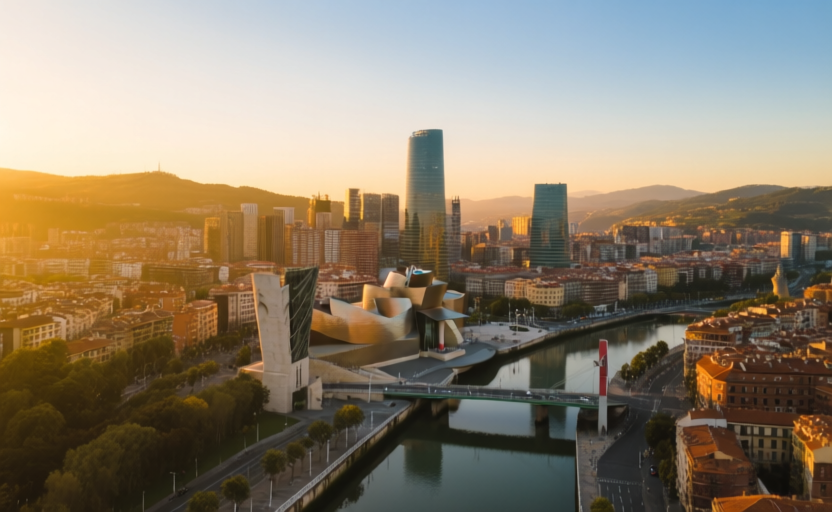
Bilbao is much cheaper than it looks and much more industrial than the Guggenheim suggests
Good to knowThe museum reframed the city's image, but the economy underneath is engineering, energy, banking and heavy industry — Iberdrola, BBVA's origins, CAF, Petronor, Sener. That means real professional salaries rather than a tourism wage floor, and rents well below Madrid or Barcelona. It is one of the better value propositions in Spain for someone with a technical or corporate career.
Top industries & employers
Energy & utilities
Iberdrola, Petronor, Naturgy, Siemens Gamesa
Iberdrola is headquartered here and is one of the world's largest renewable energy utilities, which anchors a deep local cluster in grid, wind and energy engineering.
Banking & finance
BBVA, Kutxabank, Laboral Kutxa, Bolsa de Bilbao
BBVA was founded in Bilbao and the city retains substantial banking operations, alongside the Basque cooperative banks that finance much of the regional industry.
Industrial engineering & machine tools
CAF, Sener, Danobat, Ingeteam, ITP Aero
The Basque Country is one of Europe's densest machine-tool and capital-goods clusters, and CAF builds trains and trams exported worldwide from nearby Beasain.
Aerospace & advanced manufacturing
ITP Aero, Aernnova, Sener Aeroespacial, Aciturri
ITP Aero is a major aero-engine component manufacturer, and the surrounding supply chain makes the Basque Country one of Spain's two main aerospace regions alongside Andalusia.
Cooperatives & the Mondragón model
Mondragón Corporation, Fagor, Eroski, Orona
Mondragón, an hour away, is the largest worker cooperative federation in the world and shapes the region's industrial culture well beyond its own member firms.
Culture, gastronomy & tourism
Guggenheim Bilbao, Azkuna Zentroa, Basque Culinary Center, Michelin-starred restaurants
The Guggenheim transformed the city's economy and image from 1997, and the Basque Country has one of the highest concentrations of Michelin stars per head anywhere in the world.
Where to go in Bilbao
The Guggenheim & the Nervión riverfront
Culture · Abandoibarra
Gehry's titanium building on the site of old docks, and the riverside walk that the city rebuilt around it.
Local tip: The building is the exhibit and the outside is free. Walk the river from the Zubizuri bridge to the Euskalduna and back at dusk when the titanium takes the light — most visitors photograph one side and never see the river elevation, which is the better one.
Casco Viejo & the Siete Calles
Neighborhood · East bank, the old town
The seven medieval streets the city grew from, packed with pintxo bars, the Santiago cathedral and the Ribera market.
Local tip: The Mercado de la Ribera is one of the largest covered markets in Europe and the upstairs bars are far better value than the tourist-facing ones on Calle del Perro. Go on a Thursday evening when locals do their txikiteo.
Mercado de la Ribera & pintxo bars
Food · Casco Viejo, on the river
A vast riverside market hall with produce below and bars above, and the entry point to the city's real food culture.
Local tip: The rule of pintxos is one or two per bar and then move. Bars specialise — one does the gilda, another the bacalao — and staying in one all evening means eating the worse half of its menu.
Getxo & the Bizkaia hanging bridge
Landmark · 12 km north, at the river mouth
A UNESCO-listed transporter bridge from 1893 that carries a gondola across the estuary, with a coastal promenade and cliffs beyond.
Local tip: Ride the gondola across for almost nothing, then walk the upper walkway if you have a head for heights. Carry on to the Getxo cliff path — it is one of the best coastal walks in northern Spain and the metro brings you back.
San Juan de Gaztelugatxe
Nature · 35 km north-east on the coast
A hermitage on a rock islet connected to the mainland by a stone bridge and 241 steps, on a spectacular stretch of the Basque coast.
Local tip: Access is booked and free but slots go quickly. Go on a weekday and go early, and treat the surrounding coast road as the real attraction — Bakio and Bermeo either side are worth the whole day.
Artxanda & the funicular
Hidden gemNature · Directly above the city
A wooded ridge reached by a funicular from the city centre, with the best view over the whole Nervión valley.
Local tip: The funicular takes three minutes and costs almost nothing, and hardly any visitor rides it. At the top there are walking paths through the hills that go on for hours, and the view back down the valley explains the city's whole geography in a way no map does.
Emergency numbers in Bilbao
Compare Bilbao with…
Side-by-side cost of living, language, climate and careers — to help you choose.