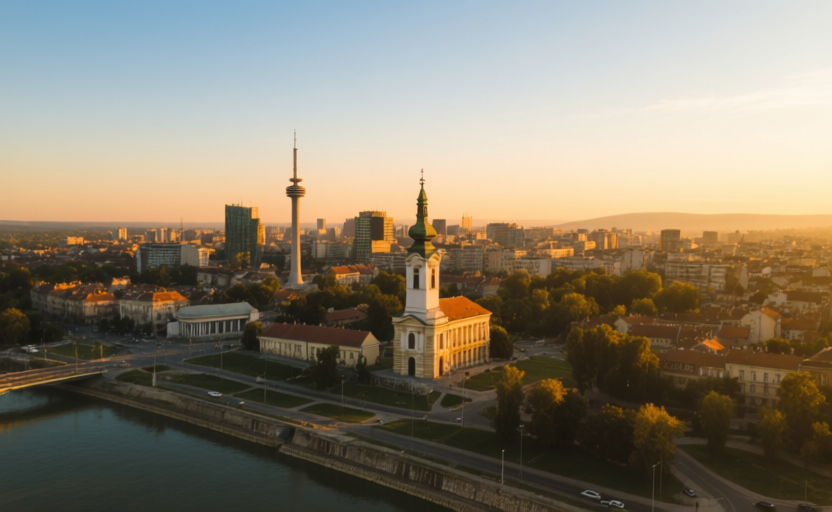
Serbia · Europe
Moving to Belgrade
Belgrade quick facts
Serbia at a glance
Europe & Central Asia
Economy
World BankReligion
% of populationSerbia Census 2022
Cost of living in Belgrade
Can you move to Serbia?
Pick your passport to see whether you can enter Serbia — and what it takes to stay.
Entry rules come from github.com/imorte/passport-index-data, updated 17 February 2026. They change without notice — confirm with the official immigration service before booking.
Getting set up in Serbia
The white card, the unified permit, and why none of this is EU law
Two things happen in parallel. First, the white card: police registration of your address, required of every foreigner on arrival and repeated on every change of address. Second, the unified residence-and-work permit — since the 2023 amendments took effect in February 2024, one electronic application to the Ministry of Interior produces one biometric card covering both residence and work, valid up to three years, with a fifteen-day statutory decision deadline. Permanent residence follows after three years of continuous residence, down from five before the reform.
Read the full step-by-step guideExchanging a licence, the one-year clock, and a city with free buses and no metro
Serbia is not in the EU, so a foreign licence is not automatically recognised indefinitely. Holders of temporary residence generally have a limited window — commonly six months from establishing residence — in which to exchange, and whether you can exchange without a test depends on Serbia's arrangement with the issuing country. Belgrade itself has no metro and traffic across the Sava and Danube bridges is the daily constraint, but since January 2025 all regular city public transport has been free, which changes the calculation for anyone considering a car.
Read the full step-by-step guideOpening a Serbian account, the dinar that barely moves, and the menjačnica
Serbian banks are generally willing to open accounts for foreigners on a passport and white card, which is easier than much of the region. The dinar floats on paper but is managed closely by the National Bank against the euro, and has been strikingly stable — which is why so much of Belgrade prices in euro and settles in dinars without anyone worrying much. Exchange offices (menjačnice) are ubiquitous, regulated and give better rates than banks.
Read the full step-by-step guideRFZO, the EHIC that does not work here, and Belgrade's winter air
Employment in Serbia brings compulsory health contributions and an RFZO health card, which gives access to the state system through a chosen doctor at a local health centre (dom zdravlja). Emergency care is provided regardless of status. Private clinics in Belgrade are numerous, quick and inexpensive by Western European standards, and are what most professionals actually use for routine care. The two things that catch newcomers are the EHIC not working and the seriousness of winter air quality.
Read the full step-by-step guideSIM cards, home internet, and the roaming cliff at the EU border
Serbia has three mobile operators — Telekom Srbija (mts), A1 and Yettel — and prices are low. Prepaid SIMs are available on a passport; postpaid contracts want the residence permit and usually a Serbian bank account. Home broadband in Belgrade is good and inexpensive, with fibre widely available in the newer parts of the city and cable elsewhere. The one genuine trap is roaming: Serbia is outside the EU, so an EU SIM used here is charged at non-EU rates and vice versa, though a regional roaming arrangement has softened this within the Western Balkans.
Read the full step-by-step guideThe 10% flat rate, the annual surcharge, and the freelancer regime that ended the limbo
Employment income in Serbia is taxed at a flat 10% on salary above a monthly non-taxable amount, with employee social contributions of roughly 19.9% on top and a further employer contribution. High earners face a separate annual personal income tax at 10% and 25% bands above thresholds set as multiples of the average annual salary, with an extra deduction for people under 40. Freelancers have their own self-taxation regime, introduced on 1 January 2023, which resolved years of uncertainty for Serbia's large contractor population.
Read the full step-by-step guideEach guide has verified costs, timelines, required documents, and the non-obvious gotchas — sourced from official government pages. Last verified August 2026.
Essential Serbian phrases
Reading a list isn’t learning it. Globe Quest turns these into a trainer — hear each phrase spoken, drill them with spaced repetition, and get scored as you say them out loud.
What to know before you go
Register the white card within the first day, and again every time you move
CriticalEvery foreign national in Serbia must be registered with the police at the address where they are staying. A hotel or registered apartment does it automatically and gives you the slip. In a private flat, the landlord or you must present at the police station covering the address, with the lease and the owner's ID and property document. The registration slip is asked for at the residence permit application, at banks and at other counters, and an unregistered stay is a genuine problem rather than a technicality. It also has to be redone whenever you change address, including for a long trip.
None of the EU machinery applies here, and that changes your whole plan
CriticalSerbia is an EU candidate and nothing more. Your Serbian residence permit gives no right to live or work anywhere else. Time spent here does not count toward EU long-term resident status. There is no EU Blue Card, no EU single permit and no EHIC — your European health insurance card will not be honoured. Serbia is also outside Schengen, which for many nationalities is an advantage: time in Belgrade does not consume Schengen days. But anyone whose longer plan is the EU should understand that Serbia is a parallel track, not a stepping stone.
Serbia has no digital nomad visa — the routes are a job, a company, or property
CriticalThe relocation industry markets Serbia to remote workers relentlessly, and there is no such permit. What exists is the unified residence-and-work permit tied to employment or to directing your own Serbian company, temporary residence on the basis of owning property here (with no minimum purchase price, which is unusual), and family or study grounds. Most relocated remote workers regularise through a Serbian company or through property. Both are legitimate and both come with obligations that a nomad visa would not carry.
The freelancer tax rules were rewritten in 2023 and you can switch models each quarter
ImportantSerbia's very large population of remote contractors spent years in legal limbo. From 1 January 2023 a self-taxation regime gives freelancers two models, filed quarterly: one with a larger fixed deduction and a higher rate, the other with a smaller fixed deduction plus a 34% standardised-cost deduction and a lower rate. You may choose a different model in each quarter, which is genuinely unusual and worth modelling rather than picking once. Separately, the flat-rate entrepreneur (paušal) regime remains popular but is capped by turnover and subject to an independence test that reclassifies disguised employment.
All city public transport has been free since January 2025
ImportantBelgrade abolished fares on all regular city and suburban bus, tram and trolleybus lines from 1 January 2025, becoming the largest European city to do so. There is no ticket, no card and nothing to validate — you board and sit down. The exceptions are the A1 airport express and the E express minibus lines, where you pay on board. There is no metro: construction of the first line is under way but the deadline has slipped to the 2030s, so surface transport plus walking is the city, and traffic on the bridges is the constraint.
Winter air quality is a genuine health consideration here
ImportantBelgrade regularly appears near the top of global air pollution rankings during winter inversions, driven by household solid-fuel heating in the surrounding settlements, older vehicles and the regional power plants. It is not a constant — summer air is fine and the riverside is better than the interior — but during cold, still December and January spells the readings are serious. Anyone with asthma, small children or a running habit should track the readings rather than assume, and factor an air purifier into the flat budget.
Top industries & employers
Software & IT services
Microsoft Development Center Serbia, Nordeus, Endava, HTEC, Vega IT, Levi9
Microsoft's Belgrade development centre is one of its oldest outside the United States, and Nordeus — the studio behind Top Eleven — was founded here and later acquired by Take-Two.
Relocated technology employers
A large cohort of firms and independent contractors that moved operations to Belgrade from 2022
The post-2022 relocation wave brought tens of thousands of technology workers, mostly Russian-speaking, and created a dense parallel professional community with its own coworking spaces, schools and services.
Business services & outsourcing
NCR Voyix, Continental, Schneider Electric, Zurich Insurance, Ericsson
Belgrade competes with Bucharest and Sofia for multilingual shared-service work, with the advantage of lower costs and the disadvantage of sitting outside the EU for data and regulatory purposes.
Banking & finance
Banca Intesa, OTP, NLB Komercijalna, UniCredit, Raiffeisen, AIK
The National Bank of Serbia manages the dinar closely against the euro, which is why the exchange rate has been remarkably stable despite the dinar being a floating currency on paper.
Energy & mining
NIS, Elektroprivreda Srbije, Zijin Mining, Rio Tinto (Jadar, contested)
Energy and mining are politically central in Serbia in a way they are not in its neighbours, and the Jadar lithium project has been one of the country's most contested public issues.
Film & creative production
PFI Studios, Work in Progress, Firefly Productions
Serbia's production incentive and Belgrade's mix of Habsburg, socialist and brutalist architecture have made it a steady stand-in location for international productions.
Where to go in Belgrade
Kalemegdan & Belgrade Fortress
Landmark · Stari Grad
The fortress on the ridge where the Sava meets the Danube, with a park wrapped around it and the best view in the city.
Local tip: Everyone photographs the Victor statue at sunset. The better hour is early morning, when the park belongs to chess players and dog walkers, and the lower ramparts toward the Danube are empty and free to walk.
Novi Beograd blokovi
Neighborhood · Across the Sava, west
A planned socialist city of numbered superblocks, brutalist towers and enormous green space between them.
Local tip: Addresses here are given by block number, not street, and Blok 45 and Blok 70 are as far apart as two different towns. Blok 45's riverfront promenade along the Sava is where Novi Beograd actually lives on a summer evening.
Savamala
Nightlife · Between the centre and the river
The old warehouse district that became Belgrade's design and nightlife quarter, and then met the Belgrade Waterfront development.
Local tip: Savamala's transformation is a live and contested story rather than a finished one — parts were cleared for the Waterfront project. What remains around Karađorđeva and Braće Krsmanović is still the most interesting few streets in the city after dark.
Ada Ciganlija
Nature · Sava river, south-west
A river island turned peninsula with a seven-kilometre lake beach, forest paths and every watersport the Sava allows.
Local tip: Belgraders call it 'the Belgrade sea' without irony. It is genuinely a beach — swimming, rowing, bars — twenty minutes from the centre and free. Go on a weekday; a July Saturday puts a hundred thousand people on it.
Skadarlija
Food · Stari Grad
The cobbled bohemian street of nineteenth-century kafanas, live music and long grilled-meat dinners.
Local tip: It is touristed and the prices reflect it, but the kafanas here are genuine institutions with a hundred years of history. Go late — Belgrade eats at nine and the music does not start until the tables are full.
Zemun & the Gardoš tower
Hidden gemNeighborhood · North-west, across the Danube from the centre
A separate Habsburg town absorbed into Belgrade, with a low-rise old quarter, a riverside quay and a nineteenth-century watchtower above it.
Local tip: Zemun was Austria-Hungary while Belgrade across the river was the Ottoman frontier, and the architecture still shows the border. The walk up through the Gardoš lanes to the tower takes fifteen minutes, costs nothing, and almost no visitor to Belgrade makes it.
Emergency numbers in Belgrade
Compare Belgrade with…
Side-by-side cost of living, language, climate and careers — to help you choose.