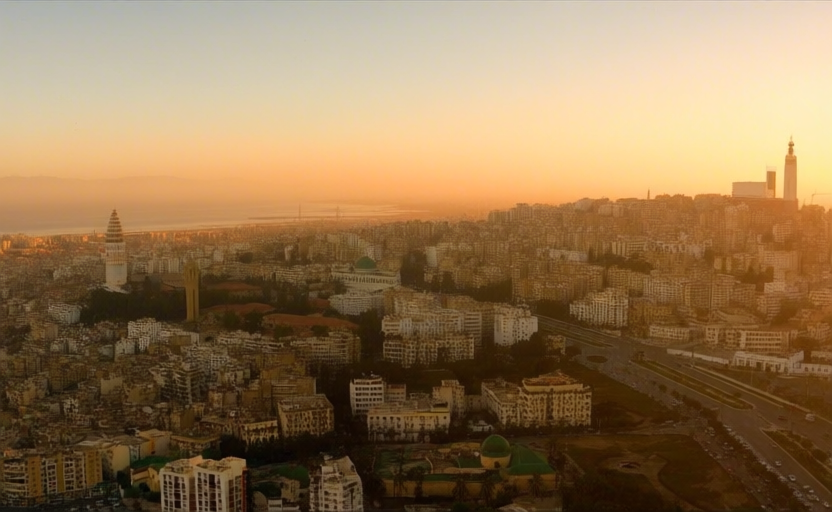
Algeria · Africa
Moving to Algiers
Algiers quick facts
Algeria at a glance
Middle East, North Africa, Afghanistan & Pakistan
Economy
World BankReligion
% of populationCIA World Factbook / national censuses
Cost of living in Algiers
Can you move to Algeria?
Pick your passport to see whether you can enter Algeria — and what it takes to stay.
Entry rules come from github.com/imorte/passport-index-data, updated 17 February 2026. They change without notice — confirm with the official immigration service before booking.
Getting set up in Algeria
Work permit first, residence card second — and no shortcuts between them
Algeria's process is sequential and employer-led. The employer obtains a provisional work authorisation from the employment services; an Algerian consulate abroad then issues a work visa, requiring an employer attestation guaranteeing repatriation costs; you enter on that visa; and the wilaya issues a carte de résident afterwards. The work permit cannot exceed two years under loi 81-10 and is renewable. A ten-year card exists after seven years of legal continuous residence. There is no self-sponsored route, no nomad visa and no investor or retirement residence programme we were able to establish against an official source.
Read the full step-by-step guideDriving in Algiers, licence exchange, and what we could not verify
Exchange of a foreign licence in Algeria is handled at the wilaya and depends on a bilateral agreement between Algeria and the issuing country — France has one. Beyond that, we were not able to source current Algerian processing rules, fees or timelines to a citable standard, and this guide says less as a result. What is reliably useful is practical: an international driving permit as a bridge, the fact that most expatriate housing sits in a handful of hillside communes with real traffic between them, and a metro and tramway network that is expanding but does not yet reach where most foreigners live.
Read the full step-by-step guideThe dinar, the transferable share of your salary, and the parallel market
The Algerian dinar is not convertible and exchange control is stricter than in Morocco or Tunisia. The mechanism that matters to a foreign employee is the split of salary into a transferable portion and a portion payable in dinars, agreed contractually and executed through the banking system under Banque d'Algérie instructions. A substantial illegal parallel market in foreign currency exists at a materially weaker rate than the official one. We describe it because you will encounter it and should understand what it is; we do not suggest using it.
Read the full step-by-step guideCNAS for employees, private cover for the reality, and evacuation cover for the rest
An employer must affiliate a salaried worker to the CNAS, and Algeria has a public health system that is free at the point of use and stretched. In practice foreign professionals in Algiers rely on private clinics and on an employer-provided international policy, and the single most important line in that policy is medical evacuation. Anyone coming here without evacuation cover has made a decision they probably did not realise they were making.
Read the full step-by-step guideGetting a line, paying for anything foreign, and the clock that does not change
SIMs are sold against an identity document in operator shops — bring the passport, and the residence card once you have it. Mobile coverage in Algiers is good and prepaid is inexpensive. The distinctive difficulty is not connectivity but payment: exchange control means paying a foreign service in foreign currency is an administrative exercise rather than a card transaction, and international card payments from Algerian accounts are limited. That single fact shapes how software, cloud and subscriptions get bought here.
Read the full step-by-step guideIRG, fiscal domicile, and why the currency question comes first
Article 3 of the Code des Impôts Directs sets out fiscal domicile: broadly, having a home or principal place of stay in Algeria, or carrying on a professional activity here, or having the centre of your principal interests here. Someone fiscally domiciled in Algeria is taxable on all their income; someone domiciled outside it is taxable on Algerian-source income. Employees have IRG withheld at source by the employer. For most foreign workers here the tax question is simpler than the currency question, and it is the currency question that should be settled first.
Read the full step-by-step guideEach guide has verified costs, timelines, required documents, and the non-obvious gotchas — sourced from official government pages. Last verified August 2026.
Essential Arabic phrases
Reading a list isn’t learning it. Globe Quest turns these into a trainer — hear each phrase spoken, drill them with spaced repetition, and get scored as you say them out loud.
What to know before you go
The work permit comes before the visa, and the residence card comes after arrival
CriticalThe sequence is fixed and it is the thing people get wrong. Your employer obtains a provisional work authorisation from the employment services; a consulate abroad then issues a work visa on the strength of it, along with an employer attestation guaranteeing your repatriation costs; you enter; and only then does the wilaya issue a carte de résident. You cannot arrive on a business or tourist visa and regularise from inside the country. The permit itself cannot exceed two years under loi 81-10 and is renewable.
Negotiate the transferable share of your salary into the contract, in writing
CriticalSalaries earned in Algeria by foreign workers are transferred abroad under a specific Banque d'Algérie mechanism in which the pay is split into a transferable portion and a portion payable in dinars — and that split is contractual, agreed between employer and employee. Whatever proportion you agree at signature is the proportion of your earnings that can ever leave the country. People negotiate hard on the headline number and accept the split as a formality. It is not a formality; it is the number that matters.
Expect to pay a full year's rent in advance, which is why most people let their employer handle housing
CriticalResidential leases in Algiers are commonly for one year with the entire year's rent payable up front, plus a deposit. That is a large single outlay in a currency you cannot bring in freely or take back out, and it is the main reason expatriate housing here is usually arranged and paid by the employer rather than by the individual. If you are arranging it yourself, ask about the payment terms in the first conversation, not the last.
A lease that is not written with a certain date is void
CriticalArticle 467 bis of the Algerian Civil Code, as amended, requires lease contracts to be concluded in writing with a certain date, on pain of nullity — and in practice this means a notarised contract. An informal arrangement is not a weak contract, it is not a contract at all, and a tenant under one has no rights to enforce. This is unusually strict by regional standards and it is worth insisting on properly even when a landlord suggests otherwise.
The dinar has an official rate and a parallel one, and they are far apart
ImportantThe dinar is not convertible and the Banque d'Algérie sets the official rate. A substantial parallel market exists — the Square Port-Saïd in Algiers is its best-known location — and trades at a materially weaker rate than the official one. Using it is illegal. The practical consequence for a newcomer is simply that a foreign-currency salary converted through the banking system at the official rate buys considerably less in Algiers than the headline figure suggests, and you should model your cost of living on that basis rather than on an unofficial rate you have read about.
French and Arabic both work, and which one depends on the room
Good to knowArabic is the national language and Tamazight is official; French remains pervasive in business, engineering, banking and higher administration, and much of the professional class is genuinely bilingual. English is growing among younger professionals and in the hydrocarbon sector but is not a substitute. If you have French, you will function. If you have neither French nor Arabic, working life in Algiers is materially harder than in Tunis or Casablanca.
Top industries & employers
Hydrocarbons & energy
Sonatrach, Sonelgaz, and the international service companies contracted to them
Sonatrach is the largest company in Africa by revenue and the centre of the Algerian economy. Most foreign professionals in Algeria are here because of it, directly or through a service contractor, and most are on rotation or fixed-term assignment rather than settling.
Engineering & construction
Cosider, ETRHB, and Chinese, Turkish and European contractors on public works
Large public infrastructure programmes — housing, motorways, the Algiers metro extensions, water — sustain a substantial foreign engineering and project-management presence, much of it employed by non-Algerian contractors.
Banking & finance
BNA, BEA, CPA, Société Générale Algérie, BNP Paribas El Djazaïr, Natixis Algérie
A mix of large state banks and foreign subsidiaries. Foreign banks are usually the practical choice for a newcomer because they are used to expatriate salary arrangements and foreign-currency accounts.
Automotive, pharmaceuticals & industry
Assembly and pharmaceutical plants under successive import-substitution policies
Industrial policy has pushed hard toward local manufacturing, with pharmaceuticals the most established. Policy has changed direction more than once, so sector conditions here are unusually dependent on the current framework.
Telecoms & IT
Algérie Télécom, Mobilis, Djezzy, Ooredoo Algérie, Cyberparc de Sidi Abdellah
A large domestic market and a growing local software sector, constrained by exchange control — paying a foreign cloud or software provider is a real administrative exercise rather than a card transaction.
Public administration & diplomacy
Ministries, the African Union's regional presence, embassies, UN agencies
Algiers is a capital with a substantial diplomatic and institutional presence, historically important in African and non-aligned diplomacy, and the associated foreign community is concentrated in the same few communes as the corporate one.
Where to go in Algiers
Casbah of Algiers
Landmark · Above the port, old city
The UNESCO-listed Ottoman citadel quarter — stepped alleys, palaces and terraces stacked down the hillside to the sea.
Local tip: It is a living neighbourhood in fragile condition, not a restored monument, and parts are genuinely unsafe structurally. Go with a local guide or a resident, which is also the only way you will get inside any of the palaces or onto a terrace. Photograph people only after asking.
Notre-Dame d'Afrique
Landmark · Bologhine, on the cliff north of the centre
A nineteenth-century basilica on a headland above the bay, with the inscription asking Our Lady to pray for Muslims and Christians alike.
Local tip: The view over the whole bay from the terrace is the best in the city and free. The inscription behind the altar — 'priez pour nous et pour les musulmans' — is the single most quoted thing about Algiers and worth reading in place.
Jardin d'Essai du Hamma
Nature · Belouizdad, east of the centre
A vast nineteenth-century botanical garden climbing from the sea toward the Bardo, with avenues of dragon trees and ficus.
Local tip: One of the great botanical gardens anywhere and used as an ordinary park by Algerois families. The French garden at the bottom is the photographed part; walk up through the English garden to the museum at the top for the view back down the axis to the sea.
Hydra & Sidi Yahia
Neighborhood · The heights, south of the centre
The hillside commune where most foreign residents and much of the diplomatic corps live, with the Sidi Yahia shopping streets below it.
Local tip: This is the practical answer to 'where do foreigners live in Algiers'. Sidi Yahia is where the cafés and shops are and where you will actually spend time; Hydra above it is quieter and residential. Neighbouring El Biar and Ben Aknoun are the other two names you will hear constantly.
Tipaza
Culture · 70 km west along the coast
A Roman city on the sea, with basilicas and a forum overlooking the Mediterranean and the Chenoua mountain behind.
Local tip: The most beautiful Roman site in Algeria and an easy day trip west. Camus wrote about it, and the essay is worth reading before you go. Combine it with the Royal Mausoleum of Mauretania on the ridge above, which almost nobody visits.
Chréa and the Blida Atlas
Hidden gemNature · About an hour south
Cedar forest and a national park in the Atlas above Blida, high enough to get snow in winter.
Local tip: Algerois go up here in summer for the temperature and in winter for the snow, and it is almost entirely unknown to foreigners in the city. The cedar forest and the views back over the Mitidja plain are the point. Check road conditions in winter — the approach is steep and the weather changes fast.
Emergency numbers in Algiers
Compare Algiers with…
Side-by-side cost of living, language, climate and careers — to help you choose.