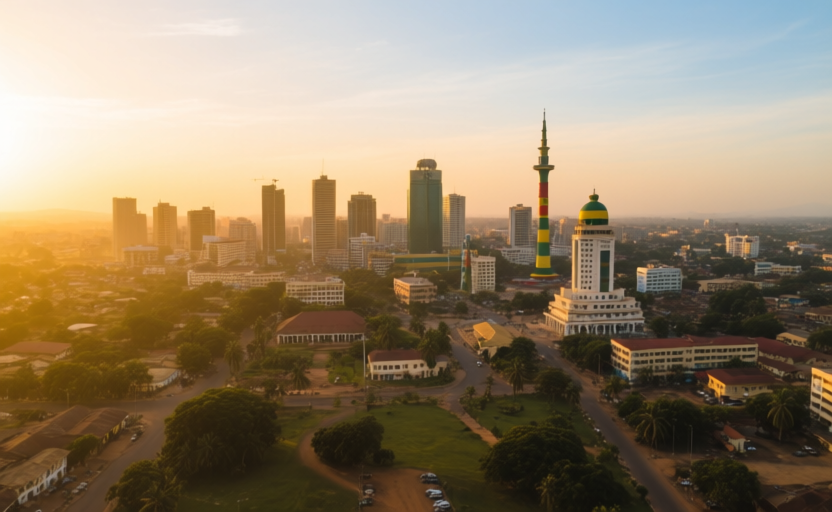
Ghana · Africa
Moving to Accra
Accra quick facts
Ghana at a glance
Sub-Saharan Africa
Economy
World BankReligion
% of populationGhana Population and Housing Census 2021
Cost of living in Accra
Can you move to Ghana?
Pick your passport to see whether you can enter Ghana — and what it takes to stay.
Entry rules come from github.com/imorte/passport-index-data, updated 17 February 2026. They change without notice — confirm with the official immigration service before booking.
Getting set up in Ghana
Work permit, residence permit and the Ghana Card that comes first
Ghana keeps the permission to work and the permission to live here as two separate instruments, issued in sequence and both required. Sitting underneath both is the non-citizen Ghana Card, issued by the National Identification Authority to foreigners resident 90 days or more, which the residence permit application requires. Companies registered with the Ghana Investment Promotion Centre get an automatic expatriate quota that shortcuts the work-permit queue for a defined number of positions. Two diaspora routes — Right of Abode under the Immigration Act 2000 and naturalisation — are real statutory instruments and are described honestly in the residency routes for Ghana.
Read the full step-by-step guideConverting a licence at the DVLA, and whether to drive at all
Foreigners staying beyond 90 days are treated as residents and are expected to convert a foreign licence to a Ghanaian one. Conversion is a defined DVLA process that skips the mandatory driving-school hours, but it requires a Ghana Card, a copy of a residence permit with more than two months left to run, a recent medical certificate and an accepted English translation where the licence is not in English. Processing takes four to six weeks. Accra traffic is far more manageable than Lagos's, and self-driving is genuinely normal here.
Read the full step-by-step guideOpening an account, mobile money, and the Ghana Card gate
The non-citizen Ghana Card is the identity document Ghanaian banks work from, and it is required for financial transactions including opening an account and using mobile money. Foreign-currency and foreign-exchange accounts sit alongside cedi accounts and are the standard way of holding hard currency. Mobile money — MTN MoMo above all — is not a fringe product here; it is how a large share of everyday payments actually happen, and it is linked to your Ghana Card too.
Read the full step-by-step guideNHIS, private cover, and the SSNIT exemption people forget to claim
Ghana runs a national health insurance scheme funded in part by a 2.5% levy carved out of the employer's social security contribution. Foreign residents can register for it with a Ghana Card, but most professional employers provide private cover with a panel of private hospitals in Accra, which is where the shorter waits and the international-standard facilities are. The genuinely valuable thing to know is not about health cover at all: expatriates on assignments of 36 months or less who already contribute to a foreign social security scheme can apply to be exempted from Ghana's mandatory pension contributions.
Read the full step-by-step guideSIM registration, the 30-day passport rule, and living with dumsor
Ghana links every SIM to a Ghana Card. Visitors may register on a passport, but that registration expires in about 30 days and the SIM is deactivated — which is a serious problem if you have already given the number to your bank, your landlord and your employer. Coverage across Accra is good and data is cheap. The harder problem is power: dumsor returned in force during 2026, and a fibre connection without a battery-backed router is not a connection.
Read the full step-by-step guidePAYE, the Ghana Card PIN, and the 183-day residence line
Ghana taxes residents on worldwide income and non-residents only on Ghana-source income, and the gap between the two regimes is large: residents pay progressive rates rising to 35% with a tax-free band at the bottom, while non-residents pay a flat 25% from the first cedi. Residence turns on 183 days in any 12-month period. Your taxpayer number is your Ghana Card PIN — there is no separate TIN for individuals any more. Employers operate PAYE monthly.
Read the full step-by-step guideEach guide has verified costs, timelines, required documents, and the non-obvious gotchas — sourced from official government pages. Last verified August 2026.
Essential English phrases
Reading a list isn’t learning it. Globe Quest turns these into a trainer — hear each phrase spoken, drill them with spaced repetition, and get scored as you say them out loud.
What to know before you go
The non-citizen Ghana Card comes before the residence permit, not after it
CriticalForeigners resident in Ghana for 90 days or more register with the National Identification Authority for a non-citizen Ghana Card, and that card is a requirement for applying for or renewing a residence permit. It is also required for opening a bank account, using mobile money, registering a SIM beyond a short window, and paying tax. Newcomers assume the residence permit is the master document and the card follows from it. The dependency runs the other way, and getting that order wrong stalls everything for weeks.
A work permit and a residence permit are two different documents and you need both
CriticalThe Ghana Immigration Service issues them separately: the work permit says you may work, the residence permit says you may live here. Holding one without the other is a real and common problem — an employee whose employer proudly produced a work permit can still be unlawfully resident. Ask which of the two you actually hold, in those words, and check the expiry dates independently because they do not always match.
Your SIM stops working after 30 days if you registered it on a passport
CriticalVisitors can register a SIM on a passport, but that registration is time-limited — around 30 days — after which the SIM is deactivated. To keep a Ghanaian number beyond that you need the non-citizen Ghana Card. People who arrive, buy a SIM, give the number to a bank, a landlord and an employer, and then lose it a month later have a genuinely disruptive week. Start the Ghana Card process in your first fortnight.
Six months' advance rent is the legal maximum and two years is the common ask
CriticalSection 25(5) of the Rent Act, 1963 (Act 220), as amended, limits advance rent to six months for tenancies longer than six months and two months for shorter ones, with three months on renewal, and it carries criminal penalties. Landlords in Accra routinely demand one to two years. The Rent Control Department has been enforcing the six-month limit more actively since 2026 and will take a complaint. Knowing the number is what turns a two-year demand into a negotiation rather than a fait accompli.
If you are on assignment for under three years, you may be exempt from SSNIT
ImportantGhana's National Pensions Act 2008 requires 18.5% of basic salary in contributions — 13% employer, 5.5% employee — and it applies to foreign workers too. But an expatriate employed in Ghana for a period not exceeding 36 months who can show membership of a social security scheme in another country can apply to the National Pensions Regulatory Authority for exemption. The exemption is not automatic; someone has to apply for it, and if nobody does, the deductions simply happen.
Dumsor is a live problem in 2026, not a memory from 2015
CriticalPower cuts have returned in force. Causes cited during 2026 include a substation fire at Akosombo taking out a large block of cheap generation, plus ageing distribution cables and overloaded transformers. ECG has at times declined to publish a fixed load-shedding timetable, which makes it harder to plan than a scheduled outage would be. Ask about backup power at every viewing, and assume that any building marketed to professionals should have a generator with stated hours.
Top industries & employers
Mining & minerals
Newmont Ghana, Gold Fields, AngloGold Ashanti, Perseus
Ghana is Africa's largest gold producer. The mines are inland at Obuasi, Tarkwa and Ahafo, but the corporate, finance and technical functions sit in Accra.
Oil & gas
Tullow Oil, Kosmos Energy, GNPC, Eni Ghana
The Jubilee and TEN fields offshore Cape Three Points made Ghana a producer from 2010. The operating offices are in Accra with logistics run through Takoradi.
Banking & financial services
Ecobank, GCB Bank, Absa Ghana, Stanbic, Databank
Ecobank's pan-African group has deep Accra roots and the city is a regional financial base. The sector went through a hard domestic debt restructuring in 2022–23 and has been rebuilding since.
Technology & startups
mPharma, Chipper Cash, Hubtel, MEST Africa, Google Research Africa
Google's Africa AI research centre opened in Accra in 2019 and MEST has been training and funding founders here since 2008 — the ecosystem is smaller than Lagos's but noticeably easier to enter.
Cocoa & agribusiness
COCOBOD, Olam Ghana, Barry Callebaut, Niche Cocoa
Ghana is the world's second-largest cocoa producer and COCOBOD's marketing monopoly makes the sector unusually centralised. Processing and export functions are concentrated in Accra and Tema.
Development & international organisations
UN agencies, World Bank, African Continental Free Trade Area Secretariat
The AfCFTA Secretariat is headquartered in Accra, which has drawn a substantial trade-policy and diplomatic community alongside the long-standing NGO sector.
Where to go in Accra
Jamestown & Ussher Fort
Neighborhood · Old Accra, coast
The oldest part of the city — a working Ga fishing community around a colonial lighthouse and two forts.
Local tip: Go with a guide from the community rather than wandering with a camera; several run walking tours from the lighthouse. The Chale Wote street art festival takes over these streets every year.
Kwame Nkrumah Memorial Park
Landmark · Central Accra, High Street
The mausoleum and museum of Ghana's first president, on the spot where he declared independence in 1957.
Local tip: The museum was substantially redeveloped and is far better than it was a decade ago. Go for the personal effects and the photographs rather than the monument itself.
Osu & Oxford Street
Nightlife · Osu
The densest strip of bars, restaurants and late-night life in the city, running down toward the coast.
Local tip: Oxford Street itself is the tourist face of Osu. The better eating is on the side streets — Lokko Road and the lanes off it — and the crowd there is far more local.
Makola Market
Food · Central Accra
The city's great trading market, run overwhelmingly by women, selling everything from cloth to dried fish.
Local tip: The market women are the backbone of Accra's economy and have real political weight. Go early, go with a local, and buy your kente and wax print here rather than in a hotel shop.
W.E.B. Du Bois Memorial Centre
Culture · Cantonments
The house where Du Bois lived out his last years as a Ghanaian citizen, with his library and grave in the garden.
Local tip: Small, quiet and unmissable if you want to understand why Accra became the centre of the diaspora-return movement. It is a ten-minute walk from Cantonments and almost never crowded.
Achimota Forest & the Eco Park
Hidden gemNature · Achimota, north-west
A large remnant of forest inside the city, part of it opened as a public park after years of contested development plans.
Local tip: Genuinely rare — several hundred hectares of tree cover inside a West African capital, with walking trails and cooler air. It is the best place in Accra to run without traffic, and most residents have never been.
Emergency numbers in Accra
Compare Accra with…
Side-by-side cost of living, language, climate and careers — to help you choose.