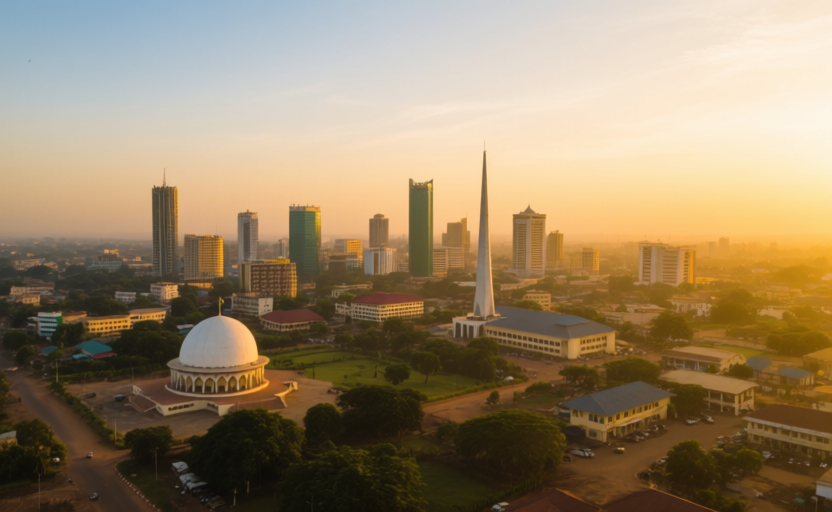
Nigeria · Africa
Moving to Abuja
Abuja quick facts
Nigeria at a glance
Sub-Saharan Africa

Economy
World BankReligion
% of populationCIA World Factbook (2018 est.) — Nigeria's census has not recorded religion since 1963, so all splits are survey estimates
Cost of living in Abuja
Can you move to Nigeria?
Pick your passport to see whether you can enter Nigeria — and what it takes to stay.
Entry rules come from github.com/imorte/passport-index-data, updated 17 February 2026. They change without notice — confirm with the official immigration service before booking.
Getting set up in Nigeria
Expatriate quota, the pre-arrival permit and CERPAC — from the capital
Nigeria licenses foreign employment at the company level. Your employer must hold an approved expatriate quota position for the job title before you can be hired into it. The pre-arrival step that follows is in transition: the old sequence was a Subject To Regularisation (STR) visa at a Nigerian mission abroad, regularised into a CERPAC residence permit within a 90-day window, while the Nigeria Visa Policy 2025, in force 8 May 2025, introduced a pre-arrival e-CERPAC serving as a 30-day entry permit and regrouped the visa classes into Short Visit, Temporary Residence and Permanent Residence families in place of the six types under the 2020 policy. Ask the mission you are applying through which sequence it is running. All of this is identical in Lagos. What differs in Abuja is proximity: the Ministry of Interior and the NIS headquarters are both in the city, which materially changes how a stuck application gets unstuck.
Read the full step-by-step guideDriving in a planned city, licences and the light rail
Abuja is one of the few Nigerian cities where driving yourself is genuinely pleasant: wide dual carriageways, a master-planned grid and journeys measured in minutes. A foreign licence covers a short settling-in period; beyond about three months you are expected to hold a Nigerian licence, obtained either through the FRSC's foreign driver's licence route or the ordinary driving-school and Vehicle Inspection route. Vehicle registration in the FCT goes through the Directorate of Road Traffic Services rather than a state authority, and the plates say Abuja rather than a state name.
Read the full step-by-step guideOpening an account, the BVN, and a floating naira
Nigerian banking runs on the Bank Verification Number, a biometric identifier issued to you rather than to a bank and required before anything meaningful happens. Domiciliary accounts in dollars, pounds or euros sit alongside naira accounts and are the ordinary way foreign residents hold hard currency. The naira has floated since June 2023 and the segmented official-versus-parallel world is gone, so advice built on arbitraging that gap is obsolete.
Read the full step-by-step guideHMO cover, the NHIA mandate, and where the good hospitals are
The NHIA Act 2022 made health insurance compulsory for all Nigerians and legal residents and obliges employers with five or more staff to enrol employees. Abuja's private hospital sector is smaller than Lagos's but well concentrated around Maitama, Wuse and Asokoro, and the National Hospital in the Central Area is the flagship federal facility. Diplomatic and development-sector employers commonly carry international insurance and evacuation cover on top, and the two are different products.
Read the full step-by-step guideSIM registration, the two-year NIN rule, and home internet
Every Nigerian SIM must be registered and linked to a National Identification Number — but the NCC's own rules exempt foreign nationals resident for less than two years, who register on their international passport bio-data and visa pages instead. Coverage across the planned city is good and data is cheap. Home internet options are better than most Nigerian cities because the districts are newer and the fibre build followed the master plan, but availability is still building by building.
Read the full step-by-step guideThe 2026 reform, FCT-IRS, and the rent relief
Nigeria's personal tax system was rebuilt by the Nigeria Tax Act 2025, in force from 1 January 2026. The Consolidated Relief Allowance was abolished and replaced with a zero band on the first NGN 800,000 of annual income, six progressive bands to a 25% top rate, and a new rent relief of 20% of rent up to NGN 500,000. Residence turns on more than a day count: a permanent home in Nigeria, or significant economic or family ties, can establish it below 183 days. In the FCT your PAYE goes to FCT-IRS, not to a state and not to FIRS.
Read the full step-by-step guideEach guide has verified costs, timelines, required documents, and the non-obvious gotchas — sourced from official government pages. Last verified August 2026.
Essential English phrases
Reading a list isn’t learning it. Globe Quest turns these into a trainer — hear each phrase spoken, drill them with spaced repetition, and get scored as you say them out loud.
What to know before you go
The immigration route is federal and identical to Lagos — quota, a pre-arrival permit, CERPAC
CriticalYour employer obtains an expatriate quota position from the Federal Ministry of Interior; you then obtain a permit before you travel and hold CERPAC as your residence permit. That middle step is in transition. The long-standing version was a Subject To Regularisation (STR) visa from a Nigerian mission abroad, regularised into CERPAC inside a 90-day window after landing. The Nigeria Visa Policy 2025, in force 8 May 2025, introduced a pre-arrival e-CERPAC — an entry permit valid 30 days — meant to remove that two-step, and the NIS's public visa listing no longer shows an STR class; but the NIS still publishes its STR/R2A page and existing STR holders are still being regularised. Confirm the sequence with the mission you will actually apply through. Abuja's advantage is that the Ministry of Interior and the Nigeria Immigration Service headquarters are both here, so escalating a stuck file is a taxi ride rather than a phone tree. A business visa still cannot be converted, and visa-on-arrival ended on 1 May 2025.
Your tax is filed with the FCT Internal Revenue Service, not with a state or with FIRS
CriticalNigeria's personal income tax follows the taxpayer's residence, and the Federal Capital Territory has its own revenue service. Living in Abuja means PAYE remitted to FCT-IRS and tax clearance certificates issued by it. This catches out people who move from Lagos and keep filing with LIRS, and people who assume that because Abuja is federal their tax must be federal. It is not — FIRS handles companies and VAT.
Learn the district numbering before you look at a single property
ImportantAbuja was master-planned and its addresses reflect it: Wuse is divided into zones, Garki into numbered areas, and the whole city into phases radiating out from the Central Area. A 'Wuse 2' address and a 'Wuse Zone 4' address are different places with different characters. Satellite towns — Lugbe, Kubwa, Nyanya, Karu — are cheaper and outside the planned city, with a commute that behaves quite differently. Getting the geography straight is the first hour of work.
Check the AEDC band on the feeder, and note that Abuja is still NERC-regulated
ImportantNigerian electricity customers are banded by the hours their feeder actually delivers, with Band A promising twenty hours or more at the highest tariff. In the FCT the distributor is AEDC and regulation remains with the national regulator, NERC — unlike Lagos, which transferred oversight to a state commission in December 2024. That means the national compensation directives when supply falls short apply here directly. Ask which band the feeder is on and ask to see a recent bill.
Land and property title in the FCT works differently and diligence is not optional
CriticalLand in the Federal Capital Territory is allocated federally, and the documentary chain — allocation papers, a Certificate of Occupancy, and the various interim instruments — is its own subject. Disputes over allocations and revocations are common enough that no one should transfer money on a property here without a lawyer looking at the title. This applies to renting as well as buying: verify that the person letting the property is entitled to.
Abuja is calmer and easier than Lagos, and the trade-off is the size of the private economy
ImportantDaily logistics here are genuinely straightforward by Nigerian standards: distances are short, roads are wide, the light rail runs, and a cross-town journey is twenty minutes rather than two hours. What you give up is depth of private-sector opportunity. Abuja's economy is government, diplomacy, development agencies, oil and gas regulation, and the professional services around them. If your work is commercial rather than institutional, the counterparties are mostly in Lagos.
Top industries & employers
Government & public administration
Federal ministries, the National Assembly, CBN, NNPC Ltd
Abuja exists because the federal government moved here in 1991. Every ministry, agency and regulator is headquartered in the city, and the public sector is by far the largest employer.
Diplomacy & international organisations
Over 100 embassies and high commissions, UN agencies, ECOWAS Commission
The ECOWAS Commission is headquartered in Abuja, which gives the city a regional diplomatic weight beyond its size and a substantial international civil service population.
Development & humanitarian
World Bank, USAID successor programmes, DFID/FCDO programmes, Gates Foundation, INGOs
Nigeria's development sector runs its country offices from Abuja because the counterparties are federal ministries. It is one of the larger employers of foreign professionals in the city.
Oil & gas regulation and policy
NUPRC, NMDPRA, NNPC Ltd, NCDMB liaison offices
The fields are in the Delta and the trading houses in Lagos, but the regulators and the policy apparatus created by the Petroleum Industry Act sit in Abuja.
Banking, telecoms & professional services
Head-office functions of the major banks, MTN and Airtel regulatory teams, the big four accounting firms
Most commercial head offices are in Lagos; what Abuja holds is the regulatory affairs, government relations and public-sector consulting arms — a distinct and well-paid professional layer.
Construction & real estate
Julius Berger, Brains & Hammers, Urban Shelter, FCTA infrastructure programmes
The city is still being built out district by district under the master plan, and construction and property development remain a major private-sector employer. Julius Berger built much of the original city.
Where to go in Abuja
Aso Rock & the Three Arms Zone
Landmark · Central Area, east
The 400-metre granite monolith the city was planned around, with the Presidential Villa, National Assembly and Supreme Court at its foot.
Local tip: You cannot approach the rock itself — the security zone is real. The best view is from the Central Area or from the Millennium Park side, and photographing security installations is a genuinely bad idea.
Abuja National Mosque & National Christian Centre
Culture · Central Area, Independence Avenue
The gold-domed national mosque and the vast national church face each other across the central axis — deliberate symmetry in a country balanced between the two.
Local tip: The mosque welcomes non-Muslim visitors outside prayer times with appropriate dress and a guide from the office. Seeing the pair together on the same avenue explains more about Nigeria than most museums do.
Jabi Lake & the boardwalk
Nature · Jabi
A reservoir in the middle of the city with a waterfront mall, a boardwalk and boats — the city's default place to be outdoors.
Local tip: Go on a weekday evening rather than a Saturday. The lakeside path is one of the few pleasant places to walk in Abuja, and the mall side gets very crowded at weekends.
Arts and Crafts Village
Culture · Central Area, near the Sheraton
A permanent market of small stalls selling work from across Nigeria — leather from Kano, bronze from Benin, textiles, beads and carvings.
Local tip: Prices are negotiable and the quality varies a lot; go slowly and look at several stalls for the same item. It is the most reliable place in Abuja to buy Nigerian craft that was actually made in Nigeria.
Usuma Dam & the Gwagwalada road
Nature · West of the city
The reservoir that supplies Abuja's water, in green hills that look nothing like the popular image of northern Nigeria.
Local tip: Access is controlled and it is worth checking the current position before driving out. The wider landscape west and south of the city — granite inselbergs and open savannah — is the surprise for anyone who expected desert.
Katampe Hill
Hidden gemNature · Katampe, north of Maitama
A high ridge above the city with the best panoramic view of the whole master plan laid out below.
Local tip: Go at sunset on a clear evening in the dry season and you can see the entire planned city from the Central Area to Gwarinpa. It is a short drive from Maitama, costs nothing, and most residents have never been up.
Emergency numbers in Abuja
Compare Abuja with…
Side-by-side cost of living, language, climate and careers — to help you choose.